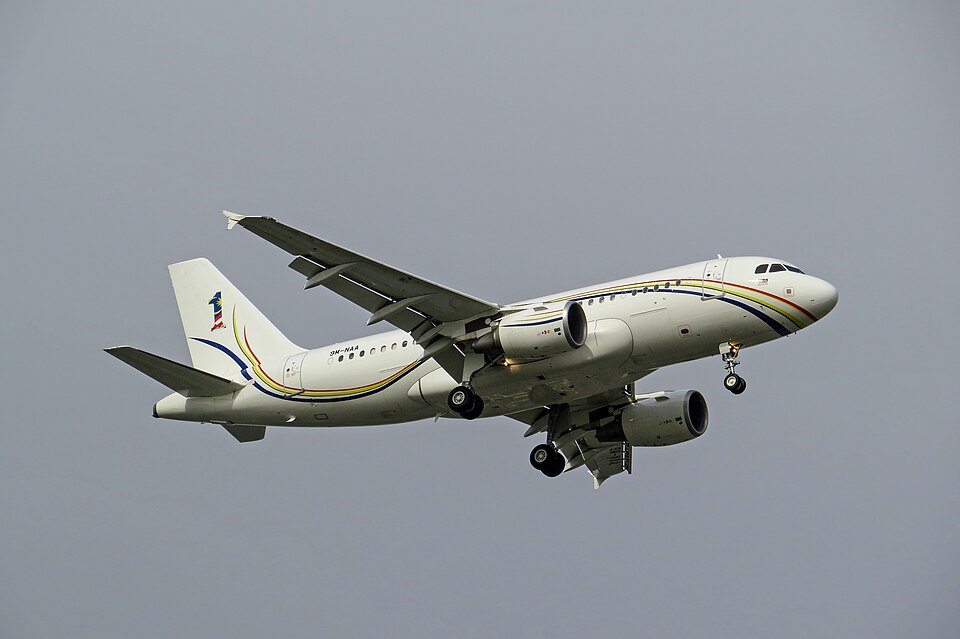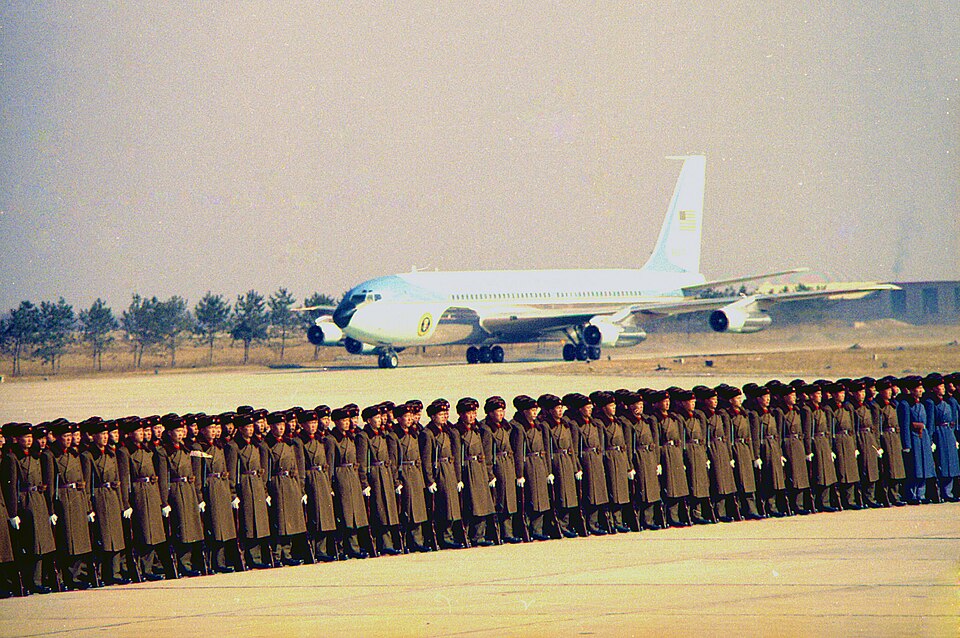
President Trump landed in Beijing on Wednesday evening local time for a meeting with Chinese President Xi Jinping, arriving amid a continuing war with Iran and signs of economic strain at home and abroad.
Trump was greeted at the airport by China's vice president Han Zheng, foreign affairs minister Ma Zhaoxu, and ambassadors from both countries. As the president and his entourage walked the red carpet, 300 young Chinese men and women waved Chinese and American flags in unison, according to CBS News.
Trump brought a delegation of business leaders with him on the trip. Elon Musk was spotted aboard Air Force One, along with Nvidia's Jensen Huang, who boarded in Anchorage, and Apple's Tim Cook was also expected. Director Brett Ratner, who directed the documentary "Melania," also made the trip. Trump's son Eric, executive vice president of the Trump Organization, and his wife Lara were also on Air Force One, though a spokesperson for the Trump Organization said in a statement that Eric Trump would not be doing business on the trip.
Before departing, Trump told reporters he intended to push Xi to open up China to more American business. He described the relationship between the two nations in broad terms, speaking to New York City radio host Sid Rosenberg and saying there are "a lot of advantages to us getting along." He added: "If we didn't get along, you'd know about it, but a lot of advantages."
Iran loomed over the trip even as Trump downplayed its role in the agenda. China is the biggest buyer of Iranian oil, and large quantities are currently trapped behind Iran's blockade in the Strait of Hormuz. Trump told reporters before boarding that he did not need China's help with the war or the economy, though he said he expected a long conversation with Xi. "I wouldn't say Iran is one of them, to be honest with you, because we have Iran very much under control," he said about topics he expected to discuss.
When asked how much Americans' financial situations were motivating him to make a deal, Trump responded: "Not even a little bit." He added: "I don't think about Americans' financial situation. I don't think about anybody. I think about one thing: we cannot let Iran have a nuclear weapon."
The financial cost of the conflict has continued to climb. Acting Pentagon comptroller Jules Hurst told lawmakers on Tuesday that the Iran war has cost U.S. taxpayers $29 billion so far. Defense Secretary Pete Hegseth had put a $25 billion price tag on it last month, though U.S. officials familiar with internal assessments suggested the war could already have cost close to $50 billion.
Wholesale prices also rose sharply in April. The Producer Price Index rose 6% for the 12 months ending in April, the highest 12-month increase in more than three years, pushed by a surge in energy costs linked to the conflict.
In Lebanon, the United Nations peacekeeping mission said Wednesday it was increasingly concerned about activity by both Iranian-backed Hezbollah and Israeli forces near U.N. positions in southern Lebanon. The mission, UNIFIL, said three presumed Hezbollah drones detonated near its Naqoura headquarters on Monday, within meters of where Israeli Defense Forces soldiers could have been present, and that two more drones blew up near UNIFIL posts on Tuesday. No one was injured, but buildings were damaged.
Lebanon's health ministry said Israeli attacks since March 2 have killed more than 2,880 people, wounded more than 8,000, and displaced more than 1 million from their homes.