King Charles III became only the second British monarch in history to address a joint session of Congress on Monday, delivering a roughly 30-minute speech that called on the United States and Britain to deepen their alliance and stand firm on Ukraine and climate change. His mother, Queen Elizabeth II, was the first to do so, in 1991.
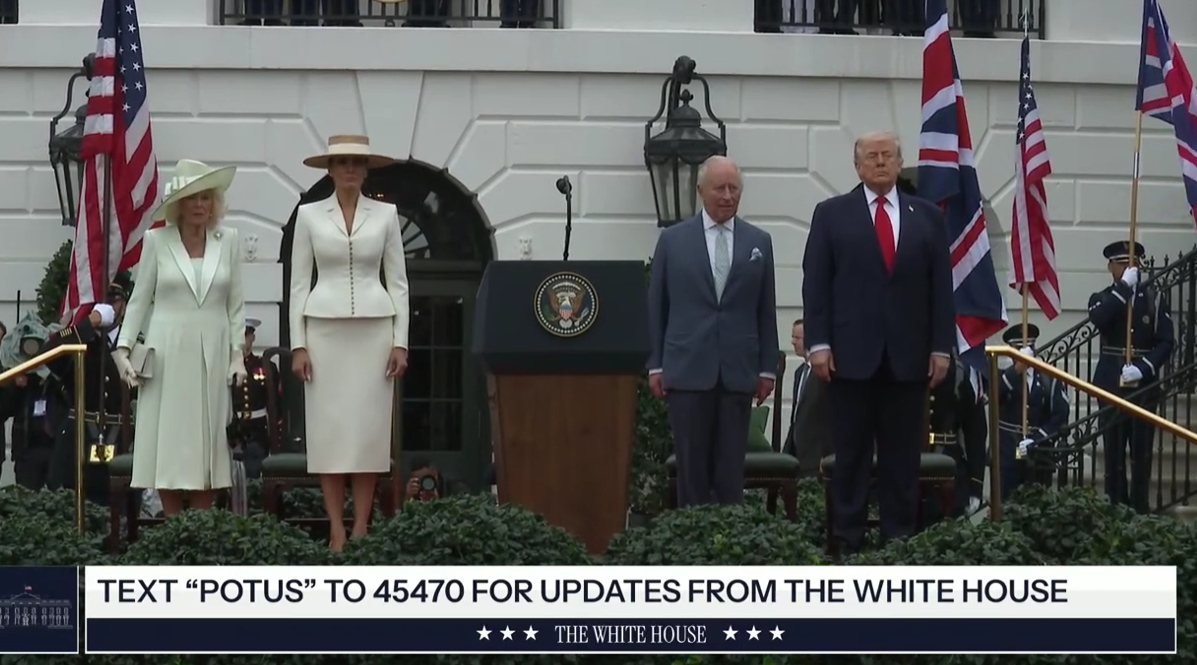
The king and Queen Camilla arrived at the White House for a formal state ceremony that included a military flyover and cannon salute. President Trump cast the visit in both personal and historical terms, citing his mother's Scottish ancestry and noting that "no tribute could be more appropriate" than the royal couple's presence as the U.S. marks the 250th anniversary of the signing of the Declaration of Independence. A state dinner is scheduled for Tuesday night.
Inside Congress, Charles drew one of the session's loudest ovations when he asserted that "executive power is subject to checks and balances." He spoke broadly about the "truly unique" bond between the two nations, stressing that shared history must translate into shared action. "America's words carry weight and meaning, as they have since Independence," he said. "The actions of this great nation matter even more."
On Ukraine, Charles said the same resolve that bound the two countries together after September 11 was now urgently needed. "That same unyielding resolve is needed for the defense of Ukraine," he told lawmakers, framing the alliance not as sentiment but as practical security for future generations. He also pressed on climate change, quoting Theodore Roosevelt on America's "glorious heritage" of natural wonders while warning that "our generation must decide how to address the collapse of critical natural systems."
Charles emphasized trade, education, and research ties between the two countries, and closed by calling on Britons and Americans to "rededicate ourselves to each other in the selfless service of our peoples and of all the peoples of the world."
The speech was carefully choreographed to project unity. But the visit was shadowed by an uncomfortable disclosure reported by the BBC, published just as Charles arrived at the White House. In a leaked audio recording from February, Britain's ambassador to the United States, Sir Christian Turner, told a group of students that the phrase "special relationship" is "quite nostalgic" and "backwards-looking," and that the only country that probably has a truly special relationship with the U.S. is "probably Israel."
The UK Foreign Office quickly distanced itself from Turner's remarks, calling them "private, informal comments" that were "not any reflection" of the government's position. But the timing was difficult to ignore. The ambassador also said in the recording that he did not believe the two countries were in a "moment of rupture," while acknowledging that "we're certainly at the end of an era, and the era is changing" and that Europe can no longer simply rely on an American security umbrella.
Turner's comments are arguably rooted in current geopolitical reality. The U.S. and Israel are jointly conducting military operations in Iran, a war that British Prime Minister Sir Keir Starmer has declined to join. Relations between Trump and Starmer have been described as strained. Charles's visit was explicitly designed to repair and reinforce the alliance at a moment when its foundations are being tested.