

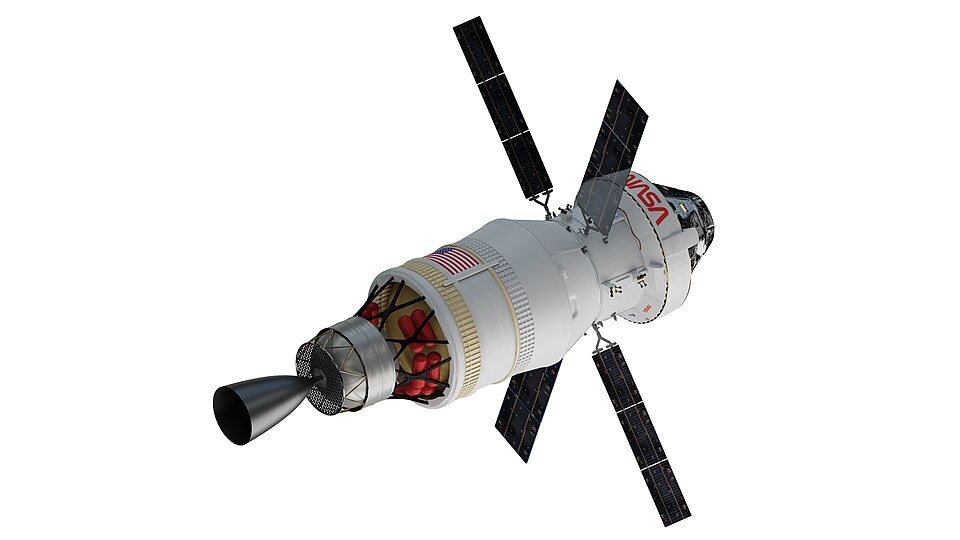
For ten days in early 2026, four astronauts traveled farther from Earth than any humans before them. Much of what the world saw of that journey, in crisp high-definition, arrived via an invisible beam of infrared light.
NASA's Artemis II mission carried a new optical communications terminal mounted on the exterior of the Orion spacecraft. The system transmitted 484 gigabytes of data between Orion and Earth over the course of the mission, roughly equivalent to 100 high-definition movies. That volume of data would have been impossible using the radio frequency systems that have served NASA for decades.
Traditional radio links at lunar distances are limited to single-digit megabits per second. The laser system, when operating with line of sight to ground stations, established multiple downlinks running at 260 megabits per second, surpassing several of its demonstration targets.
The terminal handled a wide range of data types: high-definition video, crew photographs, flight procedures, engineering readings, science data, and voice communications. Some of the mission's most striking images, including views of Earthset and Earthrise captured from lunar distance, came down through those laser links. The system also pushed data up to the crew, delivering information directly to the Orion capsule.
Laser communications work by encoding data onto infrared light rather than radio waves. Because light carries far more bandwidth than radio frequency signals, the same hardware can move vastly more information in a single transmission. The tradeoff is precision: the beam requires a clear line of sight, and ground terminals need to be positioned to receive it reliably.
NASA placed receiving telescopes at two locations chosen for their high-altitude, dry environments. The Jet Propulsion Laboratory in Southern California and the White Sands Complex in New Mexico both served as ground stations, selected specifically to minimize atmospheric interference that could degrade the optical link.
The mission's science team noticed the difference in real time. "Access to high-resolution imagery and other scientific data during dynamic science mission phases is a game changer," said Dr. Kelsey Young, Artemis II lunar science lead. "It means faster insights, better science decision-making to support the crew as they're completing science exploration, and a mission with a more integrated science presence." Young added that the faster data pipeline made the morning-after science debrief following the lunar flyby more productive than it could have been with radio alone.
Artemis II's primary communications backbone remained NASA's Near Space Network and Deep Space Network, the agency's established radio infrastructure. The optical terminal operated as a demonstration payload alongside those systems, not as a replacement. The goal was to prove the technology works at crewed lunar distances before it plays a larger role in future missions.
NASA astronauts Reid Wiseman, Victor Glover, and Christina Koch flew alongside Canadian Space Agency astronaut Jeremy Hansen. The four crewed the first piloted Artemis flight around the moon, a mission designed to validate systems and procedures before NASA attempts a lunar landing. The optical communications test was one of several technology demonstrations embedded in the mission profile.
The 484-gigabyte total transmitted during Artemis II will now serve as a baseline for planning how laser communications can support longer, more complex missions, including eventual surface operations on the moon.
