For nearly a decade, CRISPR-based tools have worked the same way: an RNA molecule acts as a guide, directing a Cas protein to a specific DNA target. Researchers at the Hong Kong University of Science and Technology have now built a system that runs the process in reverse, using DNA to guide the Cas protein toward RNA instead.
The work, published in Nature Biotechnology, was led by Prof. Hsing I-Ming of HKUST's Department of Chemical and Biological Engineering, in collaboration with Prof. Zhai Yuanliang of the university's Division of Life Science. The team calls its diagnostic platform SLEUTH, short for Specific Locus Evaluation Utilizing Targeted Hydrolysis.
To explain the shift, Hsing reached for a navigation analogy. In traditional CRISPR, he said, "the RNA guide molecule is like the address you type in, and the Cas protein is the car that drives to that address — the DNA target." Existing rapid diagnostic platforms, including the widely cited SHERLOCK and DETECTR systems, are all built on that principle. SLEUTH runs the GPS in the other direction.
The key was engineering a synthetic molecule the team calls CRISPR DNA, or crDNA. This molecule reprograms the Cas12a protein to accept DNA as its guide, then directs the protein to cleave selected RNA targets. The team combined that engineered guide with isothermal amplification, a technique that copies genetic material at a constant temperature without the cycling required by standard PCR, to build a functional diagnostic system.
What made the inversion possible was separating two functions that are normally locked together in natural CRISPR systems. The system relies on a short sequence called a PAM to activate the Cas protein and a separate sequence to carry the targeting information. In nature, both functions are bundled into the RNA guide. The HKUST team designed a short DNA strand that mimics the PAM-containing structure, effectively decoupling activation from targeting and creating what they describe as an entirely new design space for programmable RNA tools.
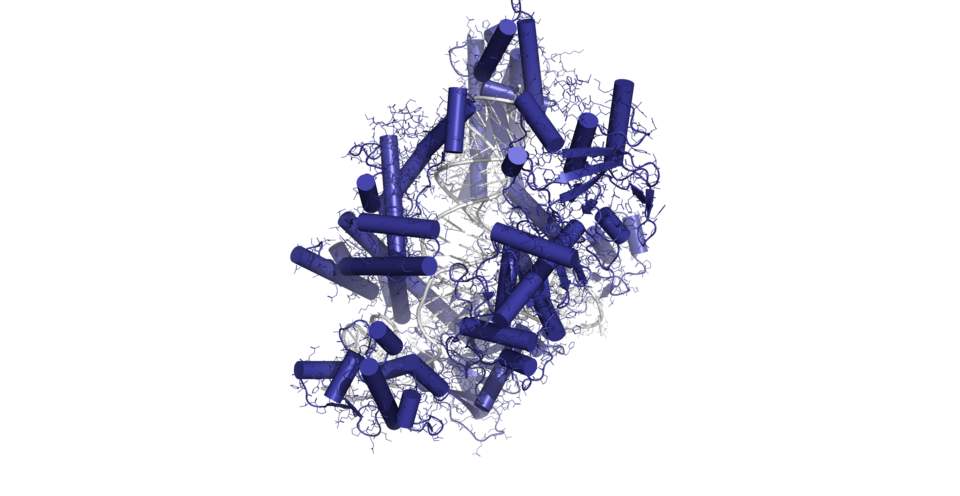
The team validated the design using three independent methods. AlphaFold-guided computational modeling and molecular dynamics simulations predicted how the engineered complex would behave. High-resolution cryo-electron microscopy, carried out by Zhai and postdoctoral fellow Dr. Lam Wai-Hei, then produced structural images of the actual complex. The experimental structure closely matched the computational predictions, confirming that the artificial activation pathway works as designed.
The practical applications point in two directions. On the diagnostic side, a system that targets RNA rather than DNA could improve the speed and accuracy of tests for infectious diseases, many of which are caused by RNA viruses. On the therapeutic side, programmable RNA cleavage opens a potential path toward antiviral treatments that disable viral RNA before it can direct the production of new virus particles. Both applications are areas where existing CRISPR tools have faced limitations, and where a DNA-guided system could offer new options.