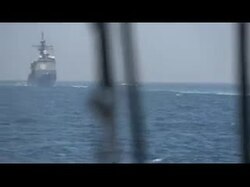
U.S. forces fired precision munitions into the smokestacks of two Iran-flagged oil tankers Friday, disabling the vessels before they could dock at an Iranian port on the Gulf of Oman in violation of the ongoing American naval blockade. U.S. Central Command confirmed the strike, saying the ships were unladen and non-compliant.
The attack came as Secretary of State Marco Rubio was awaiting a formal response from Iran on a U.S. peace proposal. "I hope it's a serious offer, I really do," Rubio said during a visit to Italy. He said Washington would see what the response entailed once it arrived.
President Trump, meanwhile, insisted the U.S.-Iran ceasefire remained intact despite the escalating military exchanges in the waterway, but issued a blunt warning. He told reporters the U.S. would "knock them out a lot harder, and a lot more violently," if Tehran declined to accept a peace deal.
Iran's Foreign Minister Abbas Araghchi pushed back hard, accusing the United States of reaching for a "reckless military adventure" every time a "diplomatic solution is on the table." He said Iranians would "never bow to pressure," posting the statement on X a day after both sides accused the other of initiating exchanges in the Strait of Hormuz.
Centcom said U.S. forces are currently preventing more than 70 tankers from entering or leaving Iranian ports as part of the blockade, which Washington has maintained to pressure Tehran into agreeing to American terms. Iran has in turn been attacking U.S. allies in the Gulf and restricting traffic through the Strait of Hormuz, a critical artery through which roughly 20% of the world's oil and liquefied natural gas flows. The disruption has sent energy prices sharply higher since the war began in February.
The United Nations weighed in Friday as well. Secretary-General Antonio Guterres expressed concern over the reported exchanges, with spokesman Stephane Dujarric saying Guterres "underscores that this is a critical moment for de-escalation and urges all sides to exercise maximum restraint to avoid further escalation." Iran's Ambassador to the U.N., Amir Saeid Iravani, wrote to both the Security Council and Guterres warning that the consequences of U.S. actions in the Persian Gulf "could be catastrophic" and extend far beyond the Middle East.
On the sanctions front, the U.S. Treasury Department announced Friday that it was targeting 10 individuals and companies accused of supporting Iran's drone and ballistic missile programs, including firms based in China, Dubai, Hong Kong, and Belarus. The State Department added four more entities to its own sanctions list. Among those named was Hong Kong-based Mustad Limited, which the Treasury Department alleged helped Iran procure millions of dollars worth of weapons materials.
Diplomatic activity continued on multiple tracks Friday. U.S. Vice President JD Vance met in Washington with Qatar's Prime Minister Sheikh Mohammed bin Abdulrahman Al Thani to discuss Pakistan's mediation efforts between the U.S. and Iran. The Qatari prime minister urged all parties to engage with negotiations addressing the "root causes of the crisis." Separately, the U.S. signaled it would host a new round of Israel-Lebanon talks on May 14 and 15, aimed at halting clashes between Israeli forces and Iranian-backed Hezbollah. A State Department spokesperson said those talks would work toward "lasting security for Israel, and sovereignty and reconstruction for Lebanon," though Hezbollah has rejected participating.
Iran was expected to deliver its response to the U.S. peace proposal by Friday.