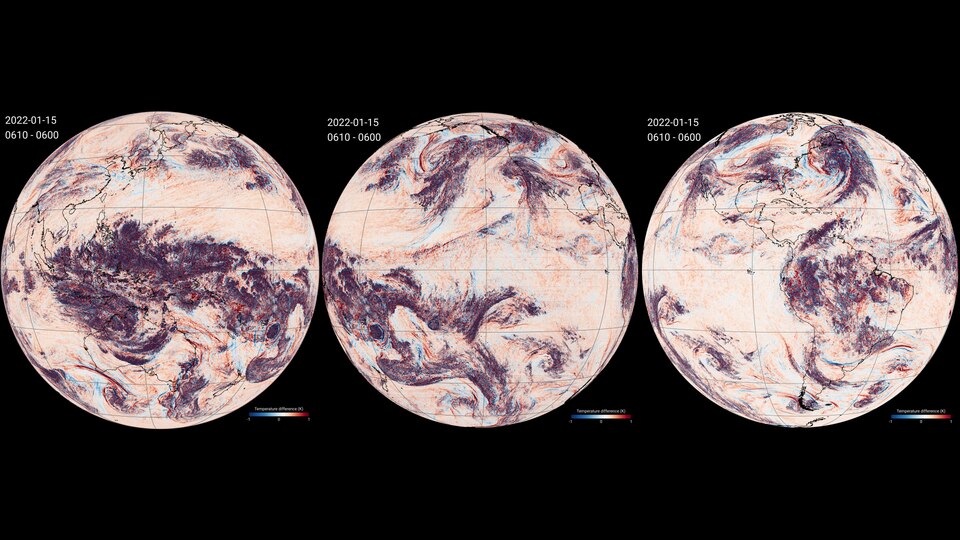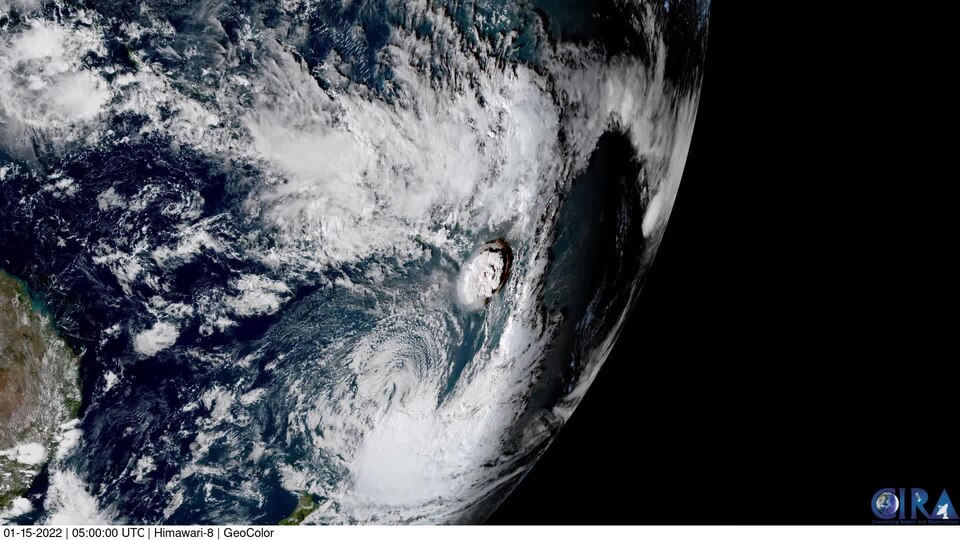
The 2022 eruption of the underwater volcano Hunga Tonga-Hunga Ha'apai in the South Pacific was already considered one of the most powerful in modern history. Now scientists have found it did something no one expected: it helped destroy methane, one of the most potent greenhouse gases in Earth's atmosphere.
Using satellite data, researchers detected unusually high concentrations of formaldehyde inside the massive volcanic plume produced by the eruption. Formaldehyde forms when methane breaks down in the atmosphere, so the readings immediately signaled that something significant was happening to the methane in the plume.
"When we analyzed the satellite images, we were surprised to see a cloud with a record-high concentration of formaldehyde. We were able to track the cloud for 10 days, all the way to South America. Because formaldehyde only exists for a few hours, this showed that the cloud must have been destroying methane continuously for more than a week," said Dr. Maarten van Herpen from Acacia Impact Innovation BV, the study's first author.
The findings were published in the journal Nature Communications. According to Science Daily, the research was led by scientists connected to the University of Copenhagen.
Van Herpen added that while it was already known that volcanoes emit methane during eruptions, this study revealed something new. "It is known that volcanoes emit methane during eruptions, but until now it was not known that volcanic ash is also capable of partially cleaning up this pollution," he said.
The researchers believe the eruption set off a rare chemical chain reaction. Volcanic ash mixed with salty seawater and was then struck by sunlight. That combination produced tiny reactive particles called iron salt aerosols, which released chlorine atoms. Those chlorine atoms then reacted with methane molecules and broke them apart.
The process was not entirely unfamiliar to the team. In earlier research published in 2023, the same scientists had found that dust blowing off the Sahara Desert, when combined with sea salt spray over the Atlantic Ocean, could trigger the same type of chlorine-releasing reaction. That earlier discovery had already changed how scientists understood atmospheric chemistry in the lower atmosphere, known as the troposphere.
What stunned the researchers this time was finding the same mechanism operating in a completely different environment. "What is new -- and completely surprising -- is that the same mechanism appears to occur in a volcanic plume high up in the stratosphere, where the physical conditions are entirely different," said Professor Matthew Johnson from the University of Copenhagen's Department of Chemistry.
The stratosphere sits well above the troposphere, and conditions there, including temperature, pressure, and the mix of gases present, differ sharply from those closer to Earth's surface. The fact that the same iron salt aerosol chemistry could operate under such different conditions suggests the process may be more widespread and adaptable than scientists had assumed.
The finding carries potential long-term implications for climate research. Methane is responsible for a significant share of human-caused global warming, and scientists have been searching for ways to reduce its concentration in the atmosphere. Understanding natural processes that break down methane could, over time, help researchers design strategies to replicate or amplify that effect.
The team noted that the Hunga Tonga eruption itself released methane, so the volcanic plume was in part cleaning up pollution the eruption had produced. Still, the discovery that ash, salt, and sunlight can combine to destroy methane in the upper atmosphere was not something scientists had predicted or observed before.
Researchers say the next steps involve studying whether other large volcanic eruptions have produced similar effects and whether the iron salt aerosol mechanism could be observed elsewhere in the stratosphere under different conditions.