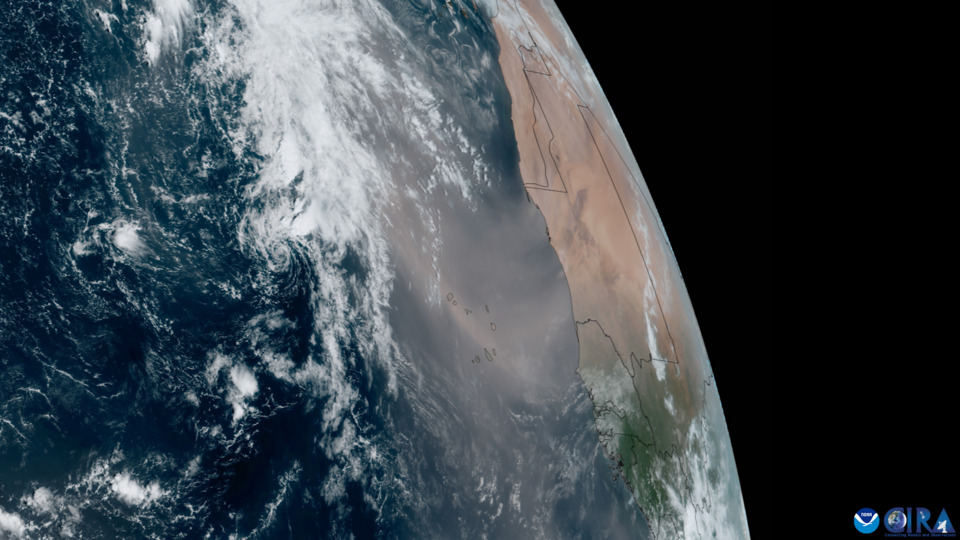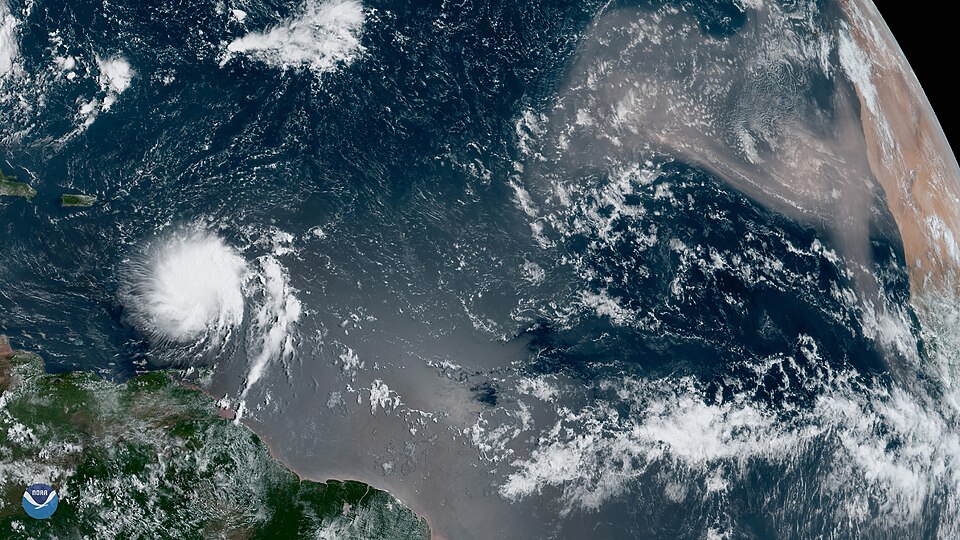
The Amazon rainforest, one of the most biodiverse places on Earth, depends in part on dust blowing across the Atlantic Ocean from Africa to survive. Now, researchers have discovered that heavy rainfall over the tropical Atlantic, driven by large-scale weather systems thousands of kilometers away, can block that dust from ever arriving, according to a study published in Geophysical Research Letters.
Scientists found that synoptic systems, which are large-scale meteorological phenomena such as cold waves in the United States and high-pressure anomalies in the South Atlantic, alter heavy rainfall patterns along the tropical belt of the Atlantic Ocean. Those rainfall changes, in turn, determine whether the Amazon receives air loaded with African particles or air that is essentially clean of them. Days with fewer aerosols over the Amazon were preceded by peak precipitation over the ocean, washing the dust out before it could complete its transatlantic journey.
The finding matters because most of the Amazon's soil is nutrient-poor. Despite the forest's towering canopy and extraordinary biodiversity, intense leaching, the process by which rainwater strips nutrients from soil, leaves the ground depleted. Phosphorus is the most limiting element for plant growth in the region, followed by calcium, potassium, and magnesium. What partly makes up for that deficiency is a steady stream of mineral dust from the Sahara Desert and smoke aerosols from biomass burning in Africa, carried westward by prevailing winds across the Atlantic.
Professor Luiz Augusto Toledo Machado, from the Physics Institute at the University of São Paulo and a collaborator with the Department of Chemistry at the Max Planck Institute in Germany, is the corresponding author of the study. He said the research reveals something larger than a regional weather pattern.
"The results demonstrate that there's an interconnection, a symbiosis of life on the planet. Climate change affects this pattern, causing a disruption whose outcome and consequences for future ecosystems are still unknown," Machado explained.
He also pushed back against the common assumption that the Sahara is simply a wasteland with no ecological value. "Contrary to what one might imagine, this region is very important for the health of the planet. Its dust contains crucial minerals not only for fertilizing the Amazon, but also for sustaining aquatic life. Among them are iron and phosphorus, which are fundamental for forest productivity and life in the oceans," he said.
Before this study, researchers assumed that changes in the amount of African aerosols reaching the Amazon were caused mainly by shifts in wind direction. The new research shows that large-scale weather systems, including cold air masses pushing south through North America, are also reshaping those patterns by triggering rain events over the ocean that scrub the dust from the atmosphere.
Machado pointed to a 2022 study published in the journal Nature, led by Brazilian researchers, that demonstrated low phosphorus levels in the soil can limit Amazon rainforest growth even when the atmosphere contains elevated concentrations of carbon dioxide. That finding makes the new research more urgent: if climate change disrupts the transatlantic dust transport more frequently or more severely, the consequences for the forest's long-term health remain, as Machado put it, unknown.