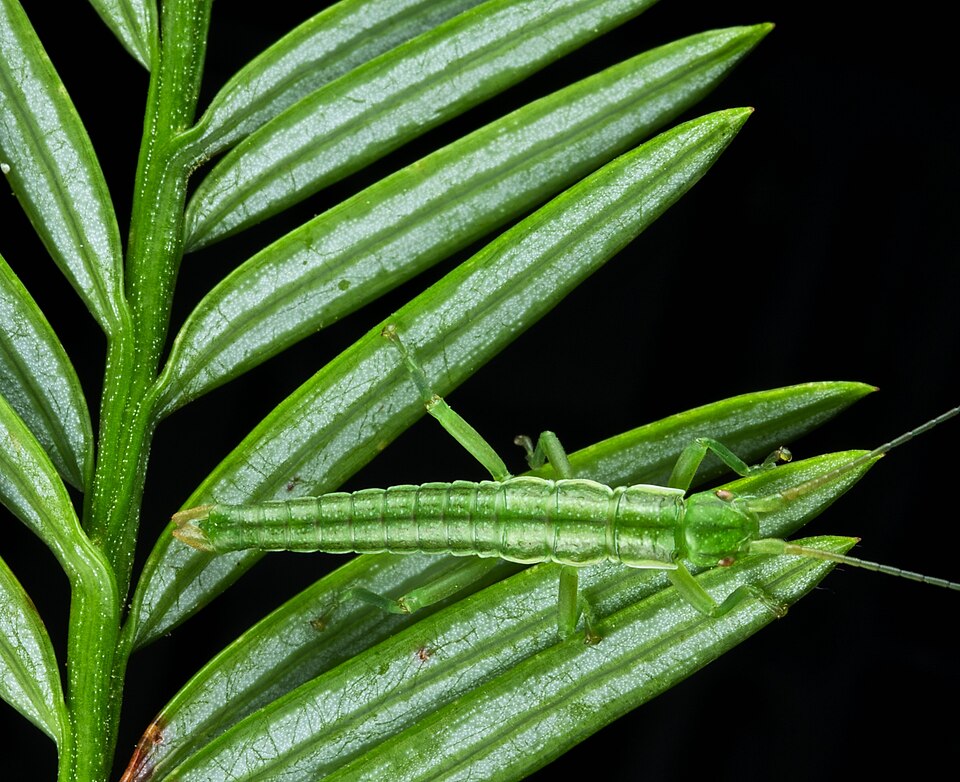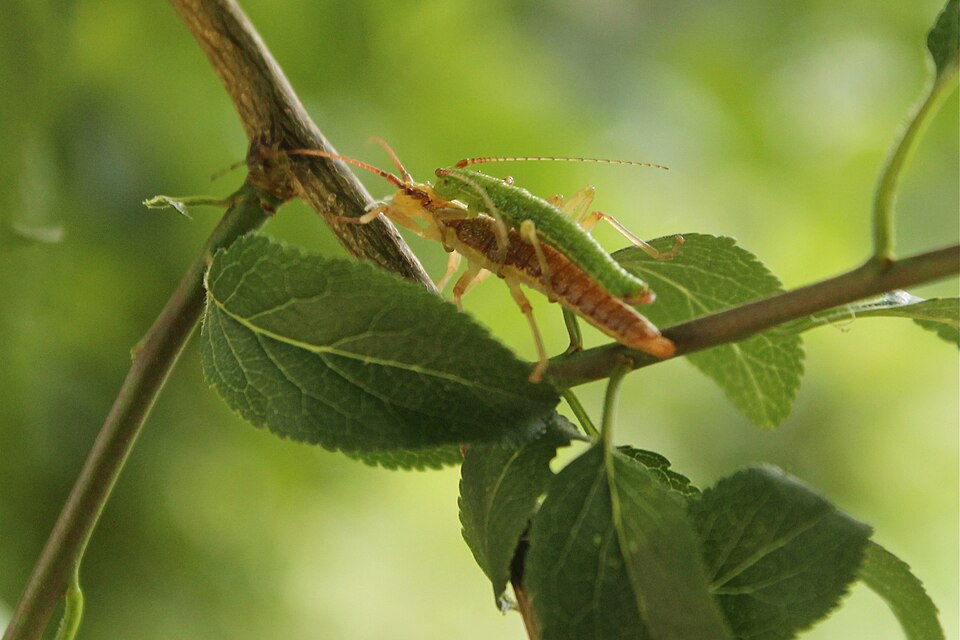
Stick insects in the far western United States have gone without sex for over one million years. That alone is notable. What surprised scientists even more is what that did not change.
Research led by Dr. Darren Parker, a lecturer in evolutionary biology at Bangor University, studied the genes of several species of Timema, a type of wingless stick insect that reproduces through parthenogenesis. That means females produce offspring from unfertilized eggs, with no male involvement. It is the longest known asexual period for any insect.
The study was published in the Proceedings of the National Academy of Sciences.
The scientists focused on a genetic system called dosage compensation. Males and females carry different numbers of X chromosomes. Males have one X chromosome and one Y chromosome, while females carry two X chromosomes. Because of that difference, gene expression needs to be balanced equally between the sexes. Species across the animal kingdom have evolved mechanisms to manage that balancing act.
In species that reproduce sexually, those mechanisms serve an obvious purpose. But in Timema, which have had no males in the reproductive process for over a million years, scientists expected those mechanisms to have broken down. There was simply no pressure to keep them working.
That expectation turned out to be wrong.
Parker explained the core question his team set out to answer. "Males and females have a different number of X chromosomes; males have one (XY), and females have two (XX). As a result, gene expression needs to be balanced equally between them. Species have evolved a wide range of mechanisms known as 'dosage compensation' to do just this. But what happens when these mechanisms for equally sharing male and female genes are no longer needed? That's the question we set out to answer."
The team investigated gene expression in rare males that do occasionally appear in these otherwise all-female populations. What they found contradicted the standard evolutionary assumption that unused biological systems degrade over time.
Parker said: "This is the precise situation found in asexually reproducing stick insects. Because the females reproduce without fertilization from males, there is no need to equalize gene expression. By investigating gene expression in rare males, our study found that rather than decaying away as we expected, dosage compensation mechanisms remained fully functional despite not being needed for over a million years."
The findings push back against long-held assumptions about evolutionary decay. The conventional view holds that when selection pressure is removed, a biological system will gradually erode through mutation and genetic drift. The Timema data suggests that is not always the case, and that some systems can persist intact even in the absence of any obvious function.
The study does not explain why the mechanism held on. That question remains open for future research. What the data does confirm is that evolution does not always follow the expected path of discarding what is no longer needed.