

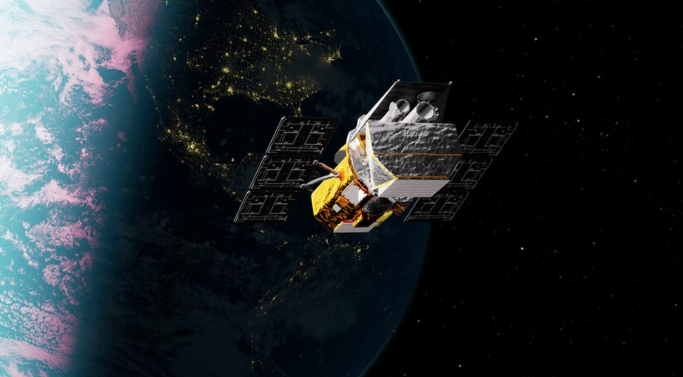
NASA’s Neil Gehrels Swift Observatory ended nearly 22 years of work on Wednesday when the spacecraft re-entered Earth’s atmosphere over North Sumatra, Indonesia. The roughly 3,200-pound space telescope had spent more than two decades tracking gamma-ray bursts and other violent events across the universe before orbital decay brought the mission to an end.
Swift re-entered at about 7:39 a.m. EST on November 4, according to reporting based on NASA and U.S. Space Force tracking. The spacecraft was traveling at roughly 22 times the speed of sound as it plunged into the atmosphere. Most of the observatory was expected to burn up, although NASA had said some denser components could survive the descent.
No injuries or property damage had been reported after the re-entry. Before the event, NASA estimated the chance of harm to any person on Earth at about one in 2,100, a figure that reflected the possibility that small pieces might reach the surface somewhere along Swift’s orbital path.
The timing corrects a major error in earlier accounts of the spacecraft’s final days. Swift was not decommissioned in October 2023. It continued operating until October 20, 2026, when worsening atmospheric drag pushed the observatory too low to maintain normal science operations.
Swift launched on November 20, 2004, with a planned two-year prime mission. Instead, it remained productive for almost 22 years, operating more than 10 times longer than its original design goal.
The observatory was built to study gamma-ray bursts, brief but enormously energetic flashes linked to events such as collapsing massive stars and mergers involving compact objects. Its three instruments allowed Swift to detect a burst and then rapidly turn toward the source for follow-up observations in gamma-ray, X-ray, ultraviolet and optical wavelengths.
That ability made Swift unusually useful to astronomers. When the spacecraft detected a transient event, it could quickly send coordinates to observatories around the world so researchers could study the same source with other telescopes before the event faded.
Over its lifetime, Swift also observed supernovae, active galaxies powered by supermassive black holes, stellar flares, comets and asteroids. Reuters reported that observations from the mission contributed to roughly 7,000 scientific papers, showing how far the telescope’s role expanded beyond its original focus on gamma-ray bursts.
Swift’s end was caused by orbital decay rather than a sudden mechanical failure. Like other satellites in low Earth orbit, it experienced drag from the thin upper atmosphere. Increased solar activity heated and expanded that atmosphere, increasing drag and causing Swift to lose altitude more quickly.
The spacecraft did not have its own propulsion system capable of raising its orbit. As the decline accelerated, NASA pursued an unusual rescue attempt that would have used a separate robotic spacecraft to capture Swift and boost it higher.
NASA awarded Katalyst Space Technologies a contract in 2025 to develop the servicing mission. Katalyst’s LINK spacecraft launched in July 2026 aboard a Northrop Grumman Pegasus XL rocket, but attitude-control problems prevented it from completing the planned capture and orbit-raising operation.
NASA announced in August that LINK would not boost Swift. The company and agency continued using the mission for rendezvous and servicing demonstrations, but the observatory itself was left on a path toward atmospheric re-entry.
After the boost attempt was scaled back, NASA restored much of Swift’s science program. The observatory resumed work with its X-ray and ultraviolet/optical telescopes in August, and its Burst Alert Telescope later returned to operation as well.
The extra observing came with a tradeoff. Repointing the spacecraft for science increased atmospheric drag, and Swift began losing altitude more rapidly again. By October 20, it had fallen to about 171 miles, or 275 kilometers, above Earth.
At that altitude, the spacecraft could no longer compensate well enough for drag to keep its telescopes steadily aimed. Swift entered safe mode, and controllers at Penn State sent a command that effectively ended operations and prepared the observatory for its final descent.
NASA had warned before re-entry that some pieces might survive because certain spacecraft components are more resistant to heat than lighter structures. The agency also noted that Swift’s orbital inclination limited potential debris locations to a band between about 20.6 degrees north and 20.6 degrees south latitude.
That zone includes broad stretches of ocean as well as portions of South America, Africa, Asia and the Pacific region. In the end, tracking placed the re-entry over Indonesia, with the spacecraft descending above North Sumatra.
Swift’s long career leaves a large archive for astronomers to continue studying. The mission repeatedly demonstrated the value of reacting quickly to short-lived events, a capability that has become increasingly important as observatories work together to study phenomena across multiple wavelengths and, in some cases, alongside gravitational-wave detections.
The spacecraft was renamed the Neil Gehrels Swift Observatory in 2018 in honor of Neil Gehrels, the mission’s principal investigator, who died in 2017. Gehrels played a major role in developing Swift and in expanding the study of gamma-ray bursts and other high-energy events.
NASA officials have described the mission as an unusually strong scientific return on a spacecraft designed for a much shorter life. Swift’s final observation came nearly 22 years after launch, and the mission ended only after atmospheric conditions and orbital physics finally made continued operation impossible.
The failed boost attempt also gave NASA and commercial partners experience with fast-turnaround satellite servicing. That work may influence future efforts to extend the lives of valuable spacecraft that were not originally designed to be refueled or raised into new orbits.
Swift’s instruments are no longer collecting data, but its scientific record remains available through NASA archives. Researchers are expected to keep using those observations to study gamma-ray bursts, black holes, supernovae and other changing objects long after the observatory’s fiery return over Indonesia.