

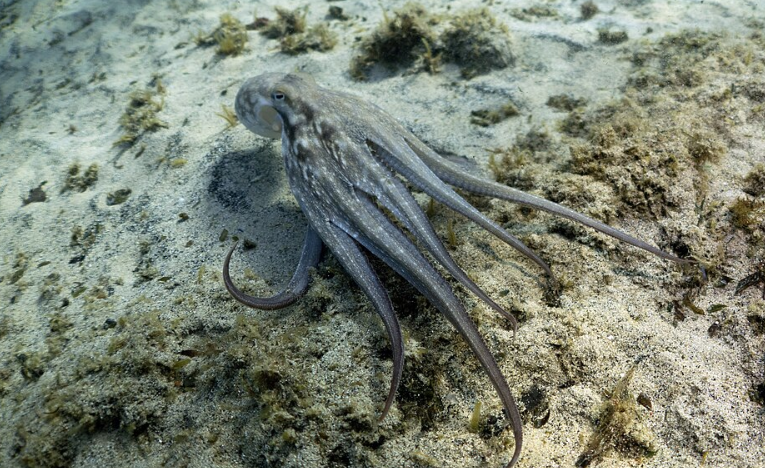
Scientists have discovered how octopuses squeeze through openings much smaller than their bodies, revealing a surprisingly organized sequence of movements. The research, published November 5, 2026, in the Journal of Experimental Biology, found that common octopuses use either three or four stages to escape confined spaces, depending on the size of the opening.
The study also revealed differences between octopus species. While common octopuses readily pushed through extremely narrow gaps, Mayan octopuses were more hesitant and generally avoided openings that appeared too small.
Researchers believe these findings could help engineers develop more adaptable soft robots. Such machines might eventually move through collapsed buildings, underwater structures and other spaces that conventional robots cannot easily reach.
Scientists Put Octopuses Through an Escape Test
The research was led by Wenci Xin of the National University of Singapore, working with Michael Kuba of the University of Naples Federico II in Italy and colleagues in Austria and Singapore. Their goal was to understand the physical movements that allow octopuses to navigate openings far narrower than their bodies.
Octopuses have eight highly flexible arms and soft bodies containing no rigid skeleton. However, they do have a hard beak and protective cartilage surrounding their central nervous system, which place limits on how tightly they can compress themselves.
To investigate these limitations, the scientists studied three common octopuses (Octopus vulgaris) and four Mayan octopuses (Octopus maya). Each animal was placed in a transparent experimental enclosure containing an opening through which it could escape.
The team first measured the distance between each octopus's eyes, which ranged from approximately 15 to 35 millimeters. This measurement served as an estimate of the width of the relatively rigid cartilage protecting the animal's central nervous system.
Researchers then created openings that were either slightly wider than this measurement or about five millimeters narrower. Cameras recorded how the animals explored the openings, positioned their arms and moved their bodies through the gaps.
The experiment allowed the team to identify specific movement patterns rather than simply observing that the animals could squeeze through small spaces.
How Octopuses Escape Through Larger Openings
When the opening was relatively large, common octopuses followed a three-stage process. Their movements involved carefully positioning their arms and using their suckers to generate enough force to move the rest of their bodies through.
The first stage involved exploring the opening with one or two arms. The animals typically inserted one arm first, often choosing one of the two arms positioned toward the front left side of their bodies.
During the second stage, the octopuses extended additional arms through the opening. Several limbs moved to the opposite side, allowing the animals to establish contact with surrounding surfaces.
The final stage required coordinated pushing and pulling. Two arms already through the opening reached backward and attached their suckers to the enclosure wall.
The octopuses then stiffened and extended those arms, pushing against the wall to propel their remaining limbs, heads and mantles through the gap. According to the researchers, the entire maneuver generally took about 20 seconds.
This sequence demonstrates that octopuses rely on more than their soft anatomy. Their flexible bodies make the movement possible, but their arms actively provide the force needed to complete it.
Narrower Holes Require an Extra Step
The common octopuses changed their technique when faced with openings narrower than their eye-to-eye distance. Instead of completing the final movement in one action, they divided it into two separate stages.
After exploring the opening and inserting several arms, the octopuses worked their remaining arms through the narrow gap. Only after all eight arms had passed through did they begin moving their heads and mantles.
The final movement involved compressing the mantle and pulling the rest of the body through the opening. This created a four-stage sequence rather than the three-stage strategy used for larger holes.
The researchers were surprised by this adjustment because they initially expected the animals to follow the same basic procedure regardless of opening size.
Instead, the observations showed that common octopuses can modify their movements when the available space becomes more restrictive. Their arms are not simply pulled along with their bodies but are repositioned to help control the entire maneuver.
The discovery offers a detailed explanation for a behavior that has fascinated aquarium workers and marine scientists for decades. Octopuses have frequently demonstrated an ability to escape enclosures through openings that appear impossibly small.
Mayan Octopuses Behaved Differently
The experiments produced a different result with Mayan octopuses. When researchers presented these animals with the narrowest openings, they generally showed little interest in attempting an escape.
Some remained in a corner of the enclosure rather than approaching the hole. Unlike common octopuses, they did not immediately investigate the tight opening with their arms.
When offered both a narrow opening and a larger alternative, Mayan octopuses explored the smaller passage before choosing the wider route.
The findings suggest that different octopus species may approach physical obstacles differently. However, researchers cannot yet determine whether those differences arise from anatomy, previous experience, individual behavior or environmental adaptations.
Mayan octopuses typically inhabit sandy and rocky marine environments. Kuba suggested that their natural surroundings might require fewer extreme squeezing movements than the environments occupied by some other octopus species.
The experiments involved only seven animals from two species, making it difficult to draw broad comparisons. More research would be needed to establish whether the observed differences consistently occur across larger populations.
What the Findings Reveal About Octopus Behavior
The study provides new insight into the coordination required for octopuses to navigate restrictive environments. These animals must control multiple flexible arms while adjusting the position and shape of their bodies.
Such coordination involves both muscular control and sensory information. Octopuses use their suckers to grip surfaces and explore their surroundings, giving them feedback as they maneuver through obstacles.
The experiments also suggest that octopuses adjust their movements in response to the dimensions of an opening. However, the results do not prove that the animals consciously plan their escape or possess a precise understanding of their body size.
Robyn Crook, an evolutionary biologist at San Francisco State University who was not involved in the research, told Science News that scientists had not previously examined these escape strategies in such a systematic way.
The results may help researchers investigate how octopuses coordinate movement across multiple arms and respond to changing physical conditions.
Future studies could also examine whether octopuses use different techniques when navigating long tubes, narrow slits or irregularly shaped passages.
How Octopus Movements Could Improve Robot Design
One of the most promising applications of the research involves soft robotics. Engineers are developing machines that can bend, compress and adapt their shapes to move through environments inaccessible to conventional rigid robots.
Many existing search-and-rescue robots use long, narrow bodies resembling snakes. These designs help them enter confined spaces but can limit the amount of equipment they carry.
Octopuses demonstrate another possible approach. Their arms can explore an opening, grip surrounding surfaces and help move a larger central body through a restricted passage.
Researchers believe similar mechanisms could help future robots carry more sensors and equipment while remaining capable of navigating narrow gaps. Potential applications include searching damaged buildings, inspecting underwater structures and exploring hazardous environments.
Xin and robotics researcher Cecilia Laschi are interested in using these findings to develop robots that combine flexible bodies with coordinated, multi-limbed movement.
Such machines remain a research goal rather than a finished technology. Reproducing the muscular control and adaptability of a living octopus presents substantial engineering challenges.
The researchers also want to understand more about how octopuses withstand the physical forces involved in extreme squeezing. Their ability to deform their bodies without apparent injury could provide additional guidance for designing durable, flexible machines.
The next stage of research will involve studying more species and different types of openings. Those experiments could help determine which escape techniques are widespread among octopuses and which are adaptations to particular environments.