

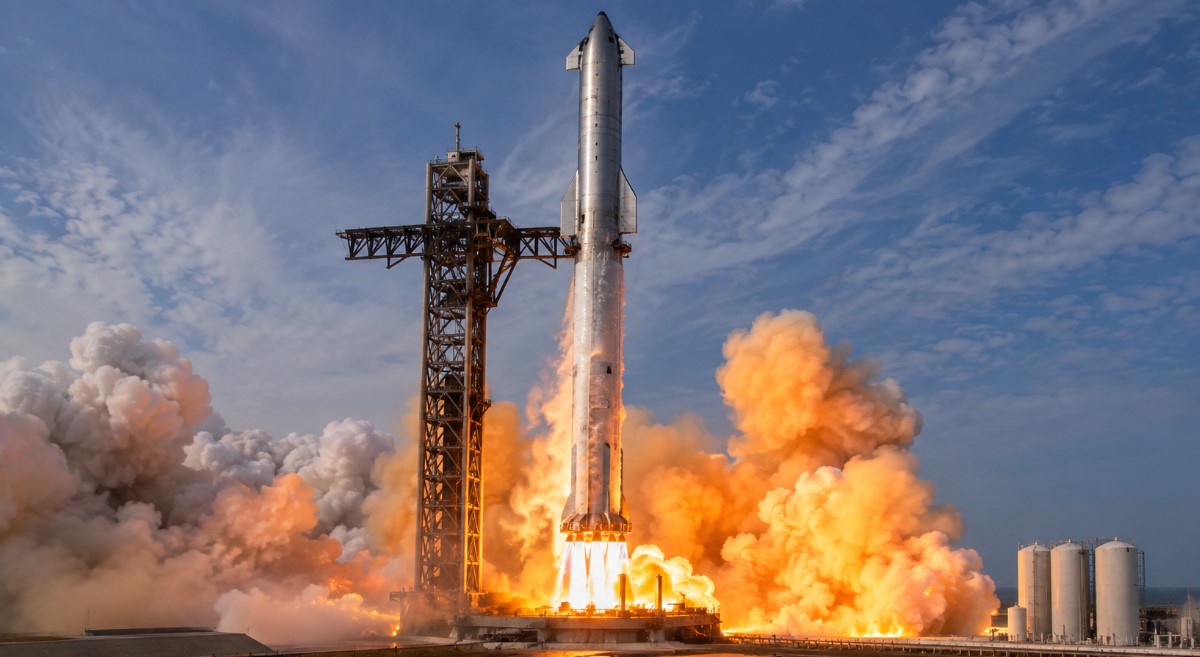
SpaceX scrubbed the Thursday evening launch of its massive Starship rocket and rescheduled the attempt for Friday, pushing back what would be the vehicle's 12th test flight and the public debut of the new Starship V3 design.
A 90-minute launch window opened at 6:30 p.m. ET Thursday. During a livestream of the event, SpaceX video hosts said the company "got the vehicle totally loaded" before the scrub was called. The rescheduled attempt will launch from a newly designed pad at SpaceX's facility in Starbase, Texas, an official company town previously known as Boca Chica.
The launch carries extra significance because it comes just days after SpaceX filed its IPO prospectus on Wednesday, making the test flight one of the last opportunities to demonstrate Starship's capabilities before shares reach the public market. According to CNBC, the company has spent more than $15 billion on the Starship program.
The new vehicle is a significant step up from earlier versions. Starship V3 stands 408 feet tall when fully stacked and features new engines that produce 18 million pounds of thrust. SpaceX described the rocket in its IPO prospectus as a vehicle "designed to deliver 100 metric tons to Earth's orbit in a fully reusable configuration while enabling rapid turnaround times akin to commercial aviation." The company is carrying mock Starlink satellites during the test flight but no astronauts or other cargo.
Starship is central to SpaceX's growth strategy. The company said in its prospectus that its "growth strategy depends on our ability to increase our launch cadence and payload capacity, which is dependent on the successful development of Starship at scale." The rocket is intended to allow SpaceX to launch more satellites into orbit at a faster pace than its current Falcon 9 rockets allow, which would accelerate the buildout of the Starlink constellation.
Starlink is currently the financial engine of the company. The connectivity unit brought in $11.4 billion in sales and $4.4 billion in operating income in 2025, accounting for 61% of SpaceX's total revenue last year and 69% in the first quarter of this year. The space segment, by contrast, generated $4.1 billion in revenue and recorded an operating loss of $657 million in 2025.
Beyond satellite internet, SpaceX has signed on to carry NASA astronauts to the moon. The agency is counting on Starship to serve as the lunar lander for its Artemis IV mission, currently scheduled for early 2028. That mission would mark the first time U.S. astronauts have traveled to the moon in more than half a century.
Elon Musk has also described longer-range ambitions for Starship, including using it to lift cargo and as many as 100 people at a time into orbit as part of his stated goal of colonizing Mars. Friday's launch window has not yet been announced publicly, but the company is expected to make another attempt before the weekend.
![[RAW] SpaceX Starship IFT-1 NASA WB-57 Cam 0TLP Network via a NASA FOIA has acquired 2 of 5 videos recorded by NASA WB-57 during the Starship IFT-1 flight. The other 3 cameras from NASA WB-57 have been classified. Thank you to NASA HQ for their support in releasing this footage to TLP Network.](https://freenewspress.com/media/2026/05/21/spacex-starship-6191d1.jpg)