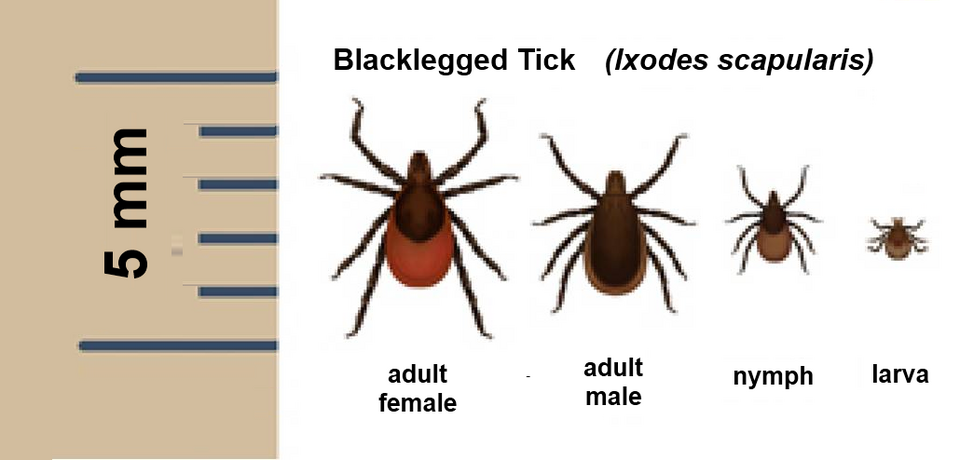
Emergency rooms across the United States are seeing more patients with tick bites than at any point in over a decade, according to a report by Healthline based on data from the Centers for Disease Control and Prevention.
All regions of the country except the South Central area reported their highest weekly number of tick bite ER visits since 2017. The Northeast is seeing the most severe increases, with the Midwest second. The peak season for tick encounters runs from May through August.
Robert Glatter, MD, an attending physician in the Department of Emergency Medicine at Lenox Hill Hospital and assistant professor of Emergency Medicine at Zucker School of Medicine at Hofstra/Northwell, connected the uptick in ER visits to a longer pattern. "This trend is consistent with a broader pattern of increasing tick-borne disease burden in the United States," he told Healthline. "An estimated 400,000–470,000 cases of Lyme disease are now diagnosed annually in the U.S., and this number has been rising over the past two decades. Higher ER visits for tick bites likely reflect both a true increase in tick encounters and growing public awareness of tick-borne illness."
Around 31 million people in the United States are bitten by a tick each year. Lyme disease is the most common tick-borne illness that results from those bites. It is a bacterial infection that can be difficult to diagnose and treat. Other illnesses can also follow a tick bite.
Lyme disease symptoms typically begin in the early stages with a distinctive rash. One of the earliest signs is a bull's-eye rash known as erythema migrans, which appears at the site of the bite. It usually has a central red spot surrounded by a clear area with a red edge. On lighter skin, the rash may appear solid red. On darker skin, it can look more like a bruise. The rash may be warm to the touch but is not painful and does not itch.
Other early-stage symptoms include fever, chills, fatigue, headaches, muscle aches, sore throat, enlarged lymph nodes, and vision changes.
Glatter stressed that hospital emergency departments in areas where Lyme disease is common need to be ready. "Emergency departments in endemic areas should be prepared for a corresponding rise in patients presenting with early Lyme disease and other tick-borne infections during peak season (May through August)," he said.
Climate change is also part of the equation. According to a media briefing by the Bloomberg School of Public Health, rising temperatures are shortening winters and creating conditions where tick populations grow. As one researcher described it, "There has been a rise in tick activity believed to be related to rising temperatures, resulting in shorter and milder winters. Ticks and the animals they thrive on flourish in these conditions."
The CDC data does not point to any sign that tick populations or the diseases they carry will decline in the near future.