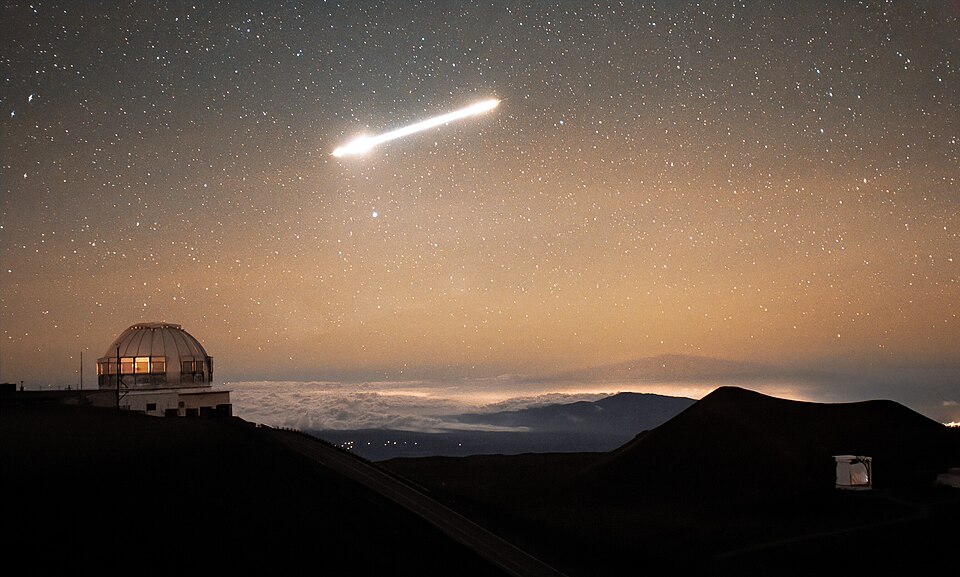
A meteor exploded off the coast of Massachusetts Saturday afternoon, shaking windows and startling residents from Boston to Rhode Island with a sudden, loud boom. NASA said the energy released when the meteor broke apart was equivalent to about 300 tons of TNT.
The boom was heard around 2:11 p.m. Eastern Time. Dozens of calls came into the WBZ-TV newsroom from people describing a sudden bang that rattled windows, startled pets, and shook some homes. Sightings were reported as far away as Ipswich, Massachusetts, and Johnston, Rhode Island. According to CBS News, dozens of people across the Northeast submitted preliminary reports to the American Meteor Society describing a fireball around 2 p.m.
Satellite lightning data from the National Oceanic and Atmospheric Administration showed a signature consistent with a meteor at the same time the boom was reported. The data indicated the meteor likely entered the atmosphere over the South Shore near Boston.
"The meteor appears to have fragmented at an altitude of 40 miles over northeast MA and southeast NH. The energy released at breakup is estimated to be equivalent to about 300 tons of TNT, which accounts for the loud noise," NASA said in a statement.
Meteors traveling at high speed create powerful shock waves as they tear through the atmosphere, similar to a supersonic jet. Those pressure waves can travel all the way to the ground as a sonic boom, sometimes heard dozens of miles from the meteor's actual path. Meteors enter Earth's atmosphere at speeds ranging from 25,000 to 160,000 miles per hour.
Shauna Edson, an astronomy educator for the Smithsonian National Space and Air Museum, explained the mechanics to WBZ-TV. "What you hear is the air compression of it moving really fast, creating those pressure waves, and occasionally sometimes you're also hearing the stone itself break apart from the forces that it's going through," she said.
The U.S. Geological Survey noted that unlike earthquakes, which occur at a single point, sonic boom events from meteors occur along a linear path in the atmosphere. As for whether any pieces of the meteor survived, Edson said it was unlikely. If it landed off the coast of Massachusetts, recovery of any fragments would be extremely difficult.