

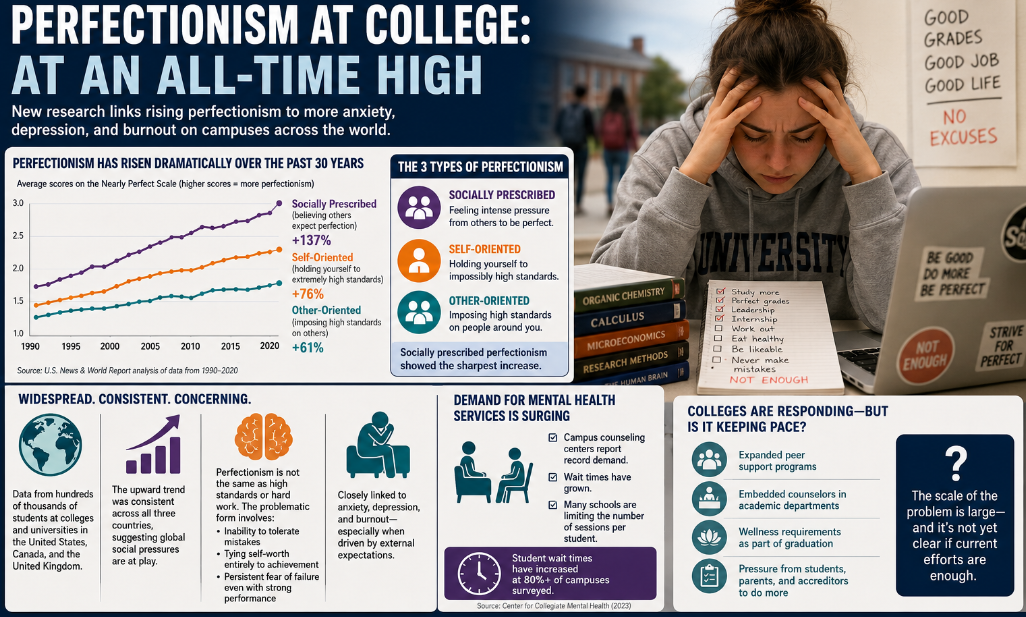
Perfectionism among college students has reached its highest recorded level, and researchers say the trend is driving rising rates of anxiety and other mental health struggles on campuses across the country.
According to a report by U.S. News and World Report, a large-scale analysis of data collected over roughly 30 years found that students today report significantly higher levels of perfectionism than students from previous generations. The increase cuts across all three types of perfectionism researchers track: self-oriented, where students hold themselves to impossibly high standards; other-oriented, where they impose those standards on people around them; and socially prescribed, where they feel intense pressure from others to be perfect.
Socially prescribed perfectionism showed the sharpest increase. That category reflects how much a student believes others expect flawlessness from them. Researchers say the rise in that particular measure is connected to broader social pressures, including competition for jobs, grades, and social standing, as well as the constant visibility that comes with social media use.
The consequences are not abstract. Perfectionism of this kind is closely linked to anxiety, depression, and burnout. Students who feel they must meet impossible external expectations often struggle to cope when they fall short, and in a college environment where academic and social pressures are constant, falling short happens regularly.
The analysis drew on data from hundreds of thousands of students at colleges and universities in the United States, Canada, and the United Kingdom. The consistency of the trend across all three countries suggests the forces driving it are not specific to one campus culture or national education system.
Researchers noted that perfectionism is not the same as having high standards or working hard. The problematic form involves an inability to tolerate mistakes, a tendency to tie self-worth entirely to achievement, and a persistent fear of failure even when performance is objectively strong.
Campus counseling centers have reported increasing demand for mental health services over the same period the study covers. Wait times at many university counseling offices have grown, and some schools have moved to limit the number of sessions available to individual students because of resource constraints.
The findings arrive as colleges are under pressure from students, parents, and accreditors to address mental health more directly. Some universities have expanded peer support programs, embedded counselors in academic departments, and created wellness requirements as part of graduation. Whether those efforts are keeping pace with the scale of the problem documented in this analysis remains an open question.