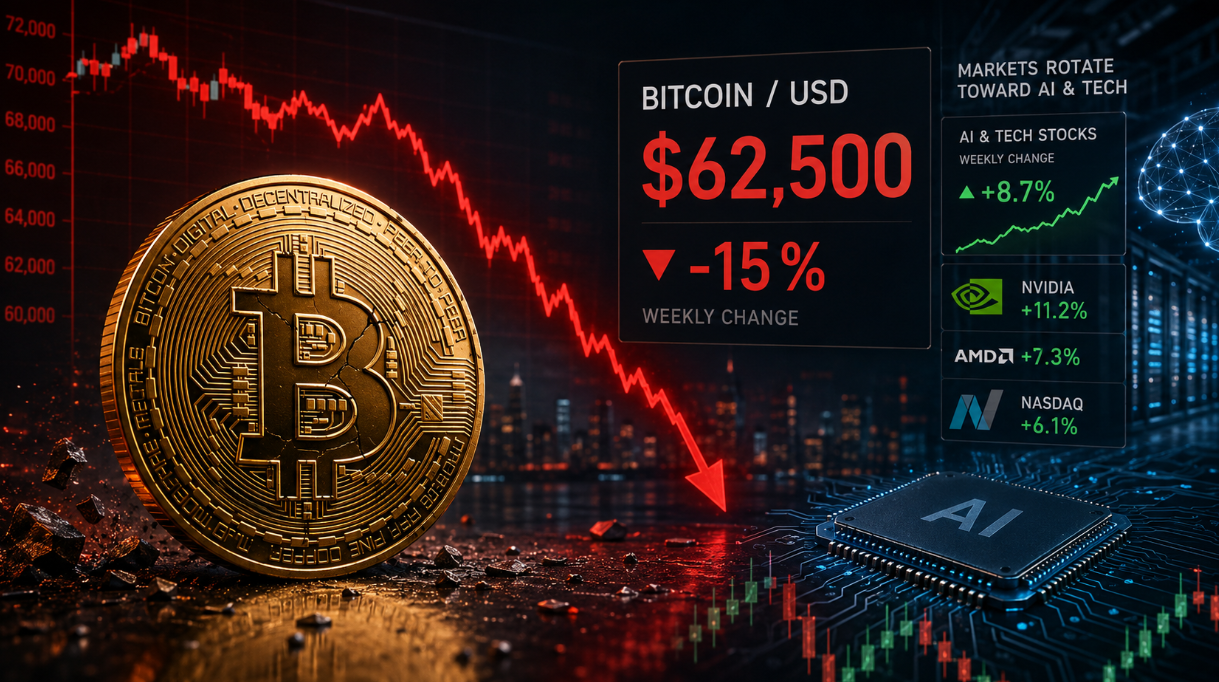
Bitcoin was on track for a loss of more than 15% for the week as of Friday, sitting at $62,500. That put the price down roughly 50% from its all-time high of $126,000 reached in October 2025. The last time bitcoin traded below $60,000 was September 18, 2024.
According to a report by CNBC, prices had already dropped to their lowest levels since early April earlier in the week after crypto treasury company Strategy sold a small portion of its bitcoin holdings. That sale weighed on market sentiment.
The week brought additional pressure. Broadcom reported a revenue miss Wednesday, pushing semiconductor stocks lower and dragging tech stocks broadly. Then Zcash, a privacy-focused cryptocurrency, tumbled after an AI-assisted security review exposed a long-standing vulnerability that could have allowed the creation of counterfeit ZEC.
Charles-Henry Monchau, chief investment officer at Syz Group, pointed to a combination of factors behind the decline. Strategy's forced selling was one. Another was money moving toward other assets.
"Speculators are going all-in on AI stocks and memory chips, especially in Korea, and the market also anticipates that upcoming monster IPOs will divert some retail money into the new stocks," Monchau told CNBC over email.
Legislative developments have also worked against bitcoin. The Clarity Act, a crypto market structure bill seen as a key catalyst for renewed investor interest, has drifted further from passage as lawmakers remain divided on key provisions and other priorities have taken over.
The broader market context has added a layer of confusion. Stocks have risen to new records while bitcoin has fallen, undermining two of the asset's main narratives. One narrative holds that bitcoin functions as digital gold and benefits from geopolitical uncertainty. The other frames it as a high-beta tech stock. Neither has held up.
"We saw the 30-day Pearson correlation between bitcoin and the Nasdaq and S&P 500 reach a near-perfect positive correlation as recently as a month ago, but that has collapsed over the last several weeks," said Rajiv Sawhney, head of international portfolio management at Wave Digital Assets, in an email to CNBC.
"So while global equities, particularly tech stocks, continued to reach new all-time highs, bitcoin has failed to track the same upward price trend."
Ongoing uncertainty around the Iran conflict has also kept pressure on bitcoin. Bloomberg reported Friday that US-Iran talks have shown little progress this week, with clashes continuing despite an April ceasefire.
Not everyone is pessimistic. Strive Chief Executive Matt Cole told CNBC's Squawk Box Europe Friday that bitcoin's fundamentals have never been better.
"This is the fifth time that bitcoin has been at its 200-week moving average — the previous four have all been the perfect time to buy the dip, and I think this time will age in the same manner," he said.
No rebound buying has materialized yet. Bitcoin remained just above the $60,000 level as of Friday morning, with traders watching closely to see whether that floor holds.