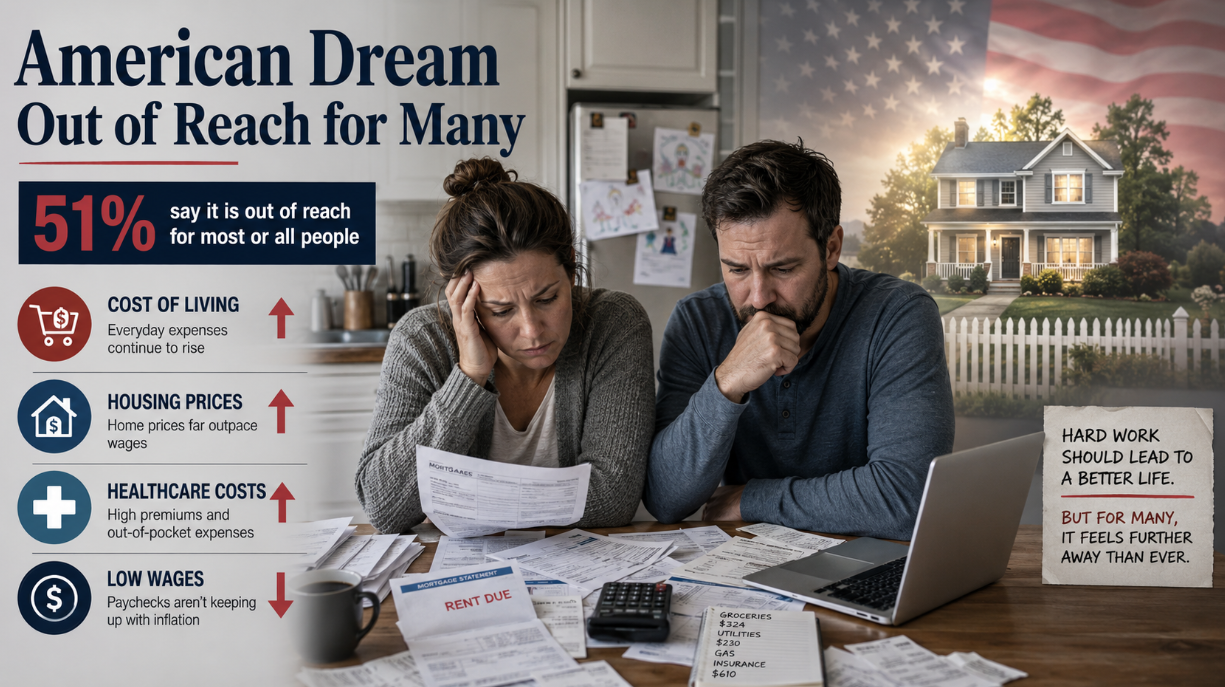
Just over half of U.S. adults believe the American Dream is out of reach for most people right now. That is the finding of a new survey released Monday.
Roughly 45% of respondents said the American Dream is only achievable for some people, and 6% said it is not in reach for anyone, according to a CNBC and SurveyMonkey American Dream Pulse Survey of 4,130 U.S. adults conducted May 6 to 11.
The term "American Dream" was popularized in the 1930s by historian James Truslow Adams, who called it a "dream of a better, richer and happier life for all our citizens of every rank." Elizabeth Suhay, professor of government at American University and author of "Debating the American Dream: How Explanations for Inequality Polarize Politics," says optimism about that idea has generally declined over the last several decades.
Americans today are "less likely to believe the American economy is meritocratic, that it is fair, that it delivers economic success to a typical hardworking person, [and] that lower-income people can work their way up" than people in previous decades, Suhay says.
Roughly four in five survey respondents identified cost of living as one of their biggest financial hurdles to achieving the American Dream. Three in five cited housing prices, almost half pointed to healthcare costs, and nearly as many blamed low wages.
While inflation has cooled from 2022 highs, it has exceeded the Federal Reserve's 2% target since 2021, and prices of gas, food, and energy remain elevated for consumers. A Marist poll of 1,400 adults conducted in December found that 70% of Americans reported the cost of living in their area was not very or not at all affordable.
"The American dream depends on what you earn, and also how much things cost," Suhay says. "All of this feeds into the increasing pessimism about whether the American dream is available to most Americans."
The survey found strong agreement on what the American Dream actually means. Seventy-two percent of respondents said they would need financial stability to feel they had achieved it, followed by owning a home at 58%, being happy at 54%, and being free to pursue passions at 51%.
The feeling of financial stability eludes many Americans right now, according to Guy Berger, workforce economist-in-residence at employer education benefits platform Guild. "People are very, very gloomy about the economy," he says. That feeling is made worse by stagnant hiring, particularly among younger workers, he adds.
Despite upticks in unemployment and inflation, "the economy itself is not terrible," says Berger. Excluding the Covid-19 pandemic, "really bad economic times are pretty far in the rearview mirror," he says, referring to periods like the 2008 financial crisis and the Great Inflation of the 1970s.