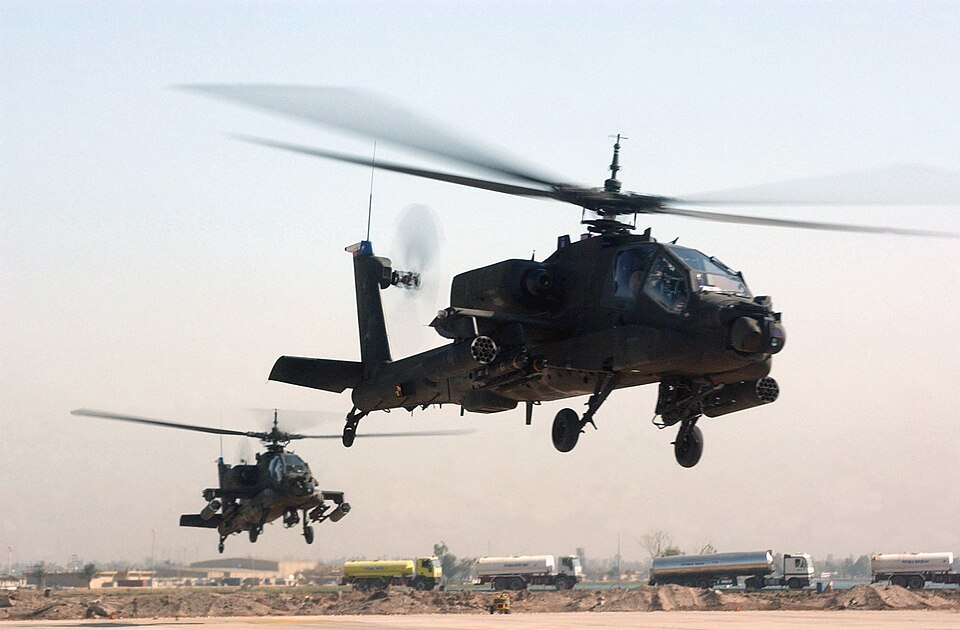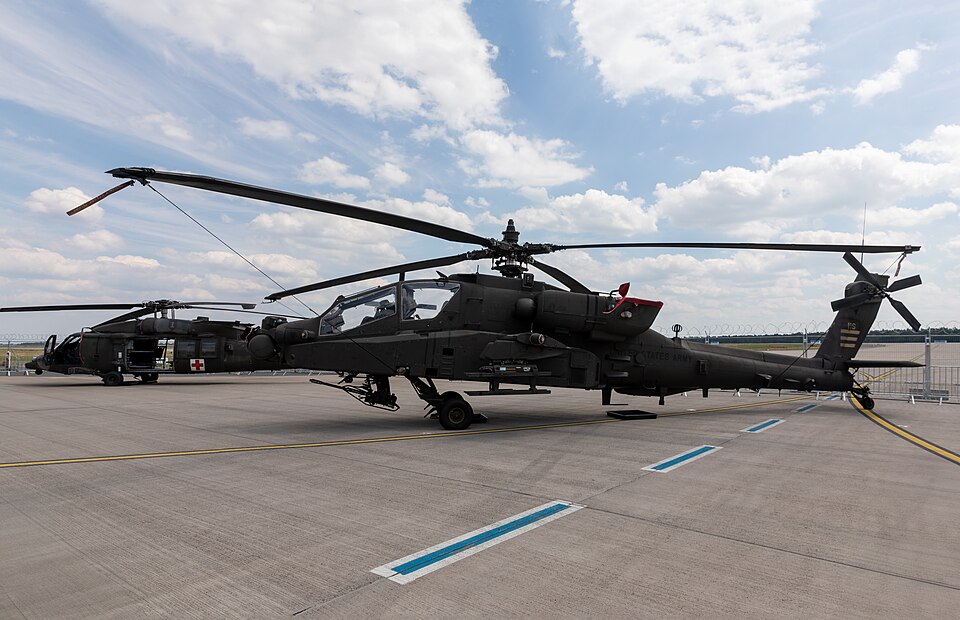
A US Army AH-64 Apache attack helicopter crashed near the Strait of Hormuz early Monday after being struck by an Iranian drone, triggering a rapid exchange of military strikes between American and Iranian forces across the Persian Gulf region. President Trump blamed Tehran for downing the aircraft and ordered retaliatory strikes on Iranian targets, while Iran responded by launching attacks on US military facilities in Bahrain, Kuwait, and Jordan.
According to Al Jazeera, the helicopter went down at approximately 1:30am local time off the coast of Oman. The two-person crew was rescued roughly two hours later by an uncrewed surface vessel, a 24-foot boat known as a Corsair, manufactured by Saronic Technologies and assigned to the US Navy's Task Force 59. US Central Command described it as the first known rescue operation of its kind. Trump later confirmed both crew members were "safe and uninjured."
Trump told Fox News that an Iranian drone had become lodged inside the Apache between the two crew members without exploding. According to Fox News reporter Trey Yingst, who spoke with Trump by phone, the pilots brought the helicopter down with the drone still inside. It remains unclear whether the helicopter was deliberately targeted, and US officials have said the incident is still under investigation.
After US Central Command launched what it described as "self-defense strikes" on Iranian targets, Iran fired back at American military installations across the Gulf. There were no immediate reports of impacts, only weapons interceptions. Trump said Wednesday that Iran had "taken too long to negotiate a deal" and would "pay the price." He told Fox News he "may keep going" with strikes and said future targets could include power plants and bridges, because Iranian negotiators are "tapping the United States along," according to Yingst.
The confrontation comes against the backdrop of a fragile ceasefire brokered by Pakistan in April. That agreement, analysts say, remains technically in place, but the latest exchanges show how quickly it can break down. Experts quoted by Al Jazeera said both Washington and Tehran appear to be testing the limits of the truce while seeking greater leverage ahead of future peace negotiations. Analysts also said Iran's actions appear aimed at deterring US patrols near the Strait of Hormuz by attacking American assets across the Gulf.
Adding to the pressure is Israel's continued military activity. Israeli airstrikes hit the center of Sidon, the largest city in southern Lebanon, on Wednesday, according to Lebanese state media. Iran has made halting Israeli strikes on Lebanon a key condition of any agreement. A ceasefire between Israel and Lebanon was agreed last week, but Iran-backed Hezbollah quickly rejected it, and both sides have continued exchanging fire.
Israeli Prime Minister Benjamin Netanyahu faces mounting pressure from multiple directions. According to Al Jazeera, former Israeli ambassador Alon Pinkas described Netanyahu as being in "a major bind, both political and diplomatic," pointing to what he called three "failed" wars: in Gaza, where Hamas retains control; in Lebanon, where Hezbollah has yet to be eliminated; and in Iran. "Diplomatically, Israel is isolated, and perceptions of it are negative," Pinkas said. Israeli elections are approaching, and Trump has previously warned Netanyahu that Israel could be left to act alone if strikes on Iran continue.