Scientists have sequenced DNA from 80 grape seeds found at the bottom of ancient wells in Tuscany, producing what researchers describe as the most extensive genetic history of ancient grapevines ever recovered from a single site. The findings were published in the Journal of Archaeological Science.
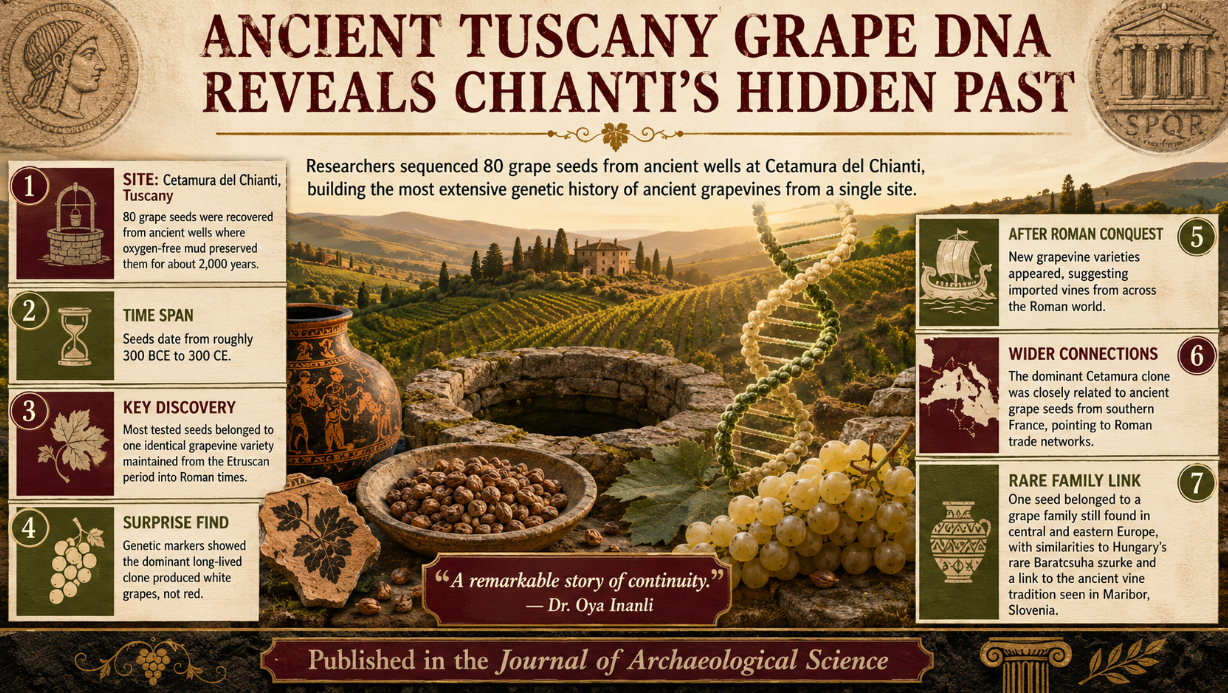
The seeds were collected at Cetamura del Chianti, a hilltop settlement in Italy's Chianti wine region. Between 300 BCE and 300 CE, local residents dropped grape pips into deep wells, where oxygen-free mud preserved them for roughly two thousand years. The site sits in a region now globally recognized for Sangiovese, a bold red wine grape.
The DNA results told a different story about the area's ancient past, according to Phys.org. A large majority of the tested seeds belonged to a single, identical variety that had been passed down continuously from the Etruscans through the Roman period.
Dr. Oya Inanli, who completed the research as part of her Ph.D. at the University of York's Department of Archaeology, described the scope of the findings. "We sequenced the DNA of 80 seeds and found a remarkable story of continuity. A large majority of the tested seeds belonged to a single, identical variety passed directly from the Etruscans to the Romans and maintained for centuries," she said.
The researchers also used genetic markers to determine the color of the ancient grapes. The answer surprised the team. "We were also able to go a step further with the genetic testing and determine the color of the ancient grapes. The markers revealed that this dominant, long-lived clone produced white berries," Inanli said.
Professor Nancy De Grummond, from Florida State University, was among the collaborators on the project. "Our team's research adds an important chapter to the history of wine in the viticulture region of Chianti. What a delightful surprise to learn that the world-famous red wine of today was actually preceded by a white vintage that was curated and maintained for centuries in Etruscan and Roman times," she said.
After the Roman conquest of the settlement, entirely new grapevine varieties appeared at the site, which the researchers interpret as evidence of choice varieties being introduced from the expanding empire. The team also found some evidence of wild grape collection, identified through analysis of pip shapes rather than DNA alone.
Genetic testing revealed that the dominant Cetamura clone was closely related to two ancient grape seeds previously tested from southern France. The researchers say this provides biological evidence of a wide-reaching agricultural trading network that Romans developed to standardize wine production across the empire.
One additional seed found at Cetamura belonged to a family of grapes still grown across central and Eastern Europe today. Its closest modern look-alike is a rare variety from Hungary called Baratcsuha szurke. The discovery also connects this ancient seed to a 400-year-old grapevine growing in Maribor, Slovenia, officially recognized as the oldest living grapevine in the world.