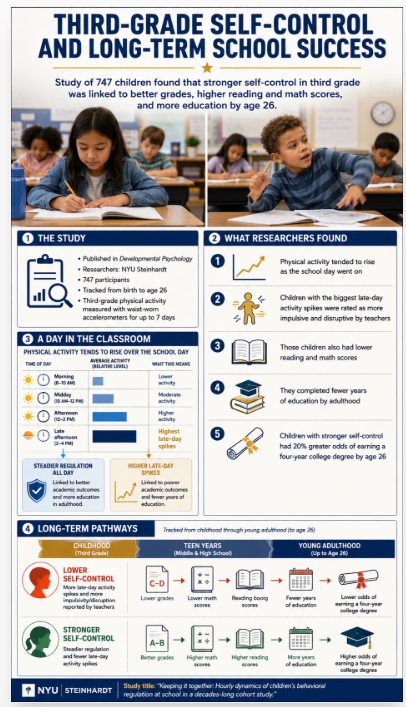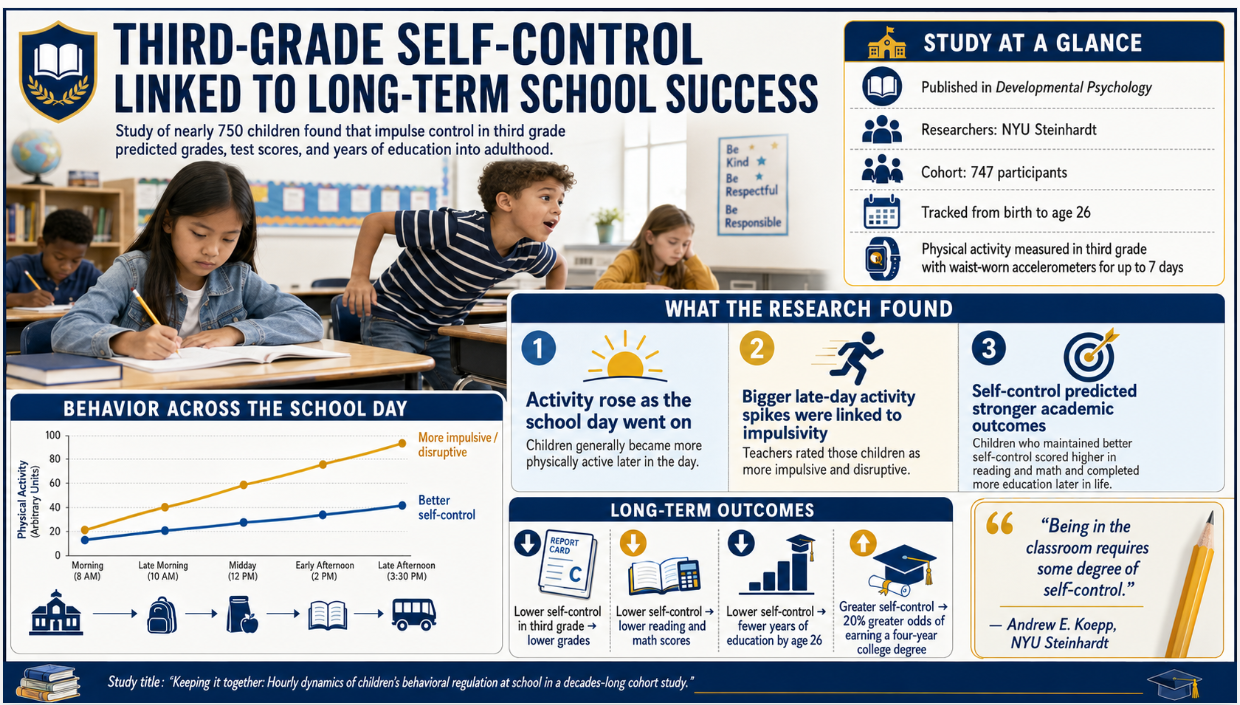
Children who struggled to control their impulses in third grade were more likely to earn lower grades, score worse on reading and math tests, and complete fewer years of education by their mid-twenties. That is the finding of a study published in Developmental Psychology that tracked nearly 750 people from birth to age 26.
According to Phys.org, researchers used data from the National Institute of Child Health and Human Development's Study of Early Child Care and Youth Development, focusing on a cohort born in 1991. They analyzed information for 747 individuals whose gross motor activity, meaning things like running and jumping, was measured in third grade using accelerometer devices worn around the waist for up to seven consecutive days.
The lead author of the study is Andrew E. Koepp, an assistant professor of applied psychology at NYU Steinhardt. His team chose third grade deliberately. "We focused on third grade because it marks a transition to middle childhood and greater independent control of behavior," the authors note in the study.
The researchers found that children's physical activity tended to increase as the school day went on. Third-graders who showed the biggest spikes in activity as the day wore on were rated as more impulsive and disruptive by their teachers. Those same children had lower math and reading scores in both elementary and high school, and they went on to complete fewer years of education as adults.
Children who maintained greater self-control showed the opposite pattern. They scored higher in math and reading and had 20% greater odds of completing a four-year college degree by age 26.
Koepp described the physical and mental demands the school environment places on young children. "Being in the classroom requires some degree of self-control. Children are expected to walk instead of run, keep their hands to themselves, and stay in their seats when the situation requires," he said. "Applying this self-control takes effort, and by the final ring of the school bell, children have been doing it for hours."
He added that the pattern of losing focus or composure by the end of the school day was common across the sample. "Our findings imply that behaviorally speaking, most children tend to 'lose it' a bit by the end of the school day," Koepp noted. "Interestingly, those who could 'keep it together' for longer tended to do better in school and were more likely to achieve educational success long term."
The researchers assessed self-regulation using several measures: physical activity levels recorded by the accelerometers, teacher ratings of hyperactivity, standardized math and reading scores, and self-reported data on the highest degree each participant had earned by age 26. This combination of objective and reported measures allowed the team to build a picture of behavior and outcomes across more than two decades.
The study was conducted by researchers at New York University and was published in the journal Developmental Psychology under the full title: "Keeping it together: Hourly dynamics of children's behavioral regulation at school in a decades-long cohort study."