

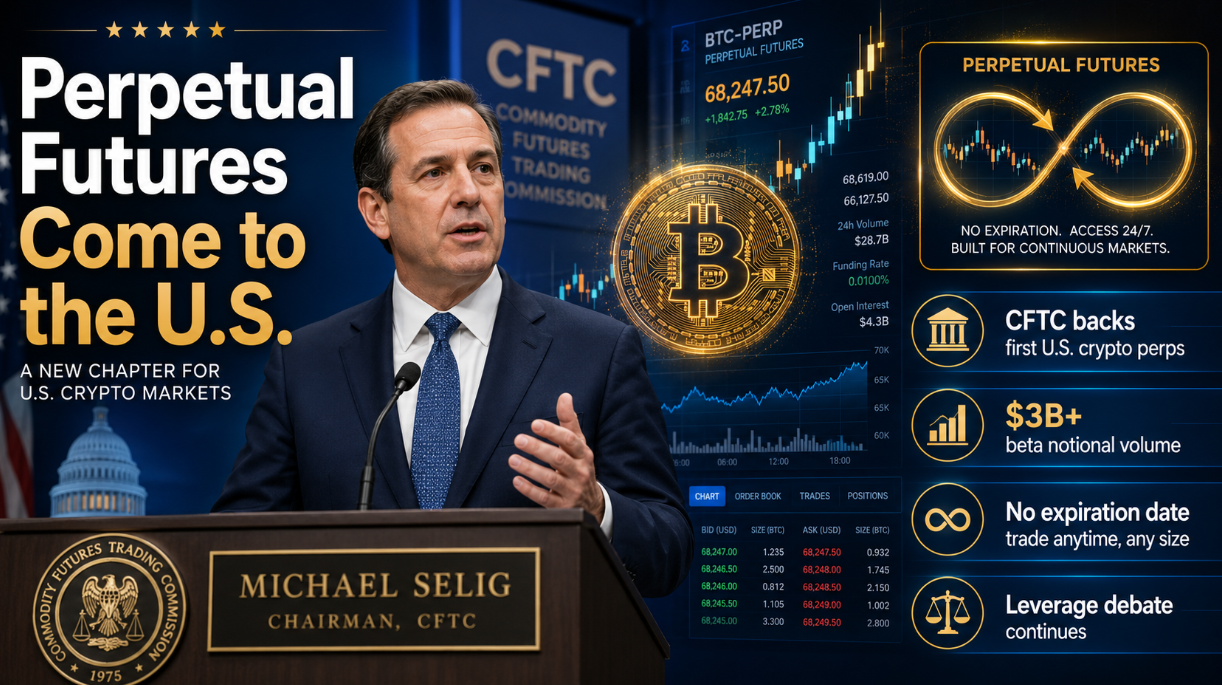
The head of the Commodity Futures Trading Commission is standing behind his agency's decision to bring perpetual futures contracts to the United States for the first time, pushing back against critics who say the products carry too much risk for American traders.
CFTC chair Michael Selig appeared on CNBC's Fast Money on Monday to defend the move, according to CNBC. In late May, the agency approved prediction market platform Kalshi to begin offering bitcoin perpetual futures, known in trading circles as perps. These are futures contracts with no expiration date that allow traders to speculate on a price without owning the underlying asset. The products have been widely available overseas but had never been permitted in the U.S. before the Kalshi approval. Kalshi has since expanded its perps offerings to other cryptocurrencies.
Selig framed the decision as part of a broader effort to bring internationally developed products under domestic regulation.
"It's time to approve regulated futures contracts that have no expiration date," he said. "We're going to make sure the product's available, but it's well regulated here in the U.S."
Demand for the new contracts has been strong. At a Thursday event celebrating the product launch, Kalshi said its perps had generated more than $3 billion in notional volume in just over a week of beta testing.
Not everyone in the industry is supportive. CME Group CEO Terrence Duffy appeared on Fast Money shortly after the regulatory decision and blasted the approval, voicing concerns about the large amount of leverage the contracts carry. Selig directly addressed that criticism on Monday.
"The notion that we should be paternalistic and allow for one type of product, because it's easier to understand, I think that's frankly a misunderstanding itself, because, of course, options are very complicated," he said. "We're going to make sure there's proper disclosure. And to the extent that there's questions around suitability, of course, the brokers have to make those calls and make sure that they're evaluating the customers that are trading in their markets."
Kalshi CEO Tarek Mansour, in a Fast Money appearance last week, noted that the maximum leverage his company allows on its perps contracts is around six times, which he said is less than what CME offers on some of its own futures products.
Selig also denied that political pressure from the Trump administration played any role in the CFTC's decision. Donald Trump Jr., son of President Donald Trump, serves as a strategic advisor to Kalshi.
"That's absolutely absurd, that insinuation," Selig said.
CNBC disclosed that it has a commercial relationship with Kalshi that includes customer acquisition and a minority investment.