

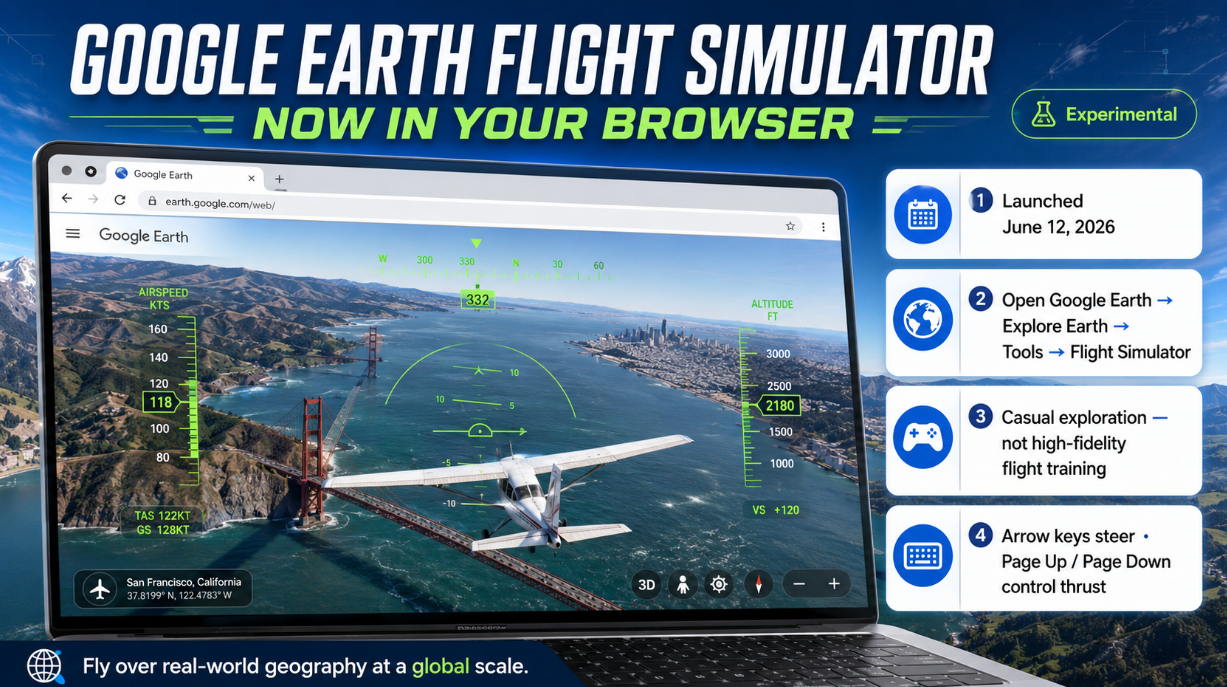
Google Earth's flight simulator mode is now available to anyone with a web browser. Google announced the update on June 12, 2026, making the feature accessible globally without requiring the desktop application.
The simulator has existed inside the Google Earth desktop app since 2007. According to a report by Engadget, which spotted a social media post from the Google Earth account announcing the change, this marks the first time the feature has been available through a standard web browser.
To access it, users navigate to the Google Earth website, click Explore Earth in the upper right corner, and then open the Tools menu. The flight simulator is the last option on that list. Controls are not displayed inside the game itself, but Google has posted them on its developer website. Players can use a mouse or arrow keys to manage pitch and roll, while the Page Up and Page Down buttons control thrust. The game ends if the plane crashes, though players can restart as many times as they want.
CNET noted that the controls take some getting used to, and it is easy to lose control of the aircraft. The browser screen will tilt and spin along with the plane during a bad flight, which can be disorienting.
Google has been clear about what the simulator is and is not. "The flight simulator is designed for casual exploration rather than high-fidelity aerodynamic training," the company stated. The feature is also labeled as experimental, meaning users may run into technical glitches.
The simulator does not include missions, achievements, or any structured progression. What it does offer is access to the full Google Earth map database, meaning players can fly over nearly any location on the planet. Users can take a low pass over major landmarks, navigate through mountain ranges, or attempt tight maneuvers around structures like the Golden Gate Bridge.
The flight simulator addition is part of a broader effort by Google to bring professional-grade desktop features to the web version of Google Earth. Other recent additions include elevation profiles, new data import types, and extra data layers. Most of those features are aimed at professionals and hobbyists doing geographic or scientific work. The flight simulator, by contrast, is purely recreational.
The tool is not a competitor to detailed flight simulation software such as Microsoft Flight Simulator or games in the Ace Combat series. It does not model aerodynamics with the same depth, and there is no weather system, air traffic, or cockpit instrumentation. Its appeal is the combination of casual gameplay with real-world geography at a global scale.
Google Earth has been expanding its features in recent years. In 2024, the platform added historical recreations that allowed users to view select locations as they appeared at different points in time. The flight simulator now joins that list of features designed to make the platform useful and entertaining beyond basic map browsing.