

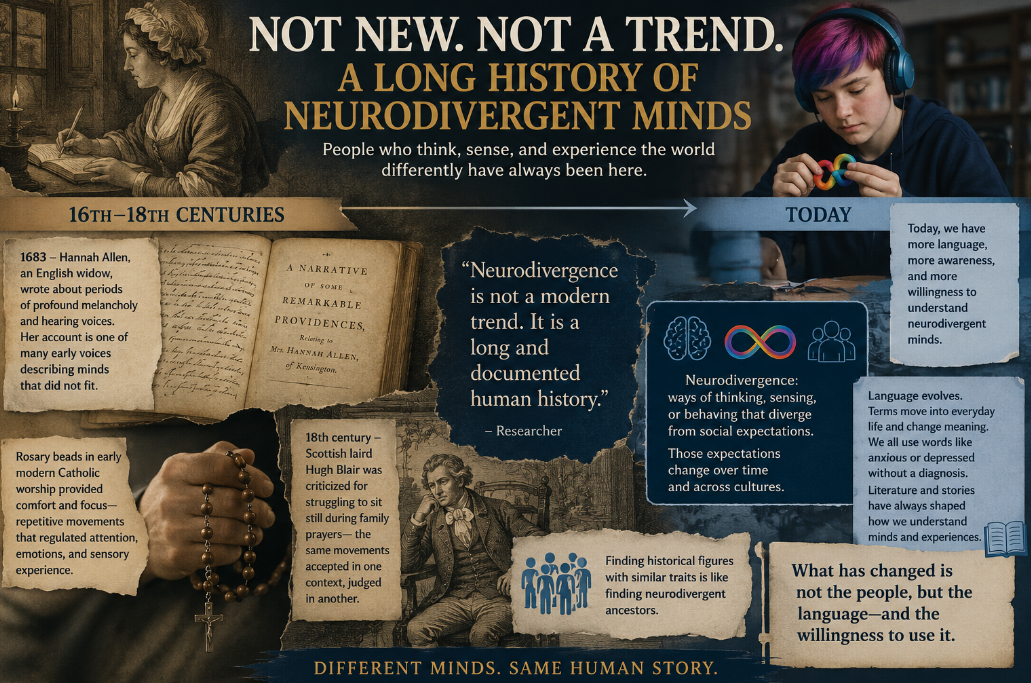
Long before words like autism or ADHD existed, people were writing about minds that did not fit.
A researcher studying early modern literature argues that neurodivergence is not a modern trend or a social media phenomenon, but a condition with a long and documented human history. The work, reported by Phys.org, draws on texts from the 16th through 18th centuries to show that people who thought, sensed, or behaved differently from social expectations have always been present.
One of the clearest examples the researcher points to is Hannah Allen, an English widow who published an account of her experiences in 1683. Allen wrote about periods of profound melancholy and hearing voices, drawing on journal entries she had kept during those difficult years. Her account is one of many historical texts that the researcher uses to show people have long searched for language to describe minds that did not fit comfortably within accepted norms.
The research does not attempt to diagnose historical figures. The researcher is explicit on that point, noting that diagnostic categories have their own history, change over time, and are shaped by specific cultural and geographical contexts. The goal is something broader: examining how people in the past were understood, by others or by themselves, as different.
One of the more striking observations involves what today might be called stimming. Many neurodivergent people describe using repetitive movements to regulate attention, emotions, or sensory experiences. The researcher points out that in early modern Catholic worship, rosary beads served a similar function. Repetitive hand movements were not only accepted in that context but encouraged as part of religious practice.
Context shaped how those same behaviors were perceived. In the 18th century, a Scottish laird named Hugh Blair was criticized for struggling to sit still during family prayers and occupying himself in other ways instead. The same type of movement that was welcome in one setting drew judgment in another.
The researcher defines neurodivergence broadly: ways of thinking, sensing, or behaving that diverge from social expectations. Crucially, the research argues that those expectations are not fixed. What counts as unusual behavior in one time or place may be entirely ordinary in another.
The work also addresses how language around mental and psychological experience has always been fluid. Clinical terms move into everyday conversation and change meaning as they travel. People describe themselves as anxious about an exam or depressed by bad weather without claiming a diagnosis. Literature, the researcher argues, has always transformed and enriched how society understands medical and psychological concepts.
Members of the research project have described discovering historical figures with traits similar to their own as like finding neurodivergent ancestors. That framing pushes back against the claim that rising rates of neurodivergent identification reflect a cultural fad. The research suggests instead that what has changed is not the people, but the language and the willingness to use it.