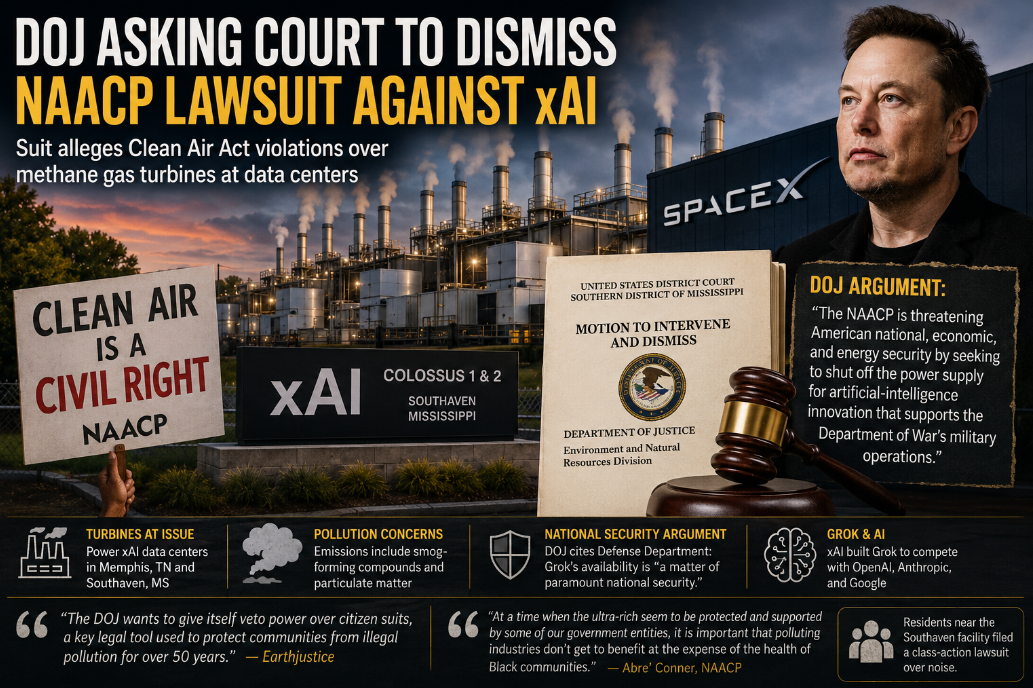
The Department of Justice filed a court motion on June 15 asking a federal court in Mississippi to throw out a lawsuit brought by the NAACP against xAI, Elon Musk's artificial intelligence company now owned by SpaceX. The suit, filed in April, accused xAI of violating the federal Clean Air Act by running dozens of methane gas-burning turbines to power its AI data centers without proper permits or pollution controls.
According to CNBC, the DOJ's Environment and Natural Resources Division argued in its filing that the NAACP was threatening "American national, economic, and energy security by seeking to shut off the power supply for artificial-intelligence innovation that supports the Department of War's military operations."
The turbines at issue power SpaceX's Colossus 1 and 2 data centers in and around Memphis, Tennessee, as well as a facility in Southaven, Mississippi, just outside of Memphis. Neighbors and environmental groups have protested the sites for more than a year over concerns including air pollution, electricity and water consumption, and noise. The pollutants emitted by the turbines include smog-forming compounds and particulate matter that can increase health risks and produce an unpleasant odor, the NAACP alleged.
The NAACP had also asked the court to issue an injunction that would stop xAI from using the turbines while the case is pending. The DOJ's motion to intervene seeks to block that path as well.
The DOJ cited Cameron Stanley, who leads artificial intelligence for the Defense Department. Stanley is quoted in the filing as saying that Grok's continued availability "is a matter of paramount national security." The filing also stated that during the Iran war, the military version of Grok had "enabled U.S. forces to deploy over 2,000 munitions to 2,000 distinct targets within 96 hours, a testament to the greatly increased operational efficiency made possible by the Grok Gov Model."
Before merging with SpaceX in February, xAI built the Grok AI model and chatbot to compete with OpenAI, Anthropic, and Google.
Earthjustice, one of the law firms representing the NAACP, pushed back directly. The organization told CNBC in an emailed statement that the DOJ wants to give itself "veto power over citizen suits, a key legal tool used to protect communities from illegal pollution for over 50 years." The Southern Environmental Law Center, which is co-counsel in the case, described the DOJ's motion as a "massive power grab" by the Trump administration.
Abre' Conner, the NAACP's Director of Environmental and Climate Justice, said by email that "At a time when the ultra-rich seem to be protected and supported by some of our government entities, it is important that polluting industries don't get to benefit at the expense of the health of Black communities."
Residents who live near the Southaven facility filed a separate class-action lawsuit earlier this month, alleging the company's power plant leaves them exposed to near-constant noise. SpaceX did not respond to a request for comment.