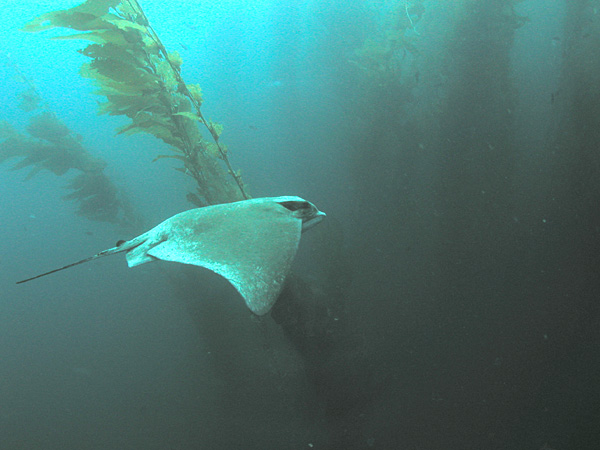
A frightened bat ray releases a chemical signal into the water, and nearby rays respond within seconds, even when they cannot see or hear the alarmed animal. That is the finding from a new study out of Oregon State University, published in the Journal of Experimental Zoology Part A: Ecological and Integrative Physiology.
Researchers set up three tanks, each holding one bat ray. One tank served as the signaler, and it flowed water into two receiver tanks. The tanks were visually and acoustically isolated from one another. After the rays had time to settle, researchers simulated a predator by chasing the ray in the signaler tank without harming it. Overhead cameras recorded what happened next in the receiver tanks.
The response was fast. Within seconds of water from the signaler tank flowing into the receiver tanks, the rays inside showed clear behavioral changes. Because the animals had no visual or acoustic contact with each other, the researchers concluded the reaction had to come from a chemical cue carried in the water.
"The animals could not see each other, and they were acoustically isolated, so our work shows the response was induced by a chemical alert from the frightened ray," said Joshua Bowman, the study's lead author.
Bowman completed the research as part of his master's degree thesis at OSU's Big Fish Lab. He is now a faculty research assistant with the Cooperative Institute for Marine Ecosystem and Resources Studies at OSU's Hatfield Marine Science Center in Newport, Oregon. He borrowed the rays used in the study from the Oregon Coast Aquarium, also in Newport.
This type of chemical warning signal, called a disturbance cue, is well known in bony fish. Schools of fish use it regularly as an anti-predator strategy. But it had never been documented in cartilaginous fish, the group that includes rays, sharks, and skates, collectively known as elasmobranchs.
Bowman took on the bat ray experiment as a first step toward understanding a larger mystery: why white sharks sometimes flee an area all at once, even when only a fraction of them could have spotted the threat.
"People don't necessarily think of sharks as prey, but even white sharks—the largest predatory sharks in the ocean—can be prey to orcas," Bowman said. "Past research has documented sharks fleeing when orcas are present, and they're probably not all seeing an orca and saying, 'Okay, time to leave.' That suggests there's probably some other signal they are responding to."
Bat rays are far easier to study than white sharks. They are smaller, more accessible, and can be housed in aquarium tanks. Their close biological relationship to sharks makes them a useful stand-in for research into shark behavior and communication.
Taylor Chapple, an associate professor and co-director of OSU's Big Fish Lab, co-authored the study. "Rays are closely related to sharks, so studying their communication pathways can provide insights into sharks as well," Chapple said. "Disturbance cues have never been described in sharks or rays, so these findings provide new insights into the communication pathways and behavioral complexities of these critically important marine species."
The research opens a new line of inquiry into how elasmobranchs share information about danger, and whether chemical communication plays a broader role in the behavior of sharks across different species and environments. Future studies may focus on identifying the specific chemical compounds involved and testing whether the same response appears in sharks directly.