For over a century, imaginary numbers have been treated as an essential part of quantum mechanics. A new paper published in the journal Physical Review Letters is now challenging that assumption.
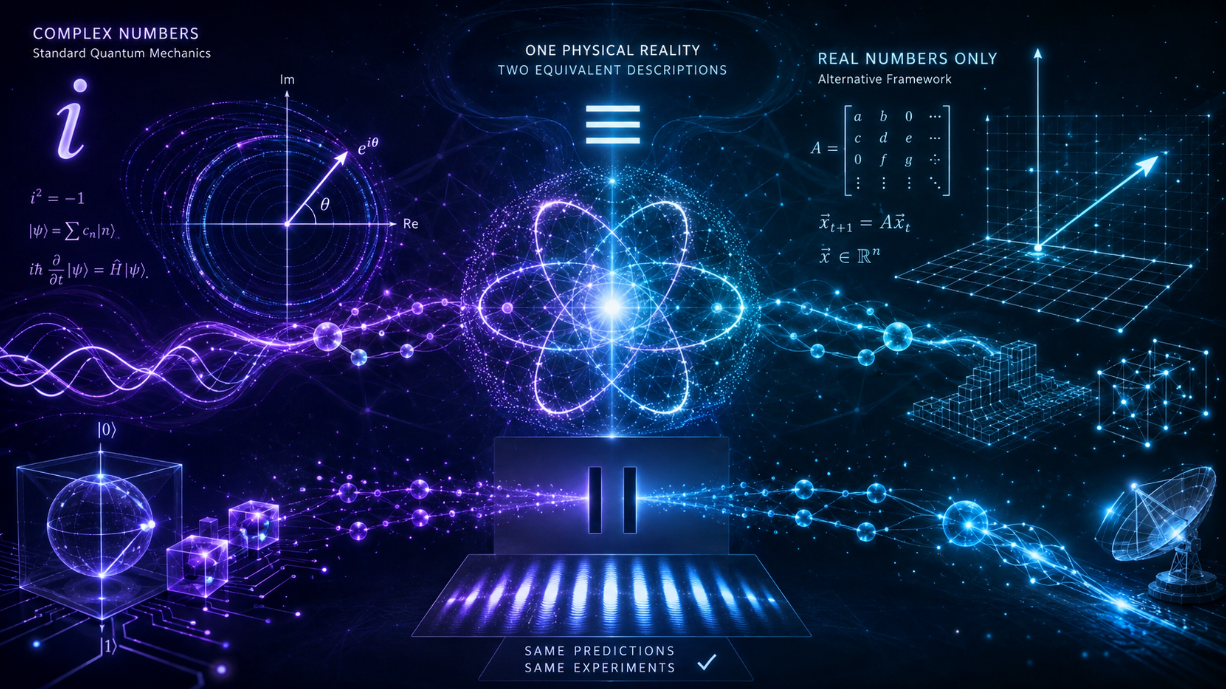
Physicists from Heinrich Heine University Düsseldorf, working in collaboration with the German Aerospace Center, found that quantum mechanics does not necessarily require imaginary numbers to function. The research, reported by Phys.org, shows that real numbers can, in principle, replace them without changing any experimental prediction.
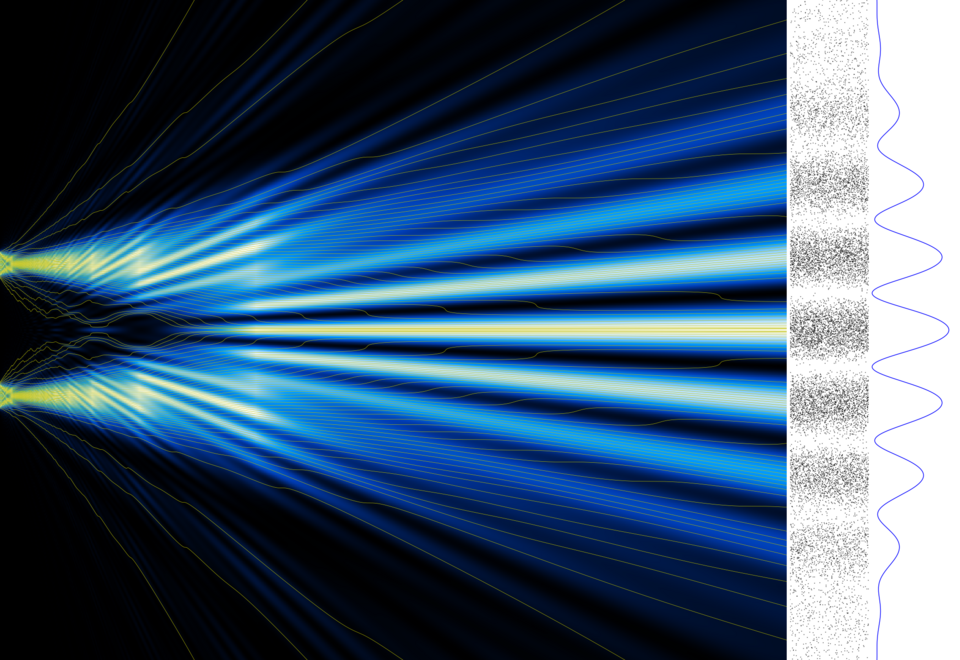
Quantum mechanics is the physical theory that describes the behavior of atomic and subatomic particles. Its foundations were built in the early twentieth century by physicists including Max Planck, Niels Bohr, Werner Heisenberg, and Erwin Schrödinger. Among the phenomena it explains are the diffraction of particles through a double slit, quantum tunneling, entanglement, and coherence. The last two are central to the development of quantum computers and quantum communication systems.
Complex numbers have been a core mathematical tool in this theory. A complex number carries two components: a real part and an imaginary part. In quantum mechanics, the real part represents the amplitude of a quantum state while the imaginary part represents the phase. Without this structure, many quantum processes could not previously be described.
Whether complex numbers are truly fundamental to quantum mechanics or simply a convenient calculation tool has been debated for decades. A 2021 study concluded that complex numbers are essential under the standard postulates of quantum mechanics, and that conclusion was also backed by experimental evidence.
The new team, led by Professor Dagmar Bruß and doctoral researcher Pedro Barrios Hita, took a close look at the postulates used in that earlier study. They found that one of those postulates was too restrictive. The researchers identified a physically motivated alternative way to formalize how quantum systems are composed. That alternative gives rise to a class of theories that can be written entirely with real numbers and that produce results experimentally indistinguishable from standard quantum mechanics.
Professor Bruß explained the significance directly. "This means that both frameworks yield identical predictions for any conceivable experiment. Within this framework, imaginary numbers are thus not fundamentally necessary in quantum mechanics and can in principle be replaced by alternative formulations using real numbers."
The finding does not overturn quantum mechanics or change how it is applied in practice. What it does is open a new question about what mathematical structures are truly required at the foundations of the theory. Researchers working in quantum information and foundations of physics are likely to examine the implications for how quantum systems, particularly those used in computing and communication, are formally described going forward.