

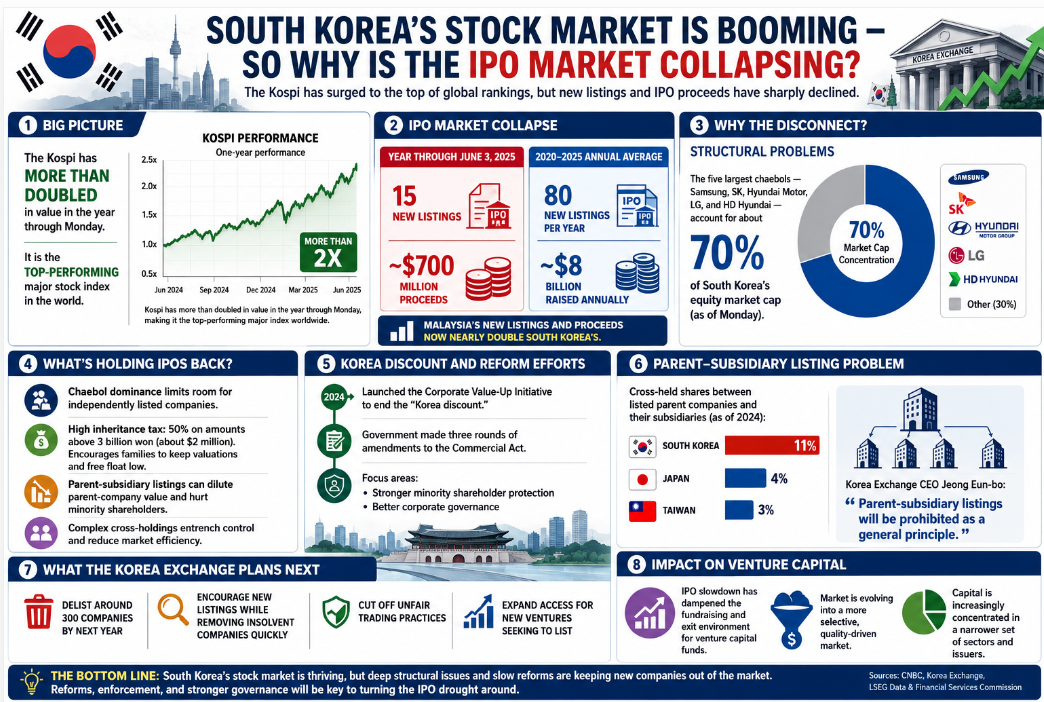
South Korea's stock market is performing at the top of global rankings, but the country's IPO market is collapsing at the same time. The Kospi has more than doubled in value in the year through Monday, making it the top-performing major index worldwide. Yet new stock listings have fallen off a cliff.
According to CNBC, South Korea saw only 15 new listings in the year through June 3, with proceeds totaling around $700 million, citing LSEG data. Between 2020 and 2025, new listings averaged 80 per year and raised around $8 billion annually. Malaysia's new listings and proceeds now nearly double South Korea's.
The disconnect points to deep structural problems tied to the country's chaebol system, the family-run conglomerates that dominate the Korean economy. The five largest of them, Samsung, SK, Hyundai Motor, LG, and HD Hyundai, accounted for around 70% of South Korea's equity market cap as of Monday, according to Korea Exchange data.
Polka Mishra, a partner at Javelin Wealth Management in Singapore, said chaebols, which were once central to South Korea's industrial development, are now "more of a hindrance than a help for creating new, independently listed champions." South Korea's inheritance tax of 50% for amounts exceeding 3 billion won, roughly $2 million, gives conglomerates a financial incentive to keep their valuations and free float low, she said.
The country has tried to fix the problem. In 2024, South Korea launched what it called the Corporate Value-Up Initiative, aimed at ending the so-called Korea discount, in which Korean shares trade at lower levels than overseas peers. The government made three rounds of amendments to the Commercial Act to improve minority shareholder protection and corporate governance.
One specific target is parent-subsidiary listings, where a unit of a larger company pursues its own listing. Korea Exchange CEO Jeong Eun-bo told CNBC on June 11 that such listings will "be prohibited as a general principle." These arrangements can dilute the parent company's value at the expense of minority shareholders while letting controlling families keep control of the newly listed subsidiary. Cross-held shares between listed parent companies and their subsidiaries accounted for around 11% of South Korea's total market cap last year, according to the Financial Services Commission. That compares to about 4% in Japan and 3% in Taiwan.
To redirect capital toward new companies, the Korea Exchange plans to delist around 300 companies by next year. Jeong said the exchange is encouraging new listings while quickly removing insolvent companies, "so that we can cut off unfair trading practices and expand access for new ventures seeking to list."
The slowdown is hurting the venture capital industry. Lee Hyo-seob, a senior research fellow at the Korea Capital Market Institute in Seoul, said the IPO slowdown has dampened the fundraising and exit environment for venture capital funds. Jungik Park described the market as "evolving into a more selective, quality-driven market, with capital increasingly concentrated in a narrower set of sectors and issuers."