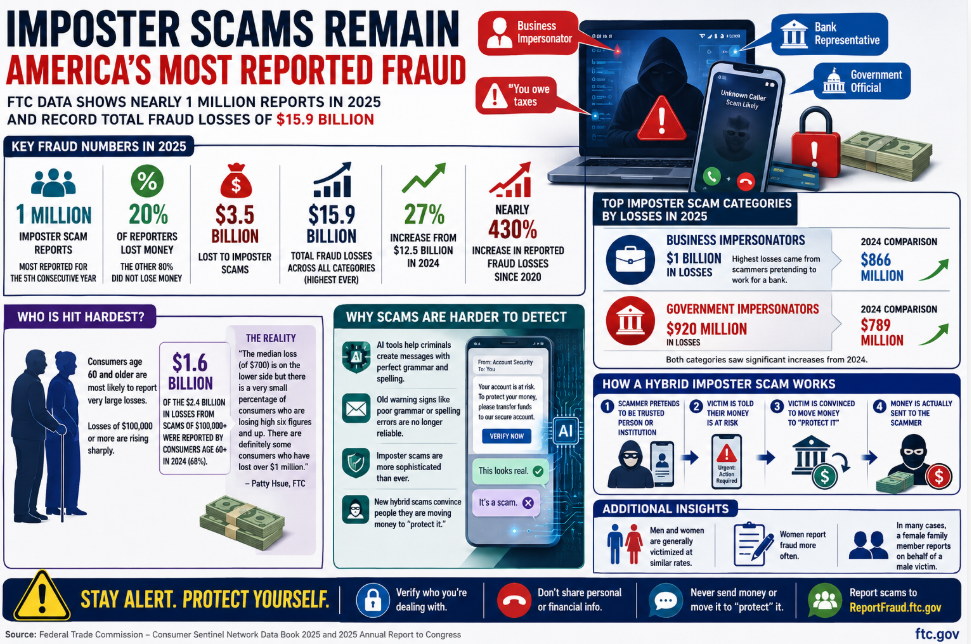
For the fifth consecutive year, imposter scams ranked as the most reported type of fraud in the United States, according to data released by the Federal Trade Commission.
Roughly 1 million people filed imposter scam reports in 2025. While 80% of those who reported did not lose money, the remaining 20% collectively lost $3.5 billion. Total fraud losses across all categories reached $15.9 billion, the highest figure ever recorded by the agency and an increase of roughly 27% from $12.5 billion in 2024. Since 2020, reported losses have climbed nearly 430%.
Patty Hsue, chief of staff for the FTC's Division of Marketing Practices, described the scale of individual losses in some cases. "The median loss [of $700] is on the lower side but there is a very small percentage of consumers who are losing high six figures and up," Hsue said. "There are definitely some consumers who have lost over $1 million."
The trend is largely driven by a rise in the number of consumers reporting losses of at least $100,000. That category occurs most often among victims age 60 or older. Scams involving losses of $100,000 or more among that age group accounted for $1.6 billion, or 68%, of their total $2.4 billion in reported losses in 2024, according to the FTC's 2025 annual report to Congress, released in December.
"While we get tons and tons of imposter reports from people of all ages … older adults do tend to report more money losses than younger adults," Hsue said.
Within the imposter scam category, business impersonators accounted for $1 billion in losses in 2025. The highest reported losses in that group came from criminals pretending to work for a bank. Government impersonators accounted for another $920 million. Both figures rose from the prior year, up from $866 million and $789 million respectively in 2024.
Amy Nofziger, senior director of victim support for the AARP Fraud Watch Network, noted that men and women are generally victimized at equal rates. But women report fraud more often, and in many cases a female family member is the person who files the report on behalf of a male victim.
Artificial intelligence is making scams harder to detect. Nofziger said that spotting poor grammar or spelling errors, once a reliable warning sign, no longer works. "Now, that's gone out the window. With the tools available to criminals, they can make any text or email sound 100% correct," she said.
Hsue described the current landscape as more sophisticated than in the past. "We've seen a change in how imposter scams operate these days," she said. "Really it's becoming much more sophisticated than it has been in the past." She noted that one newer type involves a hybrid approach in which consumers are convinced they are moving their money to protect it.