

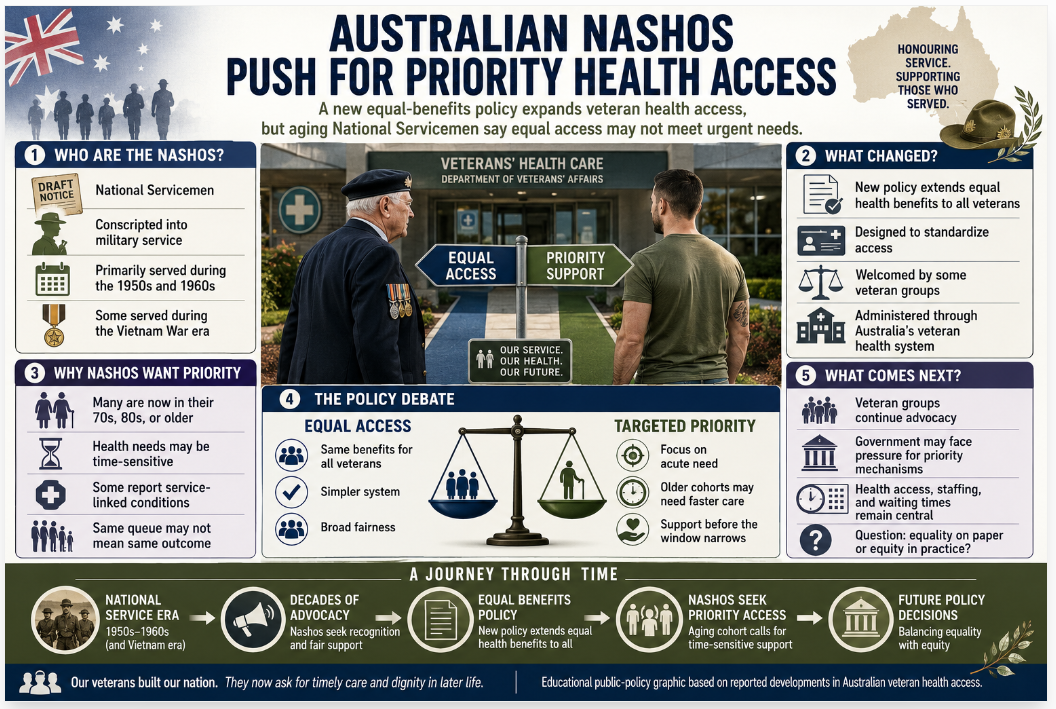
A group of aging Australian veterans known as Nashos are calling for priority health access even as a new policy extends equal health benefits to all veterans, according to a report by the Australian Broadcasting Corporation. The tension between equal access and targeted support has become a point of conflict among veteran groups as the policy takes effect.
Nashos is the informal name for National Servicemen, Australians who were conscripted into military service, primarily during the 1950s and 1960s, and in some cases during the Vietnam War era. Unlike career soldiers, these men were required by law to serve and did not choose military life. Many have argued for decades that their service has been underrecognized compared to that of regular forces.
The new policy gives all veterans equal access to government health benefits, a move that some veteran groups welcomed as a long-overdue correction. But Nasho representatives say that equal access on paper does not translate to equal outcomes for men who are now in their 70s, 80s, and older, many of whom are dealing with health conditions linked to their service decades ago.
The argument being made by aging Nashos is that priority access, rather than equal access, is what their situation requires. Their cohort is aging rapidly, and the window in which they can benefit from enhanced health support is narrowing. Waiting in the same queue as younger veterans or those with different service profiles, they argue, effectively disadvantages them despite the formal equality of the new system.
The Australian Broadcasting Corporation reported on this tension as the equal access policy was rolling out, giving voice to Nasho advocates who say the government's approach, while well-intentioned, does not fully account for their circumstances. The debate reflects a broader challenge in veteran health policy: how to balance equity across all who served with targeted support for those whose needs are most acute or most time-sensitive.
Australian veterans' health policy is administered through the Department of Veterans' Affairs, and the equal access expansion represents one of the larger structural changes to that system in recent years. Whether the government will consider carve-outs or priority mechanisms for older conscript-era veterans remains to be seen.