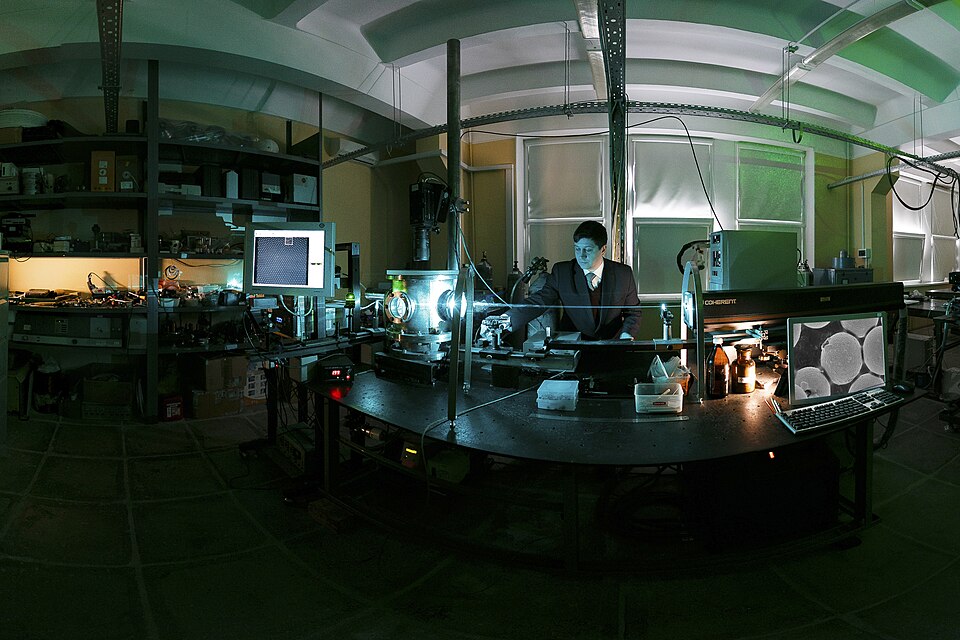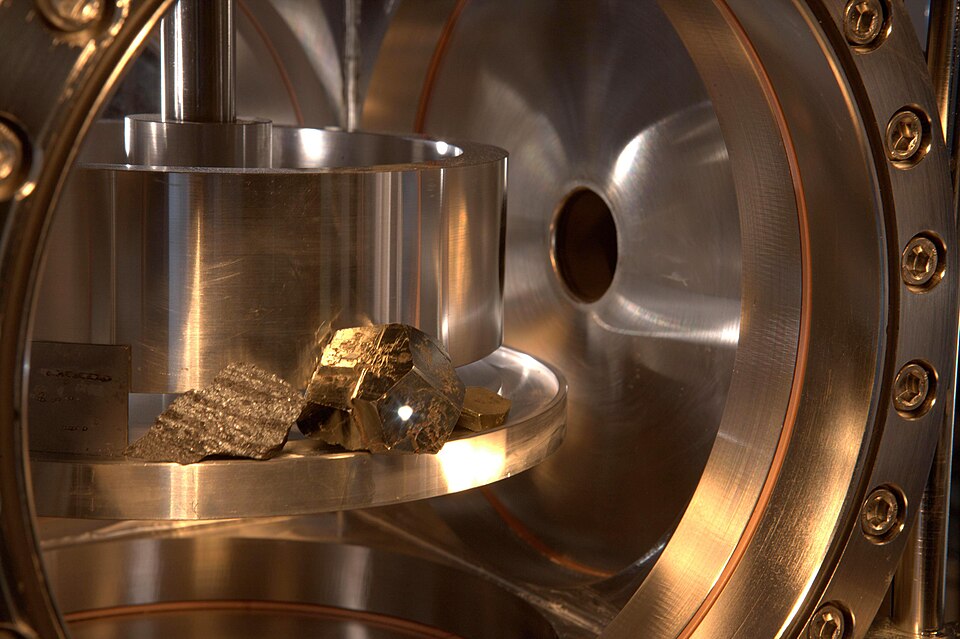
A laser that twists like a strand of DNA and stirs plasma like a whirlpool has been demonstrated for the first time. Scientists from Lawrence Livermore National Laboratory and the University of California, Irvine published the work in Nature Photonics. The achievement opens new directions in fusion energy, particle acceleration, and astrophysics research.
As Phys.org reported, conventional high-intensity laser beams hit plasma as a simple round spot. The new laser, called a light spring, rotates around its central axis at a controllable rate. Pointed at a wall, it would trace out circles over time rather than holding a fixed spot.
"For a long time, people have used high-power and high-intensity laser pulses to drive plasmas," said LLNL scientist and lead author Andrew Longman. "But those lasers are almost always in their simplest configuration. It's basically a round spot — nothing especially interesting. It's like hitting the plasma with a hammer. We're interested in laser pulses that are structured in both space and time because they let us do unusual things, like stir the plasma."
The rotation speed can be tuned across a wide range, including apparent speeds that exceed the speed of light. That does not violate relativity. The capability could allow researchers to drive types of plasma waves that have never been studied experimentally before.
Building the laser required some of the most precise optical components ever made at LLNL's National Ignition Facility. Researchers split a broadband laser into two beams, one carrying shorter blue wavelengths and the other carrying longer red wavelengths. Each beam then reflected off a custom mirror etched with an extremely subtle spiral pattern.
The mirrors are six inches, or 15 centimeters, across. To the naked eye they look flat. If scaled up to a mile in diameter, the spiral step on their surface would stand only about half an inch tall.
"For some of these freeform optics, across the entire optic, the difference between the design and the finished part was only about five nanometers," said author Tayyab Suratwala, the program director for Optics and Materials Science and Technology at LLNL. "We're talking down to almost the atomic scale."
After reflecting from the two mirrors, a second beamsplitter recombined the beams, aligning them in both space and time. The result was the light spring pulse. The beam's helical structure resembles a twisting strand of DNA.
The ability to shape laser pulses in both space and time gives researchers a new tool for controlling how energy transfers into plasma. That kind of control matters for fusion experiments, where directing and concentrating energy with precision is central to achieving ignition. It also has applications in laboratory astrophysics, where plasma conditions can be used to simulate extreme environments found in stars and other cosmic objects.