More than 70 million people in the United States live with hearing loss. Age-related hearing loss ranks as the second most common health problem in older adults. Yet scientists still do not fully understand how the inner ear separates meaningful sounds from background noise. A new study published in PNAS Nexus takes a significant step toward answering that question.
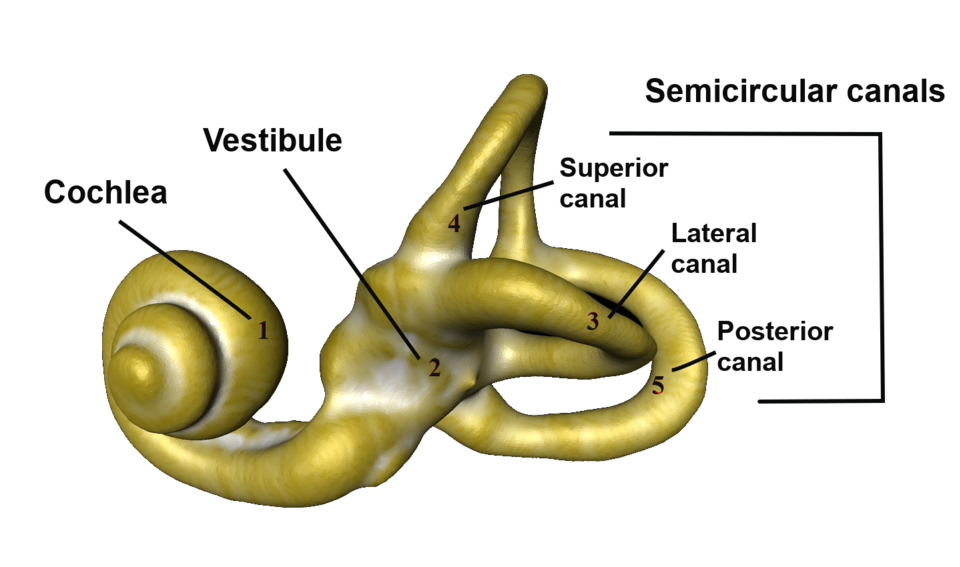
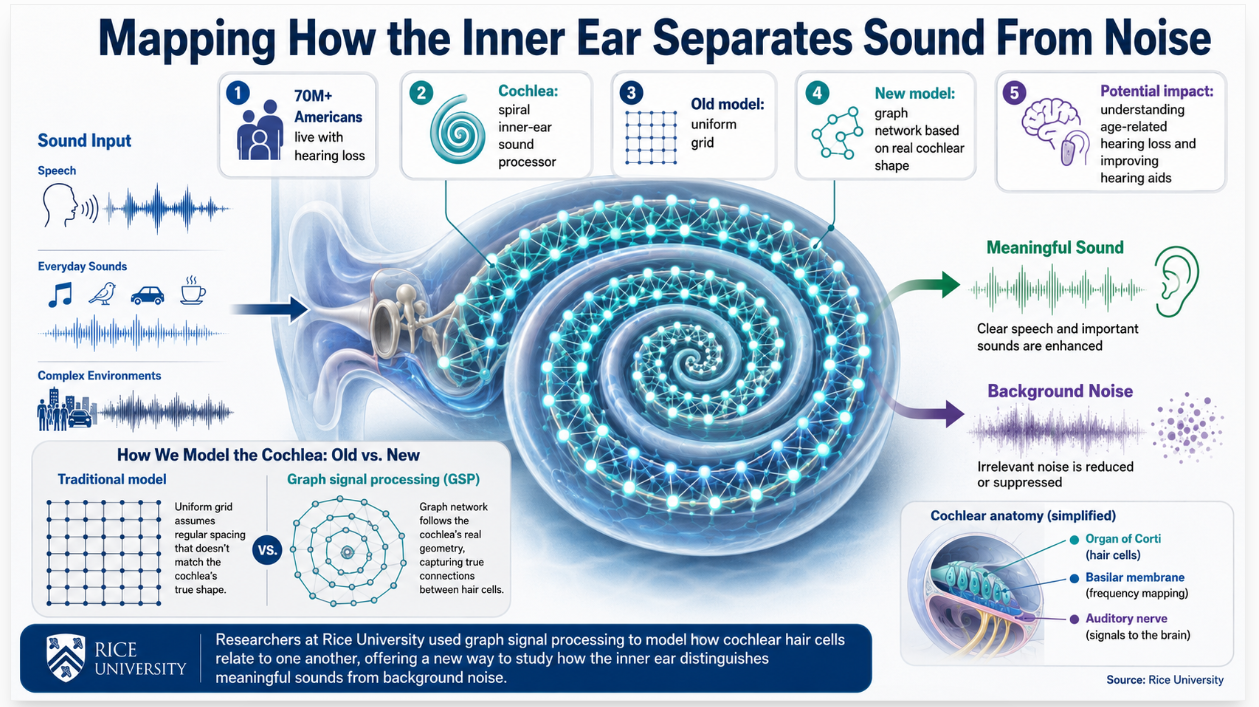
According to Phys.org, researchers at Rice University developed a new way to model how the cochlea processes sound. The cochlea is a spiral-shaped cavity in the inner ear lined with thousands of specialized sensory cells. The new approach relies on a mathematical framework called graph signal processing, or GSP.
Traditional methods treat the cochlea by mapping its responses onto a uniform grid, where each point tracks the response of an individual sensory cell. The Rice team replaced that grid with a structure built around the cochlea's natural spiral shape. In a graph, data points are called nodes and the connections between them are called links. The approach is already widely used in neuroscience to study the brain as a network.
"Classical signal processing is typically built for regular domains like lines and grids," said Santiago Segarra, W. M. Rice Trustee Associate Professor of Electrical and Computer Engineering at Rice and a study co-author. "Graph signal processing lets us move beyond that assumption and study data supported on irregular networks, which is often a better match for biological systems."
The idea grew out of a conversation between Segarra and Rice bioengineer Robert Raphael. As Segarra explained GSP theory during a brainstorming session, Raphael had an immediate reaction.
"My intuition was practically screaming at me, 'this is the way the cochlea works,'" said Raphael, an associate professor in Rice's Department of Bioengineering and a study co-author.
To build the model, Melia Bonomo, then a postdoc in the Raphael laboratory, simulated the responses of thousands of cochlear hair cells. Those responses were mapped onto a three-dimensional reconstruction of the human cochlea. The result was a network model that captures not just individual cell responses but the functional relationships between cells.
"Our framework provides a tool to study the overarching functional relationships between sensory cells, which is not possible using classical signal processing," said Bonomo, who is now a lecturer in the Department of Physics and Astronomy at Rice.
The research could help explain what happens as hearing breaks down with age. It could also open pathways toward better hearing aids and other assistive technologies. Hearing loss affects a broad portion of the population, and current tools are limited partly because the underlying mechanics of the cochlea remain poorly understood. The GSP-based model gives researchers a new lens to study how that system works and where it fails.