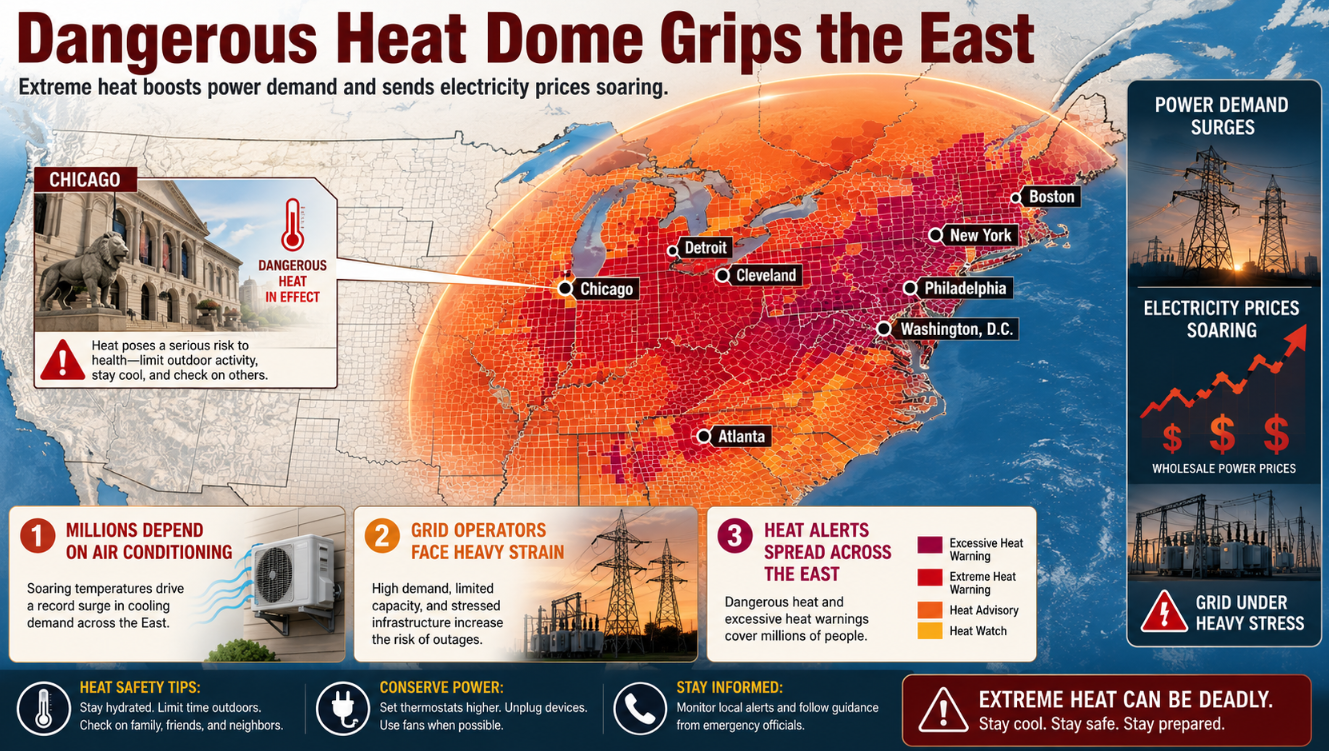
A dangerous heat dome has settled over the eastern United States, sending electricity prices soaring as millions of residents crank up air conditioning in what grid operators are describing as a significant stress test for the region's power infrastructure.
The Financial Times reported that the heat event is driving up wholesale electricity prices across the eastern grid. Heat domes trap hot air over a region for extended periods, forcing sustained high demand for cooling that can strain generation capacity and push spot prices sharply higher.
The human toll of the heat emergency is also drawing attention. David Axelrod, the chief strategist for Barack Obama's 2008 and 2012 presidential campaigns, shared a personal account on social media that illustrated conditions on the ground in Chicago. Axelrod described finding an elderly man sprawled unconscious on the front steps of the Art Institute of Chicago during what he called a heat emergency.
"An elderly man, probably homeless, was sprawled unconscious on the museum's front stone steps in the midst of a heat emergency. I called 911, and the operator said, 'Well, is he ASKING for help?' When I said no, she said, 'Well, I'm not going to send anyone.' So the man remained, passed out in the blazing noon sun. I guess that's how the City of Chicago deals with such situations," Axelrod wrote.
He followed that with a second post: "I hope we're not all complicit in assisting an unintended suicide."
Axelrod's account spread quickly online and drew responses from across the political spectrum. White House deputy press secretary Abigail Jackson wrote on X, "David Axelrod comes face to face with Democratic policies in action… turns out he doesn't like them very much." Conservative strategist Steve Guest asked, "Does David Axelrod own a mirror?"
Erielle Azerrad, deputy chief counsel for Texas Sen. Ted Cruz, said the situation was familiar to anyone who had spent time in San Francisco's Mission District. "It's awful to hear. It's also why most of us who have witnessed it are so vehemently opposed to socialist nonsense ruining our once awesome cities. Welcome to the party, dude," she wrote.
New York Post columnist Miranda Devine posted a pointed response directed at Axelrod: "Democrat policy which you dedicated your career to impose."
Not all the criticism came from the right. Susana Mendoza, a candidate for Chicago mayor, also responded to Axelrod's post. "This is awful and unacceptable. In a case like this or a freezing/blizzard spell, the city must mobilize to render necessary aid, even if its refused," Mendoza wrote. "Despite all the talk from this mayor and his administration about helping people like this in urgent need, they have abandoned them."
Axelrod added context in a later post, noting that a museum security guard told him she had already tried to help. "I asked a museum security guard about it and she said she had woken him 3 times and suggested he move into the shade and he refused each time," he wrote.
Chicago, led by Mayor Brandon Johnson, launched a five-year homelessness initiative earlier this year with the stated goal of making homelessness rare, brief, and nonrecurring. The plan is built around seven core strategies covering emergency services, housing, health, education, employment, community cohesion, and systems alignment. The initiative does not carry a stated budget of its own but works alongside city programs including a $1.2 billion housing initiative.
The heat emergency affecting Chicago and the broader eastern United States is expected to continue placing pressure on both power grids and public health systems. Wholesale electricity prices typically spike during extended heat events as utilities compete for available generation capacity, with those costs eventually working their way through to consumers and businesses on variable-rate plans.