

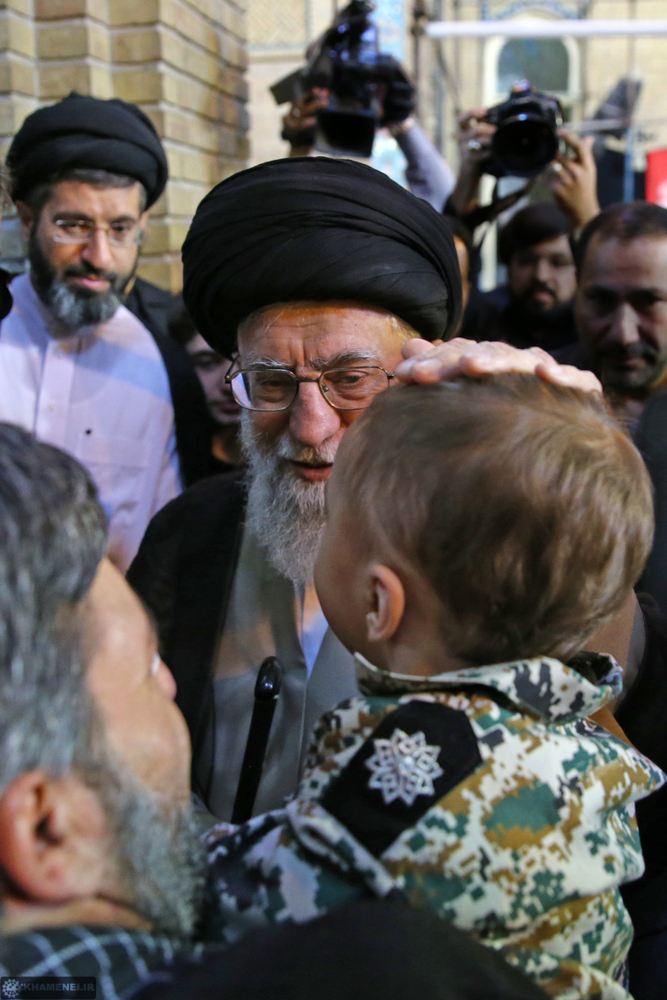
Ayatollah Ali Khamenei's body lay in state Friday in Tehran's Grand Mosalla, the vast prayer hall built to honor his predecessor, as Iran began a seven-day series of state funeral ceremonies. Delegations from more than 100 countries arrived to pay their respects following Khamenei's 37-year rule.
Khamenei, 86, was killed alongside several relatives on February 28, the first day of the joint U.S.-Israeli war on Iran, according to Al Jazeera. Those killed with him included his daughter, son-in-law, and three-year-old granddaughter. His son, Mojtaba Khamenei, formally succeeded him as supreme leader weeks after his death.
The burial had originally been scheduled for March, but the months-long conflict delayed the funeral rites until this week. His coffin was draped in a flag that previously flew over the Shrine of Imam Hussein in Karbala. The Iranian government described the red banner, which features white lettering, as a symbol of resistance, sacrifice, and devotion.
Al Jazeera's Mahmoud Abdelwahed, reporting from Tehran, said Friday was set aside for visiting dignitaries. "Today was allocated for special dignitaries, from around 100 countries who have been invited to attend this ceremony, including presidents of states, prime ministers, speakers of parliament, and other dignitaries," he said. Iranian President Masoud Pezeshkian paid his respects Friday, state media reported. Pakistani Prime Minister Shehbaz Sharif, Iraqi President Nizar Amidi, and Tajik President Emomali Rahmon were also expected to attend. European countries that supported the U.S.-Israeli military campaign against Iran were not invited, Abdelwahed noted.
Security across the capital was raised to maximum alert. The coffin of family members killed alongside Khamenei was also laid in state alongside his own.
Khamenei took power after the death of Ayatollah Ruhollah Khomeini in 1989, inheriting the revolutionary state Khomeini had built and transforming it over three decades into a regional power. According to ABC News, he supported armed proxy groups across the Middle East, pushed forward Iran's nuclear program, and used the paramilitary Revolutionary Guard as the central pillar of his rule. The Guard grew into a military and business force with reach across Iran's economic sectors.
Under his leadership, Iran built what became known as the Axis of Resistance, backing Lebanon's Hezbollah, Yemen's Houthi rebels, the Palestinian militant group Hamas, and Iranian-backed militias in Iraq. The Mideast wars that followed Hamas's October 7, 2023, attack on Israel ultimately weakened both Hamas and Hezbollah and, according to ABC News, set in motion the collapse of that network.
Khamenei issued a verbal religious ruling that nuclear weapons are un-Islamic, but vowed Iran would never surrender its right to develop what he called a peaceful nuclear energy program. Under a 2015 nuclear deal, Iran agreed to reduce its uranium stockpile in exchange for sanctions relief. After President Donald Trump withdrew the United States from that agreement in 2018, Iran accumulated a stockpile enriched to near weapons-grade levels.
The seven-day funeral proceedings are expected to draw continued international attention as Iran navigates a ceasefire and a leadership transition under the new supreme leader.