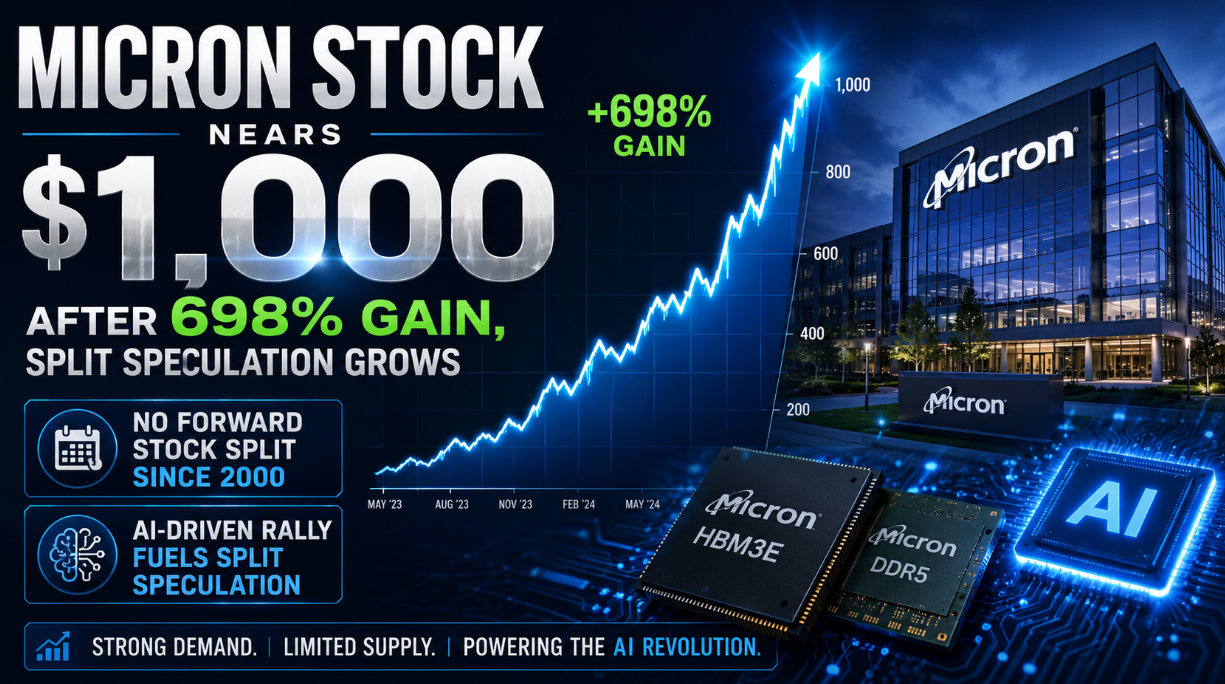
Micron Technology's stock has gained 698% over the past year, pushing its share price close to $1,000, and investors are now asking whether the chipmaker will announce a forward stock split. The question is straightforward: at nearly $1,000 per share, the stock is expensive in nominal terms for smaller investors, and the company has done this before.
According to a report by Yahoo Finance, Micron last executed a forward stock split in the year 2000. Before that, the company split its stock twice, once in 1994 and again in 1995. All three were forward splits, meaning the company increased its outstanding share count and reduced the price per share while keeping its total market capitalization unchanged.
A forward stock split does not change a company's fundamentals. It does not alter revenue, earnings, or the underlying business. The total value of a shareholder's position stays the same. What it does change is the price per share, which can make the stock more accessible to retail investors who are not using fractional share accounts or who find a lower price point psychologically more approachable.
The Nvidia comparison is relevant here. Nvidia announced a 10-for-1 forward split in June 2024 after an AI-fueled rally sent its stock price to $1,200. Since trading began on a split-adjusted basis just over two years ago, Nvidia stock has jumped 60%. That kind of post-split performance tends to focus attention on other high-price AI stocks in a similar position.
Micron sits squarely in the AI hardware story. The company makes memory chips, particularly high-bandwidth memory, which has become critical infrastructure for AI data centers and the large-scale computing workloads they require. The past year's rally reflects that demand, and the stock's valuation and growth rate have attracted significant institutional and retail attention.
The counterargument is straightforward. Many major brokerages now allow investors to purchase fractional shares, meaning a retail investor can buy a portion of a Micron share without needing to come up with $1,000. That reduces the practical barrier to entry and weakens one of the traditional arguments for splitting a high-priced stock.
Still, the report notes that a stock split could serve as a tailwind by increasing appeal among retail investors, particularly given that Micron trades at what the report describes as an attractive valuation while growing at a fast pace. Whether management views the split as worth doing is a separate question from whether the conditions for one exist. The conditions appear to exist.
Micron has not made any announcement regarding a split. The company has not commented publicly on the speculation. What is clear is that the stock's price, its recent performance, and its positioning in the AI supply chain have put the question directly in front of investors heading into the second half of 2026.