For years, scientists believed that the small human relatives who once lived on the Indonesian island of Flores had hunted and butchered pygmy elephants. A new study suggests the real hunters were the Komodo dragons, and the Hobbits just cleaned up what was left.
Homo floresiensis, the species informally known as Hobbits because of their small stature, lived on Flores until roughly 60,000 years ago. They shared the island with Komodo dragons, pygmy elephants, and giant rats. Fossil bones from pygmy elephants called Stegodon, found in the same cave layers as Hobbit remains, were covered in both stone tool cut marks and tooth marks, which originally led researchers to conclude the Hobbits were hunting the animals.
According to a report by Ars Technica, University of Tübingen anthropologist Elizabeth Veatch and her colleagues now argue that interpretation is wrong.
To test their hypothesis, the team fed a nearly whole goat carcass to a Komodo dragon at Zoo Atlanta. They then compared the resulting bone damage to the Stegodon bones recovered from Liang Bua, the cave site associated with Homo floresiensis.
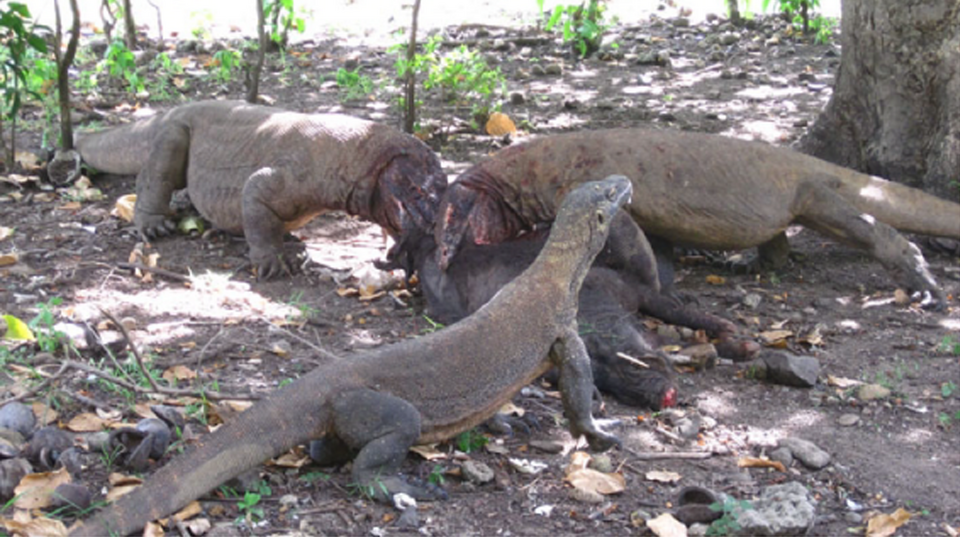
The comparison was telling. Komodo dragons have serrated teeth and a habit of gripping prey and shaking their heads side to side to strip flesh from bone. That behavior leaves marks that are typically shallower, shorter, and wider than the cut marks left by stone tools. The zoo dragon also went straight for the meatiest parts of the body, including the limbs, the fat-rich feet, and the ribs. Those are the same areas where archaeologists found tooth marks on the Stegodon bones at Liang Bua.
The findings suggest the Hobbits arrived after Komodo dragons had already brought down and begun eating the elephants, then used stone tools to work through whatever remained. If that interpretation holds, it would revise assumptions about the cognitive and physical capabilities of Homo floresiensis, and could affect broader conclusions about which hominin species first moved beyond Africa.
At least three species of Stegodon lived on Flores, ranging from 1.25 to nearly 2 meters tall and weighing anywhere from 500 kilograms to 1.5 tons. The study by Veatch and her colleagues adds a new layer to ongoing debates about what Homo floresiensis was actually capable of and how they survived on a remote island for hundreds of thousands of years.