Cleaning up air pollution in China can reduce rainfall in parts of India. That finding comes from researchers at the University of Reading, who used 10 climate models to map how pollution cuts in one country affect the monsoon in another.
The research was published this month in Environmental Research: Climate. It is part of a project called RAMIP, which involved thousands of computer runs carried out by climate science teams around the world.
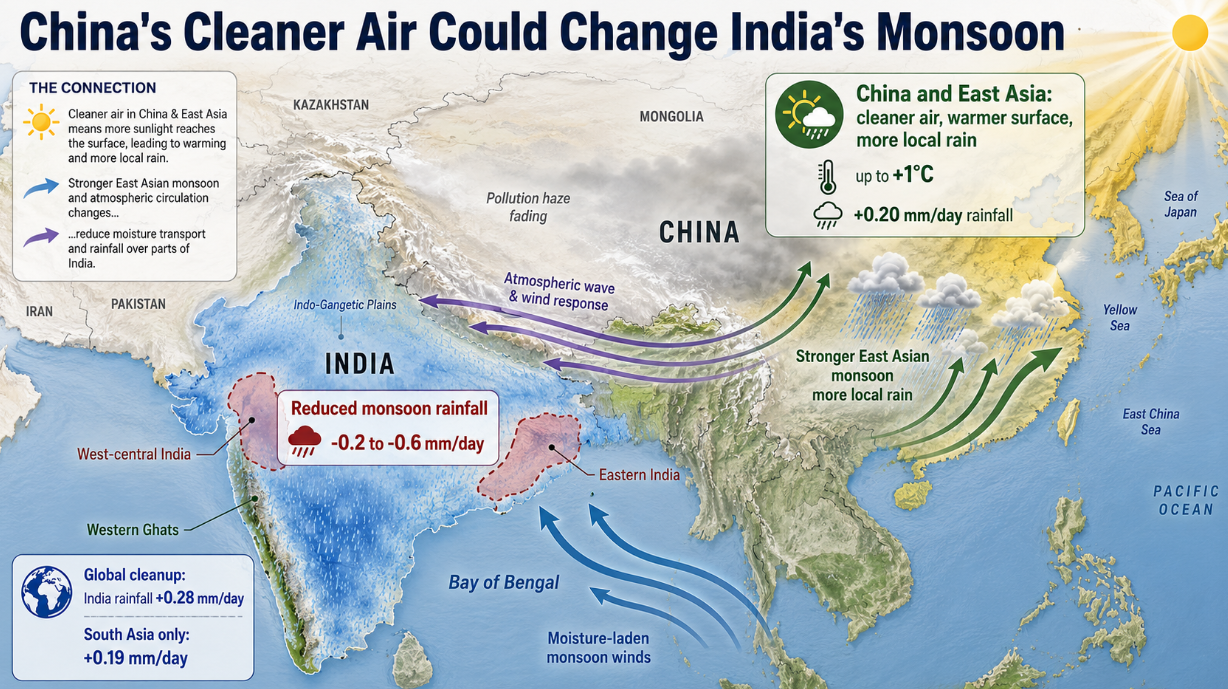
Air pollution blocks sunlight from reaching the Earth's surface. When a region cuts its pollution, more sunlight gets through, which warms the surface and strengthens monsoon circulation. That is good news for the region doing the cleaning. But the study found the effects can travel far.
According to Phys.org, when China and the rest of East Asia cut pollution, surface temperatures in that region rise by up to one degree Celsius, and daily rainfall increases by 0.20 millimeters during the summer monsoon season. For India, the same pollution cuts work in reverse. Wind patterns connecting the two regions across thousands of miles can reduce rainfall by 0.2 to 0.6 millimeters a day over parts of west-central and eastern India.
Ankit Bhandekar, the study's lead author, explained the stakes plainly. "Cleaning up pollution is good news almost everywhere it happens, but our findings show one country's clean-air plan can quietly cost another country's rain," he said. "Millions of farmers across India depend on monsoon rain that starts with decisions made thousands of miles away. If China and India coordinate their air quality plans, rather than acting in isolation, they have a better chance of avoiding these unintended trade-offs."
The numbers show why coordination matters. When pollution is cleaned up everywhere, all-India rainfall rises by 0.28 millimeters per day. When only South Asia cleans up, the increase is 0.19 millimeters per day. That is roughly 50% more rain under the global scenario. Increases are largest over the northern Bay of Bengal, the Western Ghats, and the Indo-Gangetic Plains, the stretch of land running from Pakistan through northern India to Bangladesh.
Researchers say the next step is understanding not just how much rain falls, but when it falls and how intense individual storms become. Those details will matter most for farmers and water planners trying to prepare for what comes next.