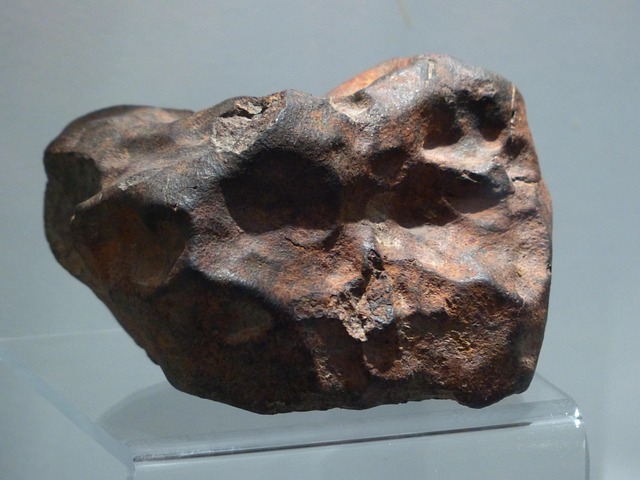
A rock that crashed through the roof of a New Jersey home two years ago has turned out to contain the chemical building blocks of life, according to a new study.
Scientists examining fragments of the meteorite found amino acids, carbon compounds and other prebiotic molecules inside. Those are the kinds of chemicals that may have helped start life on Earth. Researchers say the rock likely came from an ancient solar system body that never fully formed into a planet.
The meteorite fell on July 16, 2024, landing in a home in Hillsborough, N.J. The homeowner, who was not named in the study, moved quickly to preserve the fragments. He used disposable gloves and aluminum foil to place pieces into glass jars.
"I was at home at the time, heard a loud crash and found a hole in the ceiling of the master bedroom," the homeowner said in a statement from the SETI Institute. "I smelled a strong, sulfur-like odor and saw many black fragments, along with debris and black dust that covered my bed, carpet and surrounding areas."
Those steps made a real difference. Scientists said the fast preservation kept the fragments from being contaminated, which allowed them to study the rock's original chemistry. The study was led by Peter Jenniskens, a meteor astronomer with affiliations at the SETI Institute and NASA's Ames Research Center.
"A forensic study of the fragments revealed that they contained preserved bits from near the surface of a small primitive asteroid where it experienced concentrated salty fluids — a process not previously known from this type of protoplanet world," Jenniskens said in the statement.
The meteor had been widely seen before it hit. At least 60 observers across New York, New Jersey and other Northeastern states spotted it earlier that day. It was traveling at 32,000 mph. At least 16 people in New York and New Jersey reported feeling its shock wave. Newark Liberty International Airport briefly tracked falling pebbles with Doppler weather radar after the rock broke apart in midair.
As reported by Live Science, the study traced the meteor's origins using camera networks and a doorbell camera. The American Meteor Society used cameras in Northford, Connecticut, and Douglassville, Pennsylvania, along with the doorbell footage from Wayne, New Jersey. Mike Hankey, an operations manager at the society and a co-author of the study, said in the statement that the path traced back to low in the asteroid belt.
The rock broke apart at an altitude of about 22 miles. Fragments from only one meteorite, named Hillsborough after the town, were recovered. The study was published July 15 in the journal Science Advances.