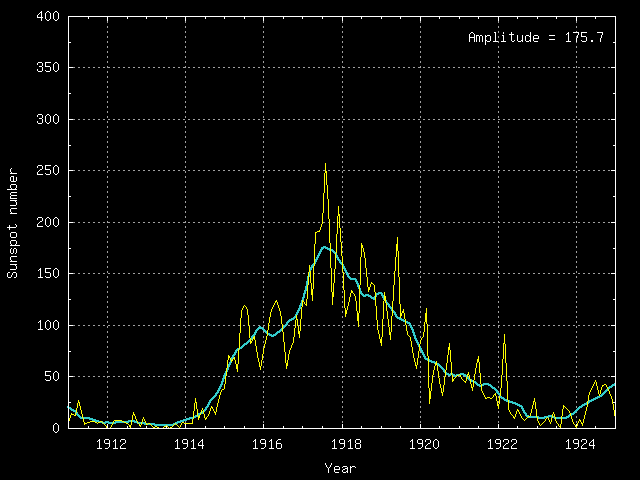
Scientists have found a way to forecast the strength of the sun's next activity cycle up to seven years before it peaks, earlier than any existing method allows. The approach focuses on a newly identified moment in each solar cycle when the most intense space weather abruptly stops.
The research was presented this week at the Royal Astronomical Society's National Astronomy Meeting in Birmingham, according to Phys.org.
The sun operates on an approximately 11-year cycle. During that time, its magnetic field reverses polarity and the number of sunspots rises and falls. Sunspots are regions of intense magnetic activity capable of producing solar flares and coronal mass ejections. Those events drive space weather that can disrupt satellites, communications systems, navigation, and power grids on Earth. Astronomers have tracked sunspots for centuries, but no two solar cycles are identical in length or intensity, which has made accurate forecasting difficult.
Sandra Chapman, professor of physics and director of the Centre for Fusion, Space and Astrophysics at the University of Warwick, led the team behind the new method. She described what they found as a sharp boundary rather than a gradual wind-down. "The sun doesn't gently go to sleep and then gently wake up again," Chapman said. "Instead, we've discovered that the most extreme space weather switches off quite suddenly at a specific point in every solar cycle. By identifying that point, we've found a new way to predict how active the next solar cycle is likely to be."
The new method builds on a tool Chapman previously developed called the "sunclock," which maps the sun's irregular cycles onto a standardized clock face. That work revealed that extreme space weather does not fade gradually but ends at a distinct moment. Her team then found that the number of sunspots present at that switch-off point is closely tied to the peak sunspot count in the following cycle.
That relationship gives researchers a forecasting window of roughly six to seven years before the next solar maximum, considerably longer than current methods that require waiting until the solar minimum before making predictions.
Using this approach, the team has already produced an early estimate for Solar Cycle 26. The prediction points to a moderate cycle, with a peak sunspot number of around 100 to 120. That would make it similar to or slightly weaker than the current Solar Cycle 25. The team cautions that the prediction will not be reliable for another two years, once Solar Cycle 25 reaches its own switch-off point and the forecast can be grounded in observed data rather than projections.
Chapman expects to refine the numbers at that point. A weaker or stronger cycle than currently projected remains possible until then.