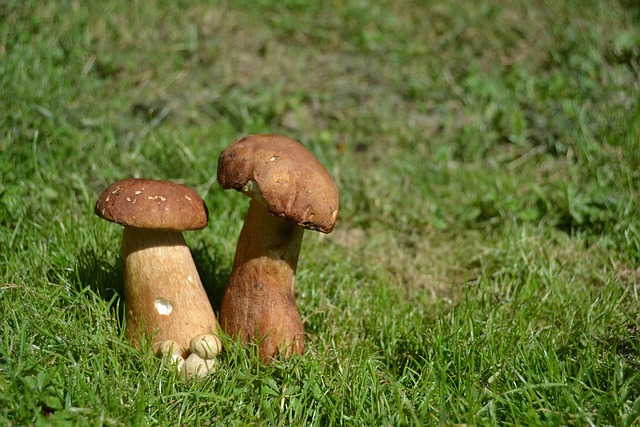
People in communities thousands of miles apart have reported the same strange experience after eating a wild mushroom: vivid visions of tiny humans moving through and interacting with the physical world. The hallucinations are known as Lilliputian hallucinations, named after the 6-inch-tall inhabitants of Gulliver's Travels. For decades, scientists debated whether the phenomenon was biological or simply a product of cultural suggestion.
A new study says it is biological. According to a report in the journal Mycologia, published June 5, 2026, University of Utah researchers used DNA sequencing to confirm that a single mushroom species, Lanmaoa asiatica, is responsible for these hallucinations in Southwest China and the northern Philippines.
The mystery stretches back nearly a century. In 1934, Western scientists first heard reports from Papua New Guinea of people hallucinating tiny humans after eating wild mushrooms. Researchers in the 1950s and 1960s narrowed the source to a few species in the Boletaceae family and conducted chemical analyses, but found nothing. Samples were even sent to Albert Hoffman, the scientist who first isolated psilocybin and discovered LSD. Even he could not find an active compound. Scientists eventually concluded the hallucinations might not be biologically caused at all, and research largely stopped in the 1960s.
Decades later, in the 1990s, reports surfaced from Yunnan in Southwest China describing a nearly identical phenomenon after people consumed bolete mushrooms. Mycologists suggested the species might be L. asiatica, which had recently been described. The link remained unconfirmed.
The final piece came in 2024. Colin Domnauer, a doctoral student at the University of Utah, heard accounts from an Indigenous community in the Philippines' remote Northern Cordillera region. Community members were consuming a wild mushroom called Sedesdem that, according to local knowledge, occasionally caused visions of little people. The same mushroom is known as Nonda in Papua New Guinea and Jian shou qing in Yunnan. It is a culturally important edible mushroom that, if undercooked, produces the hallucinations. That was a third independent case linking the same species to the same experience across separate cultures and continents.
Domnauer and Bryn Dentinger, a mycologist at the University of Utah and the Natural History Museum of Utah, coauthored the study. DNA sequencing confirmed across all three regions that the mushroom involved was L. asiatica.
The findings carry significant scientific weight beyond solving a decades-old mystery. The mushroom contains none of the psychoactive compounds currently known to science, including psilocybin. That means whatever is causing the hallucinations is something entirely new. Researchers say the discovery points to an unknown hallucinogenic compound that could offer fresh insight into neurological disease and how the brain shapes perception and consciousness.