

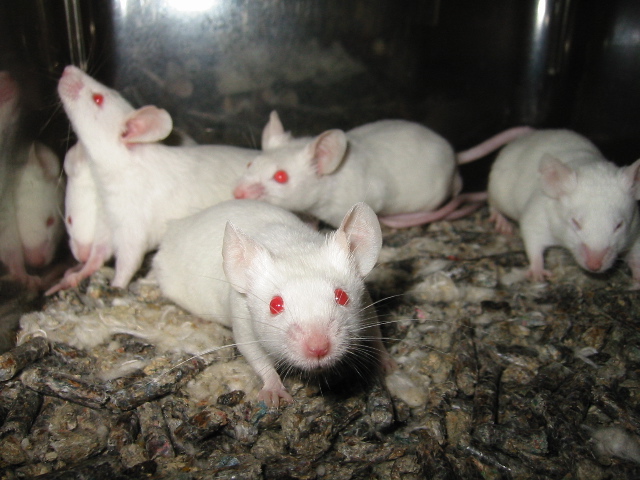
A study three decades in the making has found that being an elite athlete — at least for a mouse — does not shorten lifespan or reduce the number of offspring an animal can produce. The findings run counter to a central idea in evolutionary biology.
According to a report by Phys.org, researchers at the University of California, Riverside compared regular mice with what the team calls "high runner" mice, which were selectively bred to run extraordinary distances. These mice run on wheels up to three times as far as unaltered mice each day.
The research team, led by Theodore Garland, a distinguished professor of evolution, ecology and organismal biology, along with doctoral student Natalie Whitehead, tracked lifespans and the number of offspring produced by both groups over the course of the study. The project began in 1993, making it one of the world's longest-running animal selection experiments. The findings are detailed in a new Behavior Genetics paper.
The core idea being tested is known as the trade-off hypothesis. It holds that energy devoted to becoming stronger, faster, or more athletic is energy that cannot be spent on repairing the body, living longer, or producing and raising offspring. The team expected the data to confirm that idea.
It did not.
"We did expect to find a reproductive cost for this athletic behavior," Garland said. The average number of litters, however, did not differ between the high runners and the control lines of mice. "We also thought the runners wouldn't live as long, but they did," Garland said.
Throughout the experiment, pairs of mice lived under standard laboratory conditions with unlimited food and water. The high-runner mice did not have access to running wheels during the breeding portion of the study, but previous research has shown they remain substantially more active than control mice even without wheels. Researchers monitored each litter from birth through weaning and recorded the total number of offspring that survived over each pair's lifetime, along with the age at which the mothers and fathers died.
Garland cautioned that the results should not be applied directly to humans. Some studies suggest certain groups of elite athletes live longer than average, but people's exercise habits are shaped by genetics, culture, family influences, education, and environmental factors that are difficult to separate. Laboratory mice can be studied under carefully controlled conditions that remove many of those outside variables.
"These are mice. They aren't humans," Garland said. "In people, it would take decades to conduct a comparable study, and there are all kinds of environmental and cultural factors that can influence" the outcome.
The work was made possible through National Science Foundation funding. Garland noted that lifetime breeding studies like this one are rare because they require years of continuous monitoring and a major commitment of laboratory space and resources.