

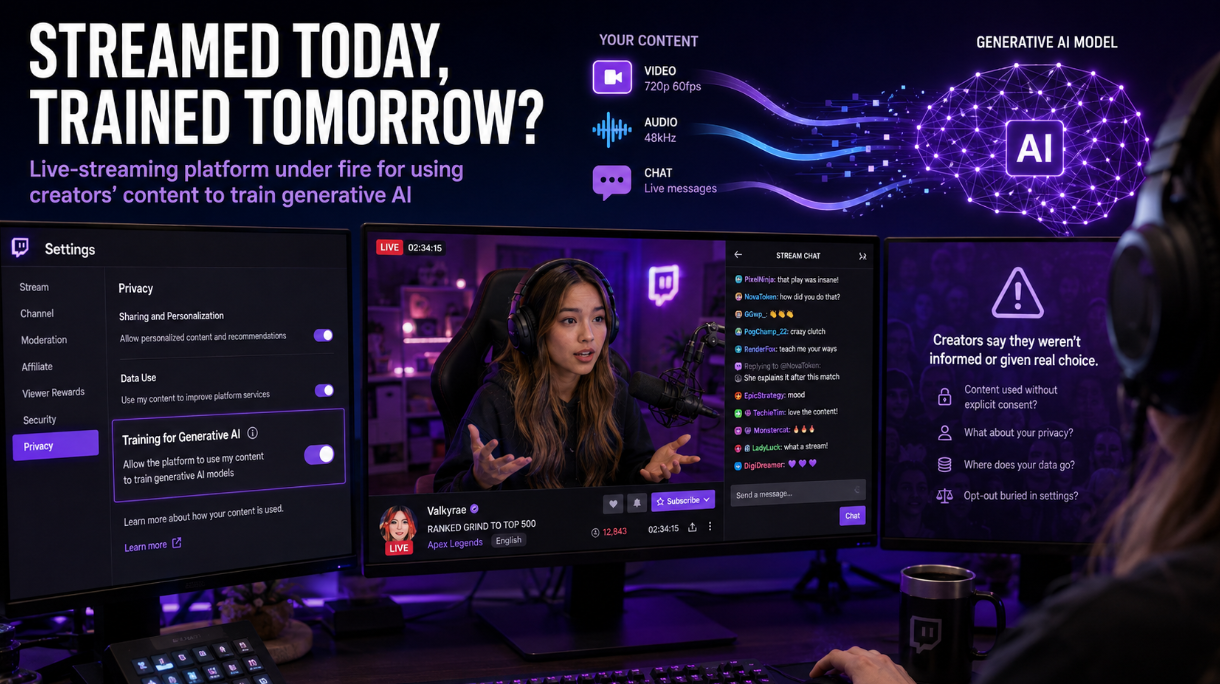
Twitch has started using streamers' content to train its generative AI models, and every user was enrolled automatically. The Amazon-owned platform made the change without giving creators the choice to opt in first, and the backlash was swift.
According to Engadget, within hours of the announcement, nearly 14,000 people had upvoted a comment on the company's support forum demanding the platform make the setting opt-in instead of opt-out. "We as creators should have the choice whether to use AI or not on our channels," the post read. Thousands of comments followed, many in stronger terms.
Users do have a way out. On the web, the setting can be turned off by clicking on the account avatar, going to Settings, then Security and Privacy, and scrolling down to Training for Generative AI. On mobile, the path is Profile, then Settings, then Security and Privacy. Twitch says users only need to opt out in one place.
What the opt-out covers is narrower than it might seem. Turning off the setting stops data from being used to train generative AI models, but it does not remove a user from all AI-related features on the platform. Twitch says it may still use data for tools like AutoMod and automatic captions. Data used for those features, the company says, is not kept for generative AI training.
Twitch Chief Product Officer Mike Minton addressed the controversy on a Patch Notes stream after the update went live. He explained that some AI features are simply built into how the platform runs. "A lot of our systems that make Twitch work now rely on some form of a — usually a specific targeted — AI model, that evaluates text and helps us understand what's going on across the service," he said. "For example, nearly every bit of audio is transcribed into text across the entire site. That then enables things like stream summaries to happen. It also helps us from an AutoMod and other perspective."
On the question of whether opting out would hurt a streamer's visibility, Minton was direct. "This setting doesn't... actually impact discoverability," he said, adding that it "has zero impact on your ability to be discovered on Twitch or anything like that."
He did not fully explain why the feature was set to opt-out rather than opt-in, though he acknowledged the company knew it would be unpopular.