

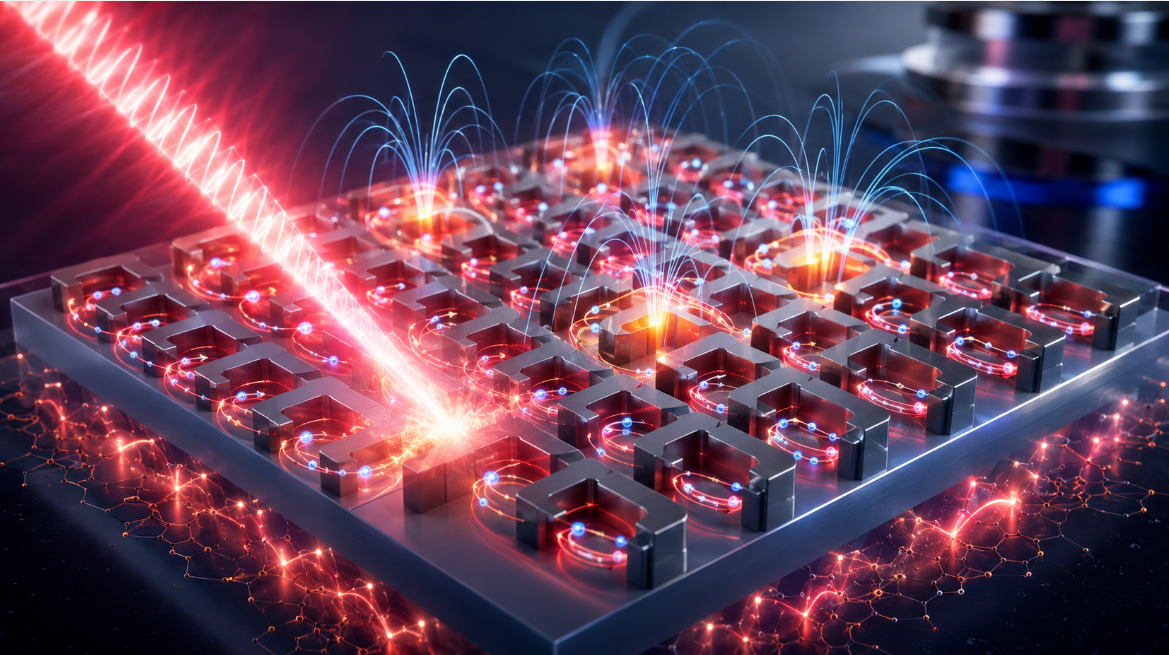
Cornell University researchers have found a way to produce magnetic fields at the nanoscale without relying on external magnets or conventional magnetic materials. Instead, the experimental method uses trapped light and a specially engineered surface to create a static magnetic field in extremely small regions.
The approach could eventually have implications for technologies that depend on controlling magnetism at very small scales, including spintronics, quantum computing, photonic computing, advanced sensors, and high-density data storage. Being able to create and manipulate localized magnetic fields with light could give researchers another way to control electrons and information inside future electronic and optical devices.
The research, published in Advanced Science and reported by Phys.org, was led by Ph.D. candidate Shivaksh Rawat and postdoctoral researcher Samyobrata Mukherjee. The researchers worked under Gennady Shvets, the J. Preston Levis Professor of Engineering at Cornell University's School of Applied and Engineering Physics.
The core of the technique involves a phenomenon researchers describe as a time interface.
Ordinarily, when light encounters a physical boundary between two materials, such as when it travels from air into water or from air into glass, its behavior changes. Some of the light can reflect from the boundary while the remainder continues through the second material. The amount of reflection and transmission depends partly on the optical properties of the two materials.
A time interface works according to a related principle, but instead of light encountering a boundary at a particular location, the properties of the material change suddenly while the light is already traveling through it.
For example, if the refractive index of a material changes extremely rapidly, the light inside that material must adjust to the new optical conditions. That sudden change can generate effects somewhat analogous to reflection and transmission at an ordinary physical interface.
In the Cornell experiment, however, the researchers demonstrated another important possibility. A carefully created time interface can effectively freeze part of the rapidly oscillating magnetic field associated with the trapped light. Instead of continuing to oscillate as part of an electromagnetic wave, some of that energy can be converted into a stationary magnetic field.
Creating such a field at the nanoscale is particularly important because controlling magnetism over very small distances remains a significant technological challenge. Conventional magnets can generate strong fields, but precisely concentrating those fields into regions only nanometers across can be considerably more difficult.
To create their time interface, the Cornell team constructed a two-dimensional metasurface consisting of a precisely engineered rectangular array of germanium nanostructures.
Metasurfaces are artificially structured materials designed to manipulate electromagnetic waves in ways that ordinary materials cannot easily achieve. By carefully choosing the shape, spacing, size, and composition of tiny structures across a surface, researchers can control how particular wavelengths of light behave when interacting with it.
In this experiment, the germanium nanostructures were designed to trap mid-infrared light inside the metasurface. Trapping the light temporarily concentrates electromagnetic energy within extremely small regions of the structure.
While that mid-infrared light remained trapped, the researchers struck the metasurface with a short and intense pulse of near-infrared light.
That second burst of light dramatically changed the electrical properties of the germanium. It excited electrons in the material, producing large numbers of free electrons along with corresponding electron holes. In semiconductor physics, a hole represents the absence of an electron and can behave much like a positively charged particle moving through a material.
The sudden appearance of these electron-hole pairs rapidly altered the refractive index of the germanium. Because the change happened while the original mid-infrared light was still trapped inside the metasurface, the process created the time interface needed for the experiment.
At that instant, the electromagnetic energy stored in the structure was forced to respond to the rapidly changing optical environment.
Some of the trapped light's energy was converted into new light waves with longer wavelengths. Another portion of the energy was transferred into the motion of free electrons inside the material.
Those electrons began circulating in microscopic current loops. Because electric currents generate magnetic fields, the circulating electrons produced localized areas of magnetism across the metasurface.
The result was the formation of concentrated magnetic "hot spots" without placing a permanent magnet near the material and without requiring the metasurface itself to be made from a traditionally magnetic substance.
That distinction is one of the potentially important aspects of the research.
"We used an approach known as localized free carrier generation, which has advantages over other methods of nanoscale magnetization," Rawat said. "One of the important contributions of our work is that our approach is material agnostic. Any nonmetallic surface will work."
If the method can be successfully adapted to other materials, researchers would not necessarily need to design future devices around conventional magnetic substances. Instead, they could potentially generate magnetic behavior only when and where it is needed by directing carefully controlled pulses of light onto a compatible surface.
Such control could be valuable for spintronics, a field that seeks to use the quantum mechanical property known as electron spin in addition to, or instead of, the movement of electrical charge used in conventional electronics. Many spintronic devices depend on manipulating extremely small magnetic environments.
The technique could also have applications in quantum technologies. Quantum systems frequently require precise control over particles and electromagnetic fields, and localized magnetic fields could potentially provide another mechanism for manipulating quantum states.
Data storage is another possible application. Traditional magnetic storage technologies encode information by changing the magnetic orientation of extremely small areas. As engineers attempt to store greater amounts of information in increasingly compact devices, the ability to produce highly localized magnetic fields becomes increasingly valuable.
Photonic computing could also benefit from techniques that allow interactions between light, electrical currents, and magnetic fields to be controlled on the same microscopic platform. Photonic technologies attempt to use light to transmit or process information, potentially allowing some operations to occur faster or with lower energy consumption than conventional electronic systems.
The Cornell researchers are not suggesting that the experimental metasurface will immediately replace conventional magnets. Significant engineering work would be required before the technique could be incorporated into practical computers, storage systems, or commercial electronic devices.
There are also physical limitations.
In an ideal system with no energy losses, the induced magnetic field could theoretically persist indefinitely. Real materials, however, lose energy through resistance, scattering, heat, and other processes. Because of those losses, the circulating electrical currents eventually weaken, causing the magnetic field to decay.
Even with that limitation, the researchers say the technique represents an important step toward controlling nanoscale magnetism using light.
The ability to create a magnetic field optically also introduces the possibility of extremely rapid control. Light pulses can be delivered on extraordinarily short timescales, potentially allowing magnetic states to be switched or manipulated much faster than with some traditional electromagnetic systems.
The experiment also demonstrates the unusual possibilities created by manipulating electromagnetic waves in time rather than simply controlling how they move through physical space. Metasurfaces have already given scientists increasingly sophisticated ways to bend, focus, trap, and redirect light. Time interfaces add another dimension by allowing researchers to alter the environment experienced by light while the light is already confined inside a structure.
Perhaps one of the most significant aspects of the Cornell work is that the principle is not fundamentally tied to germanium.
Germanium provided a useful platform for demonstrating the effect, but the researchers say the localized free-carrier approach could work with other nonmetallic materials. That could allow scientists to eventually tailor the technique to different wavelengths, device architectures, and technological applications.
Future research will likely focus on improving the strength, duration, efficiency, and controllability of the generated magnetic fields, as well as determining how easily the process can be integrated with existing semiconductor and photonic technologies.
For now, the study demonstrates an unusual connection between light and magnetism: carefully trapped light, combined with a rapidly changing material, can leave behind a localized magnetic field even after the optical conditions that created it have changed.
That ability could provide researchers with a new tool for manipulating magnetism in places where conventional magnets are difficult or impractical to use, opening another potential route toward smaller and more precisely controlled electronic, photonic, and quantum devices.