

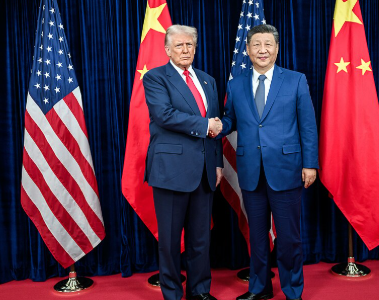
President Donald Trump and Chinese leader Xi Jinping held discussions during a recent meeting that touched on artificial intelligence safety and ongoing trade relations. Both countries agreed to continue working together through new and existing channels focused on selected bilateral issues. Xi returned to Beijing on Saturday after his visit, according to the state-run Xinhua News Agency.
The two sides also committed to signing a memorandum of understanding aimed at improving military crisis communication between their nations, according to CBS News. This agreement was announced by China’s Foreign Ministry on Saturday as part of the broader discussions that took place during the summit, according to a report from CBS News. The White House reported that both Trump and Xi agreed to use the term “super intelligence” instead of “artificial intelligence” when referring to the technology.
Trump has previously expressed a preference for this alternative term, saying it is more accurate than the traditional label. He told reporters on the White House's south lawn that calling it AI makes it sound fake or artificial. Trump emphasized that the United States is not planning to slow down its development of super intelligence technologies.
He added that he would rather not integrate with China in this area because the U.S. is currently leading by a significant margin. According to Trump, the U.S. is ahead by at least a year, possibly even a year and a half or more.
The United States and China also agreed to reduce tariffs on $30 billion of non-sensitive goods in each direction. The products include U.S. agricultural goods, wood and cosmetics as well as Chinese-made small appliances, toys and decorations.
The trade truce was extended by two months as both governments expressed a desire to continue negotiations on a broader agreement. The extension pushes the expiration of the truce to January 10.
The two countries also agreed to establish a communication channel for AI-related incidents. They plan to discuss the risks and benefits of the technology with another round of AI talks scheduled for November.
Both countries also addressed global concerns, including Iran's commitment not to develop nuclear weapons. The U.S. statement welcomed China's decision to impose export controls on two additional chemicals used in fentanyl production.
Both sides also noted recent arrests related to fentanyl-related cases in their respective countries. Experts say that while personal diplomacy between the two leaders is important, the focus on working-level engagement and military dialogue suggests efforts to build more stable and institutionalized cooperation. Wang Zichen, deputy secretary-general of the Beijing-based Center for China and Globalization, made this observation about the nature of the discussions.
The meeting took place in a context where both nations are navigating complex relationships involving technology, trade and global security.