

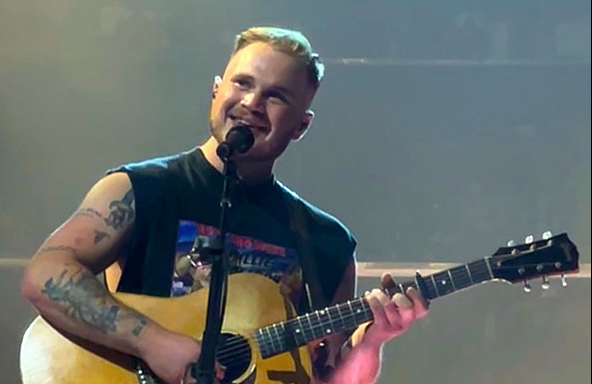
Country singer Zach Bryan wore a black “Free Palestine” shirt during his concert at Gillette Stadium in Massachusetts on Friday night, drawing attention just weeks after the venue became part of a controversy involving rapper Macklemore.
Bryan performed the first of two scheduled shows at the Foxborough stadium as part of his With Heaven On Tour.
Photos and videos from the concert showed Bryan wearing a black shirt with the words “Free Palestine” across the front.
The shirt also featured a pine tree and the phrase “An Appeal to Heaven,” a slogan connected to a flag used during the American Revolutionary War.
Bryan did not appear to make a speech about the shirt or explain its message from the stage.
However, several members of his band also wore clothing expressing support for Palestinians.
Guitarist Noah Le Gros was seen wearing a green Palestine soccer jersey.
Drummer Nate Head wore a jersey referring to Hind Rajab, a 5-year-old Palestinian girl who was killed in Gaza in January 2024 along with members of her family.
The clothing quickly attracted attention on social media because Gillette Stadium is owned by the Kraft Group.
Robert Kraft, who also owns the New England Patriots, recently became involved in a dispute involving Macklemore and Ed Sheeran’s Loop Tour.
Macklemore had been scheduled to appear as a supporting performer during several of Sheeran’s U.S. concerts.
During a September performance at MetLife Stadium in New Jersey, Macklemore made several statements supporting Palestinians and criticizing Israel’s military actions in Gaza.
He also performed “Hind’s Hall,” a protest song he released in support of Palestinians.
The performance drew criticism from several Jewish organizations and others who accused the rapper of using rhetoric they considered antisemitic.
Macklemore has rejected accusations that supporting Palestinians or criticizing the Israeli government is antisemitic.
Kraft later announced that Macklemore would not be allowed to perform at Gillette Stadium during Sheeran’s scheduled concerts there.
Kraft said the decision was based on Macklemore’s recent performances, material shown during his concerts and what Kraft described as a broader history of rhetoric and imagery that had hurt members of the Jewish community.
He said Gillette Stadium should remain a welcoming place and should not provide a platform for what he considered hate speech.
Macklemore responded by saying Kraft had contacted Sheeran and had encouraged other stadium owners to oppose his continued participation in the tour.
The tour’s promoter, Messina Touring Group, eventually removed Macklemore from the remaining U.S. dates.
Sheeran later said the decision to remove Macklemore was made by the promoter and venues rather than by him personally.
The British singer said he had spoken with Kraft and Macklemore while trying to resolve the disagreement.
The controversy grew when several other supporting performers withdrew from Sheeran’s tour.
Macklemore later announced that he would organize his own series of concerts called the Free Palestine Tour.
The first three concerts, scheduled for Dublin, Paris and London, sold out shortly after tickets went on sale.
Macklemore said proceeds from the concerts would support organizations providing assistance to Palestinians.
The disagreement also led to substantial donations for humanitarian assistance.
Macklemore said he would donate $1 million from his earnings connected to Sheeran’s tour to organizations supporting Palestinians.
Sheeran committed $2 million to humanitarian assistance.
Kraft subsequently said he would also provide $2 million after Sheeran asked him to match his contribution.
Against that background, Bryan’s decision to wear a “Free Palestine” shirt at Gillette Stadium attracted immediate attention.
Unlike Macklemore, Bryan did not give an extended political speech during the performance.
Instead, the message was communicated through his clothing and the clothing worn by members of his band.
Bryan has previously addressed controversial political issues through his music.
In 2025, he released a preview of the song “Bad News,” which included references to immigration enforcement and federal raids.
The preview generated criticism from some government officials and political commentators.
Bryan later said the song was intended to describe divisions in the United States rather than serve as an attack on one political group.
The singer is also a U.S. Navy veteran and has frequently written songs dealing with American life, military service, family and social issues.
His Friday appearance came near the end of his current tour.
Bryan is scheduled to perform a second concert at Gillette Stadium on Saturday before finishing the tour at Jordan-Hare Stadium in Auburn, Alabama, on October 10.
As of Saturday afternoon, Kraft had not publicly responded to Bryan wearing the “Free Palestine” shirt.
There was also no indication that Bryan’s second Gillette Stadium concert would be affected.
The episode adds another prominent musician to the growing number of performers who have publicly addressed the war in Gaza and the situation facing Palestinians.
It also places Gillette Stadium back at the center of a broader debate over political expression by musicians, the authority of venue owners and promoters, and where venues draw the line between political speech and messages they consider offensive or discriminatory.