

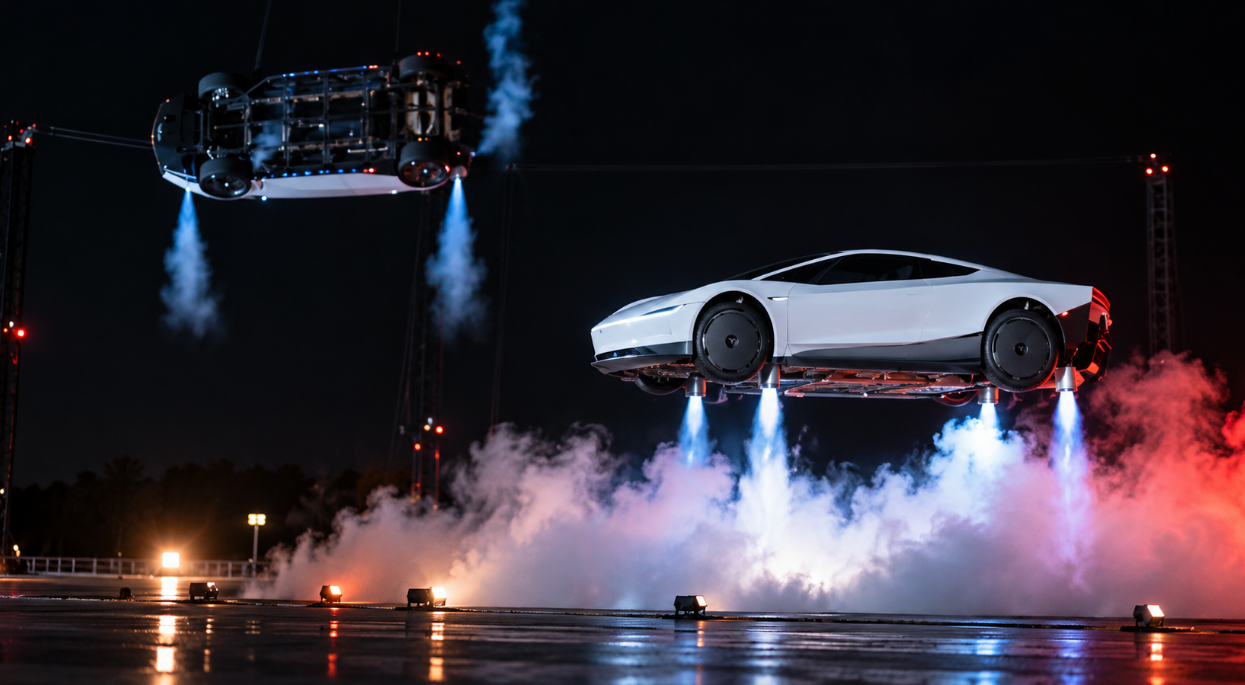
Tesla CEO Elon Musk unveiled a redesigned, rocket-powered Roadster on Thursday, October 15, 2026, demonstrating an electric sports car capable of briefly leaving the ground, rotating in midair and landing using compressed-gas thrusters. The presentation took place at SpaceX's rocket-testing facility in McGregor, Texas, nearly nine years after Tesla first introduced plans for the second-generation Roadster.
The prototype completed several unusual driving demonstrations, including traveling upside down along a curved structure and jumping over other Tesla vehicles. Musk said production is planned for 2028, although the company has repeatedly delayed the Roadster since initially promising deliveries in 2020.
Tesla presented three versions of the vehicle, including an extreme Rocket model designed for limited airborne maneuvers. That version is not approved for public roads and will be available only by invitation.
The announcement represents one of Tesla's most ambitious efforts to combine conventional electric vehicle engineering with technology developed through Musk's aerospace company.
Roadster Demonstration Includes Midair Stunts
The presentation featured a specially equipped Roadster performing maneuvers not possible with ordinary production automobiles.
During one demonstration, the vehicle accelerated toward a lineup of Tesla vehicles before using its propulsion system to rise approximately 27 feet into the air. It then descended under controlled thrust.
Another demonstration involved a curved structure that allowed the Roadster to travel upside down before leaving the surface and rotating through the air. Its thrusters helped control the maneuver and return the vehicle to the ground.
The displays showed the capabilities of a specialized prototype rather than a production vehicle ready for customers.
According to Reuters, Tesla engineers worked with SpaceX technology to develop the system that makes the airborne movements possible. The demonstrations also showed the vehicle using powerful suction to maintain contact with a surface while inverted.
Unlike aircraft designed for sustained flight, the Roadster's airborne capability is intended for brief bursts of movement. Tesla has not established that the car can function as a conventional flying vehicle for transportation between destinations.
The event was livestreamed, allowing viewers to watch the demonstrations as Tesla introduced the redesigned sports car.
How the Roadster's Rocket Thrusters Work
The Roadster uses cold-gas thrusters to generate forces beyond those produced by its electric motors and tires.
Instead of burning rocket fuel, the system releases compressed gas through specially positioned nozzles. The escaping gas produces thrust that can accelerate the vehicle or change its direction.
Tesla engineering executive Lars Moravy said the prototype includes 10 thrusters connected to approximately 600 liters of compressed air storage.
The nozzles are arranged to generate forces in different directions, allowing the system to assist with acceleration and control the car during brief airborne maneuvers.
The technology draws on principles used in spacecraft maneuvering systems, although the Roadster employs compressed gas rather than the larger propulsion engines associated with rocket launches.
Another important feature is the vehicle's multi-mode suction system.
Large fans create reduced pressure beneath the car, producing downforce that helps hold it against the road surface. The system is designed to increase traction and maintain stability during extreme maneuvers.
Tesla demonstrated this technology by operating the Roadster along an inverted surface.
The suction system and thrusters perform different functions. One improves the car's contact with a surface, while the other generates additional forces that can propel it beyond the limits of tire traction.
These systems also introduce engineering complications involving compressed-air storage, noise, energy consumption and passenger safety.
Tesla Claims Acceleration Under One Second
Perhaps the most striking performance claim concerns acceleration.
Tesla demonstrated a Roadster accelerating from 0 to 60 mph in approximately 0.81 seconds, a figure far beyond the performance of most commercially available automobiles.
The company attributes the extraordinary acceleration partly to its cold-gas thrusters.
Conventional sports cars rely on their tires to transfer engine or motor power to the road. Even extremely powerful electric vehicles face limitations because tires can provide only so much grip.
Thrusters create additional forward force without relying entirely on tire traction, potentially allowing the Roadster to accelerate much faster.
Tesla claims the new vehicle can reach speeds exceeding 230 mph, although Musk discussed the possibility of considerably higher speeds during the presentation.
He also suggested that future performance could approach half the speed of sound under certain conditions.
Such figures remain company claims and development targets rather than independently certified production specifications.
Tesla has not released complete technical documentation allowing outside engineers to verify the acceleration figures, operating limits or practical performance of customer vehicles.
The company indicated that the Roadster will offer approximately 300 miles of driving range, significantly below the 620-mile range originally discussed when the second-generation car was introduced in 2017.
Three Versions Planned for Buyers
Tesla outlined three versions of the redesigned Roadster, each intended for a different level of performance.
The Performance version is designed for conventional road use. It seats two people and includes active aerodynamic systems and the multi-mode suction system but does not feature rocket thrusters.
The Thrust model is intended for racing and high-performance driving. It also seats two people and adds rear-mounted cold-gas thrusters capable of delivering extreme acceleration.
The Rocket version takes the technology further, using 10 thrusters for airborne maneuvers and other specialized demonstrations.
That version seats only one person because the propulsion equipment occupies space otherwise available for passengers.
Tesla describes the Rocket model as suitable for airborne operation, but it is not approved for driving on public roads.
The company is accepting reservations for the Performance and Thrust versions.
Customers seeking a Performance model must provide a $50,000 reservation deposit. The Thrust version requires a substantially larger $250,000 deposit.
These amounts are reservation payments, not confirmed final purchase prices.
The Rocket version will be offered by invitation only. Tesla has not announced a public price or conventional ordering process for that model.
Flying Roadster Faces Major Legal Challenges
The Roadster's airborne capabilities raise questions about how the vehicle could legally operate outside controlled demonstrations.
Cars designed for public highways must meet motor vehicle safety requirements, while machines capable of flight may face additional aviation regulations.
The Rocket version has not received approval for public-road operation.
Aviation regulators would also need to determine which requirements apply if the vehicle were operated in a manner that qualifies as aircraft flight.
The Federal Aviation Administration oversees aircraft safety and operations in the United States. However, the exact regulatory treatment of a thruster-equipped automobile would depend on its design and intended use.
Musk acknowledged that the Roadster could face legal restrictions and would not necessarily be permitted everywhere.
He also described the vehicle as not primarily optimized for safety, emphasizing that the project is intended to demonstrate extreme performance.
The demonstration vehicles were operated without occupants during the most demanding maneuvers.
That precaution avoided exposing a driver to the powerful forces and unusual movements involved in the presentation.
Before commercial operation, Tesla would need to address questions involving occupant protection, braking, reliability and safe operation around other vehicles and pedestrians.
Production Delayed Until 2028
The Roadster's long development history remains a central issue.
Tesla first introduced the second-generation Roadster in November 2017, promising an extraordinary electric sports car with acceleration approaching 1.9 seconds from 0 to 60 mph.
At the time, Musk said production could begin in 2020.
That deadline passed without customer deliveries. Additional projected dates also came and went as Tesla focused on other vehicles, manufacturing expansion and autonomous driving technology.
The October 2026 demonstration represents a major redesign of the original concept rather than the introduction of a commercially available vehicle.
Musk now says production will begin in 2028.
No firm delivery schedule has been announced, and Tesla has not disclosed final pricing for the production models.
The company continues to accept reservation deposits despite the uncertainty surrounding when customers will receive their vehicles.
Tesla also appears to view the Roadster differently from its mass-market electric cars.
Musk has acknowledged that the project is unlikely to make a major financial contribution. Instead, it serves as a showcase for engineering and a demonstration of what the company believes electric vehicle technology can achieve.
The Roadster arrives as Tesla places increasing emphasis on autonomous driving, robotaxis and robotics.
Musk has suggested that the new sports car could be among Tesla's last vehicles designed primarily around human driving.
That positioning makes the Roadster unusual within the company's broader strategy.
Questions Remain After the Spectacular Reveal
The Texas presentation demonstrated that Tesla has built a prototype capable of performing limited airborne maneuvers using compressed-gas thrusters.
It did not establish that ordinary customers will soon be able to purchase a flying car suitable for everyday transportation.
Important questions remain about manufacturing costs, safety approval, passenger protection, range and the practical use of the propulsion system.
The differences between the three versions will also matter. Buyers reserving the road-ready Performance model will not receive the same airborne capabilities demonstrated by the Rocket prototype.
Tesla's next major challenge is converting the demonstration technology into vehicles that can be produced consistently and operated within applicable safety rules.
With production targeted for 2028, customers who placed early reservations could face a wait exceeding a decade from the Roadster's original 2017 announcement.
For now, Tesla has demonstrated a striking combination of electric vehicle performance and aerospace technology. The 2028 production target will determine when, and in what form, that technology becomes available beyond the company's test facility.