

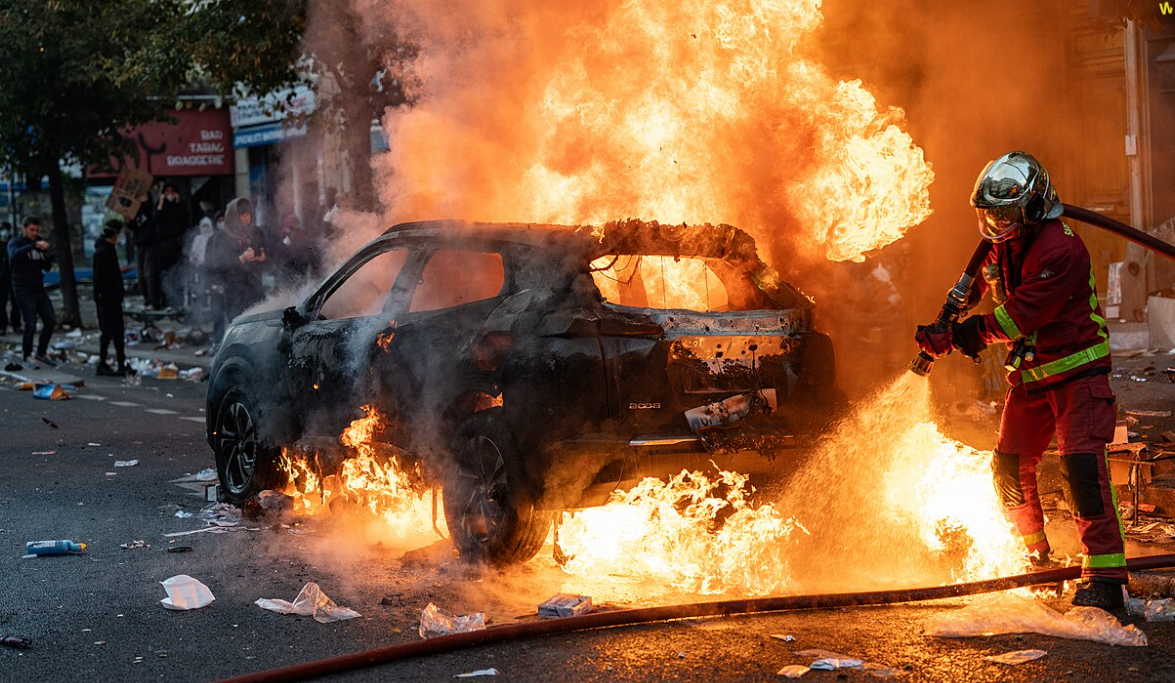
France is facing one of its most serious episodes of civil unrest in years after nationwide demonstrations over rising living costs, inequality and deteriorating public services erupted into violence on Saturday, October 17, 2026. Hundreds of thousands of people participated in protests across the country, with clashes, looting and fires reported in Paris and several other major cities.
By Sunday, authorities reported more than 2,400 arrests and approximately 1,000 injured police officers and other emergency personnel. The unrest left businesses damaged, vehicles burned and public buildings attacked, including a historic town hall in Limoges that was destroyed by fire.
President Emmanuel Macron addressed the violence on October 18, condemning those responsible for destruction while acknowledging the grievances of peaceful demonstrators. The government faces mounting pressure to address economic hardship and explain how it intends to prevent further disorder.
The demonstrations brought together high school students, university groups, trade unions and participants associated with France's Yellow Vest movement. Their demands extended beyond education to include wages, pensions, fuel prices and the condition of public services.
Student Protests Develop Into a National Movement
The current demonstrations grew from protests that began in September, when students in disadvantaged suburbs north of Paris complained about deteriorating conditions in their schools. Their concerns included teacher shortages, overcrowded classrooms and inadequate educational facilities.
Students organized school blockades and demonstrations to demand additional government funding. As the protests continued, their complaints attracted support from workers and other groups concerned about government spending priorities.
The movement expanded rapidly through social media, where organizers encouraged people across France to participate in a coordinated day of demonstrations on October 17.
Labor unions joined the mobilization, arguing that declining purchasing power and pressure on public services affected workers throughout the country. The CGT, one of France's largest unions, called for higher wages, improved pensions and measures to reduce everyday expenses.
Participants associated with the Yellow Vest movement also returned to the streets. That movement emerged in 2018 over fuel taxes and developed into a broader campaign against economic inequality and government policies.
The renewed participation of Yellow Vest activists helped connect student demands with longstanding complaints about the financial pressures facing working families.
Organizers hoped to demonstrate that concerns about education, employment and affordability were connected rather than separate problems.
Hundreds of Thousands March Across France
Saturday's demonstrations took place in approximately 110 organized marches across France, according to government figures. Estimates of total participation ranged from about 550,000 to 800,000, depending on the source.
The size of the mobilization made it one of the country's largest protest movements in recent years.
In Paris, approximately 110,000 people participated in demonstrations centered on Place de la République and surrounding streets. Separate marches organized by student groups and labor activists converged as crowds gathered during the afternoon.
Many protesters carried signs demanding better public services, improved wages and government action on living costs. Others criticized President Macron's administration and its approach to economic policy.
The main marches included substantial numbers of peaceful demonstrators. Families, students, workers and retirees joined rallies to express frustration with conditions they said had become increasingly difficult.
However, the atmosphere changed as smaller groups clashed with police near major gathering points.
Masked individuals threw objects at officers and damaged businesses, prompting police to deploy tear gas and water cannons. Fires broke out in several streets as security forces attempted to disperse violent groups.
The disorder spread beyond the main protest routes, complicating efforts to maintain security while allowing peaceful demonstrations to continue.
Looting and Fires Spread Beyond Paris
Violence was reported in several major French cities, including Marseille, Lyon, Bordeaux, Lille and Toulouse.
In Marseille, looters targeted shops, and a group of people entered city hall before police forced them to leave. Mayor Benoît Payan condemned the destruction, saying it distracted attention from the legitimate demands of students and other demonstrators.
Limoges experienced one of the most serious incidents when its historic town hall caught fire. Images showed flames engulfing the building as emergency crews attempted to contain the blaze.
The destruction drew particular attention because the building served as an important municipal landmark. Authorities began investigating the circumstances surrounding the fire and the damage caused during the unrest.
In Lyon, groups damaged commercial premises and public property. Similar incidents were reported in Bordeaux and other cities as police responded to scattered outbreaks of violence.
Paris also suffered extensive damage to shops, vehicles and street furniture. Businesses were looted, windows were smashed and several vehicles were set ablaze.
Residents returning to central Paris on Sunday found damaged storefronts and debris left behind by the disturbances.
Retailers began assessing their losses while municipal workers started clearing streets and removing damaged equipment.
The economic consequences extended beyond individual businesses, with some retailers closing locations because of security concerns.
Macron Condemns Violence and Promises Assistance
Macron addressed the country on Sunday as authorities assessed the damage and began restoring public order.
The president distinguished between people exercising their right to protest and those responsible for looting or attacking public property. He said legitimate public concerns should be heard but insisted that violence could not be accepted as part of political demonstrations.
Macron announced plans for a government crisis response to assist communities and businesses affected by the unrest.
The administration also indicated that local authorities would receive additional powers to restrict demonstrations where serious security threats existed. However, Macron did not immediately declare a nationwide state of emergency.
Prime Minister Sébastien Lecornu and Interior Minister Laurent Nuñez blamed much of the violence on radical groups and individuals seeking opportunities to loot.
Those accusations remain government assessments rather than findings establishing responsibility for every violent incident. Investigations into individual offenses are continuing.
Opposition leaders criticized the government's response from different directions.
Jean-Luc Mélenchon, a leading figure on the French left, supported the social demands behind the demonstrations while criticizing the authorities' handling of public order.
Figures associated with the National Rally argued that the government had failed to protect businesses and communities. They also called for stronger measures against those responsible for the destruction.
The political disagreement reflects broader tensions ahead of France's 2027 presidential election, when Macron's second term is scheduled to end.
Police Tactics Face Growing Scrutiny
Police actions during the demonstrations have also drawn criticism following reports of injuries among protesters.
Security forces used tear gas and other crowd-control equipment in several cities. Some participants said officers intervened before violence had occurred in their immediate area.
Officials maintained that police were responding to attacks, fires and threats to public safety.
France's national police inspectorate, known as the IGPN, had already opened 36 investigations into allegations of police violence connected to the student protests before Saturday's nationwide mobilization.
Additional questions emerged after reports of serious injuries involving young demonstrators. Authorities have been examining whether police crowd-control weapons contributed to particular incidents.
The investigations do not establish that officers acted unlawfully. They are intended to determine what happened and whether force was used appropriately.
The debate over policing has complicated the government's response because authorities must protect public safety while respecting the right to peaceful assembly.
Protest organizers have also faced questions about how future demonstrations can remain peaceful and avoid being disrupted by groups seeking confrontation.
Economic Frustration Remains at the Center of the Protests
Although the violent incidents dominated weekend coverage, the underlying demonstrations focused on economic pressures affecting households across France.
Protesters raised concerns about the cost of food, fuel, housing and other necessities. Many also demanded greater investment in schools, healthcare and public transportation.
The participation of students, workers and retirees reflected a shared concern that public services were not keeping pace with people's needs.
France has experienced repeated large demonstrations over pensions, employment protections and government spending during Macron's presidency. The Yellow Vest movement and protests against pension reforms demonstrated how economic disputes could develop into broader political confrontations.
The latest demonstrations combine those longstanding frustrations with concerns about educational opportunities and the conditions facing younger generations.
For student organizers, additional school resources remain a central demand. Labor groups are seeking measures to protect wages and purchasing power.
The government has not announced a comprehensive agreement addressing those concerns.
France Faces Pressure to Prevent Further Unrest
Sunday's cleanup operations began as authorities assessed damage to businesses and municipal buildings. Officials also continued investigations into violent incidents and reviewed security arrangements for future demonstrations.
Macron has promised assistance for affected communities, but the details of that support and the government's broader economic response have not been fully established.
Labor organizations are discussing further mobilization, including a possible nationwide strike on November 5.
Whether future protests attract comparable crowds will depend partly on government decisions and the ability of organizers to maintain peaceful demonstrations.
The immediate challenge is restoring public order while responding to demands that brought hundreds of thousands into the streets.
France now faces the possibility of continued demonstrations as public anger over living costs and government spending persists ahead of the 2027 presidential election.