

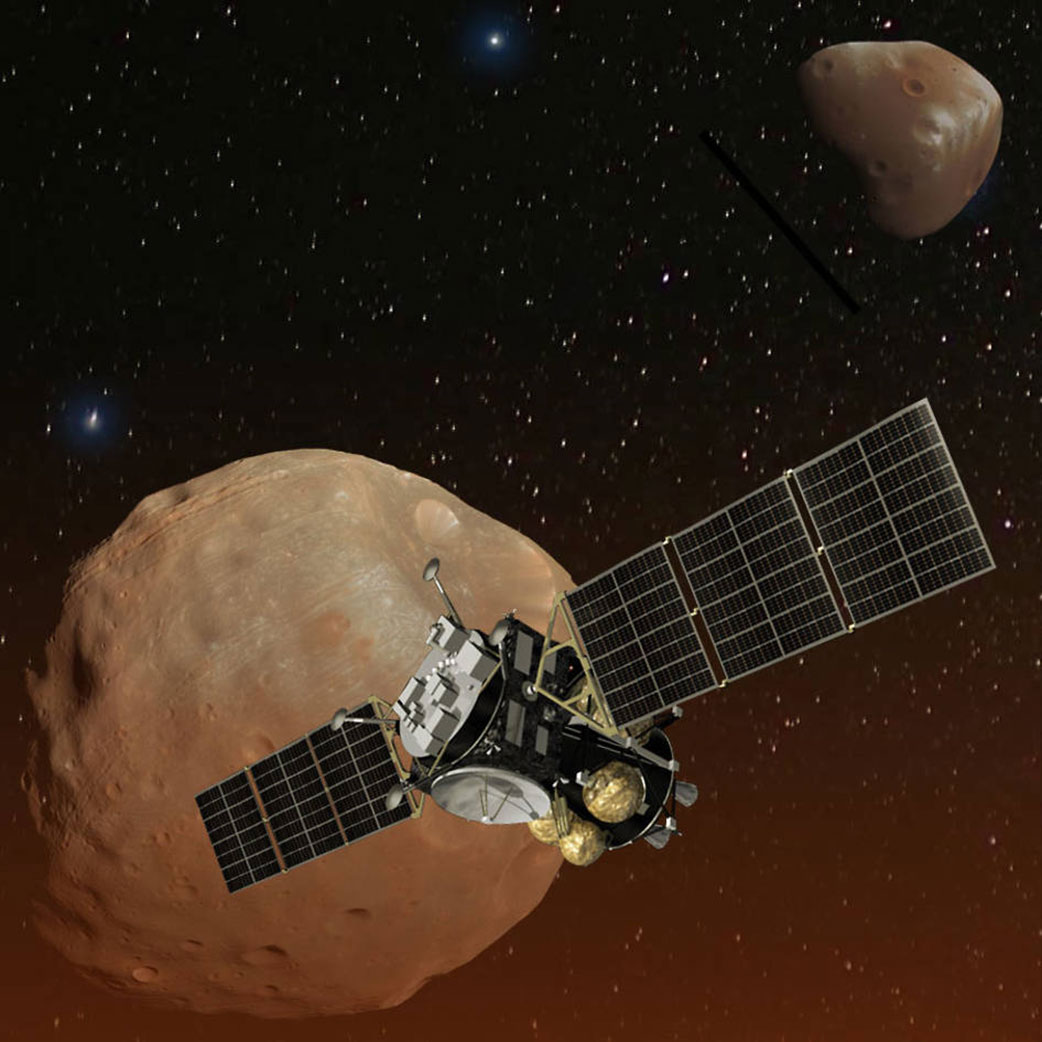
Japan is preparing to launch a spacecraft toward Mars on October 20, 2026, beginning a five-year mission to investigate the planet's mysterious moons and bring samples from one of them back to Earth. The Martian Moons eXploration mission, known as MMX, will study Phobos and Deimos, deploy a small robotic rover and attempt an unprecedented sample return from the Martian system.
The Japan Aerospace Exploration Agency (JAXA) has scheduled liftoff for 4:41 a.m. Japan Standard Time on Tuesday from the Tanegashima Space Center. The spacecraft will travel aboard an H3 rocket, Japan's newest heavy-lift launch vehicle.
The launch is scheduled for 12:41 p.m. Pacific Daylight Time on Monday, October 19, in the United States. JAXA has established a backup launch period extending through November 9 if weather or technical concerns prevent the planned departure.
MMX represents one of Japan's most ambitious planetary exploration efforts. Its central objective is to retrieve at least 10 grams of rock and soil from Phobos, Mars' larger moon, and return the material to Earth in 2031.
The mission will also investigate Deimos, the smaller Martian moon, through remote observations and planned flybys. Scientists hope the measurements will help explain how both moons formed and what they reveal about the early history of Mars.
Why Scientists Want to Explore Mars' Moons
Mars has two small, irregularly shaped moons that differ considerably from Earth's large, nearly spherical moon. Phobos measures about 27 kilometers across at its widest point, while Deimos is approximately 15 kilometers across.
Both objects are heavily cratered and travel relatively close to Mars. Phobos orbits the planet in less than eight hours, while Deimos takes approximately 30 hours to complete an orbit.
Scientists have debated their origins for decades. One explanation suggests the moons began as asteroids that were captured by Mars' gravity.
Another possibility is that they formed from debris thrown into orbit when a large object struck Mars early in the planet's history. The resulting material could have collected into the two small moons.
Each explanation carries important implications for understanding planetary formation. Captured asteroids could preserve material from another region of the solar system, while impact debris might contain evidence of Mars' ancient surface and interior.
Remote observations have not settled the question. Although previous spacecraft have photographed the moons, scientists lack laboratory samples collected directly from either surface.
MMX could change that by allowing researchers to examine Phobos material using sensitive instruments on Earth. Its measurements of surface composition, gravity and internal structure will provide additional evidence.
Researchers will also investigate whether particles ejected from Mars by ancient impacts eventually settled on Phobos. Such material could offer clues about the Red Planet's geological history.
A Complex Five-Year Journey
The spacecraft is expected to spend approximately 10 months traveling from Earth to Mars, arriving near the planet in August 2027. It will enter an orbit designed to support observations of Phobos beginning the following month.
Rather than immediately attempting a landing, MMX will spend an extended period examining the moon from a series of carefully selected orbital paths.
These paths, known as quasi-satellite orbits, allow the spacecraft to remain near Phobos while technically traveling around Mars. The arrangement is necessary because Phobos has too little gravity to support conventional low orbits around itself for long periods.
The spacecraft will map the moon's terrain, measure surface properties and investigate potential landing locations. Scientists will use the observations to identify sites that are scientifically valuable and relatively safe for touchdown.
The mission includes a main exploration module, a propulsion module and a return module. Together, these components support the journey to Mars, scientific observations, surface operations and eventual transportation of samples back to Earth.
Mitsubishi Electric served as the spacecraft's prime contractor, working with JAXA and numerous international partners to develop the sophisticated systems required for the mission.
The spacecraft carries 13 scientific instruments designed to examine surface composition, geological structure, dust and the surrounding space environment.
Among them are TENGOO, a telescopic camera for detailed surface observations, and OROCHI, a wide-angle multispectral camera used to study terrain and surface materials.
Additional equipment includes a laser altimeter for measuring topography and instruments that investigate mineral and elemental composition.
NASA is supplying the MEGANE gamma-ray and neutron spectrometer, which will measure chemical elements near the surface of Phobos. Those results could help scientists distinguish between competing theories about the moon's formation.
European Rover Will Explore Phobos
One of the mission's most unusual components is IDEFIX, a small robotic rover developed jointly by the French space agency CNES and the German Aerospace Center, DLR.
The rover weighs approximately 25 kilograms and is designed to operate in Phobos' extremely weak gravitational environment.
Unlike rovers sent to Mars, IDEFIX will not rely on a parachute or powered descent system. Instead, the spacecraft will release it above the moon, allowing it to fall toward the surface under Phobos' weak gravity.
Because the moon has such little gravitational pull, the rover may bounce after its initial contact. Its mechanical design allows it to adjust its position and right itself before beginning scientific operations.
The rover carries cameras and instruments to investigate surface conditions, mineral composition and temperature. Among its equipment are the Raman spectrometer RAX and a miniature radiometer known as miniRAD.
The rover will also gather information about how its wheels interact with the moon's loose surface material. These measurements should help engineers understand how robotic vehicles can move safely on small, low-gravity bodies.
IDEFIX is expected to operate for approximately 100 Earth days, depending on conditions after landing.
Although it will provide valuable surface observations, the rover is not responsible for collecting the samples destined for Earth. That task belongs to the main MMX spacecraft.
MMX Will Attempt Two Landings on Phobos
After completing extensive orbital surveys, MMX plans to make two landings on Phobos in 2030. The mission's schedule places these operations after the deployment of IDEFIX and the selection of suitable sampling sites.
During each landing, the spacecraft will descend carefully toward the surface using its navigation and propulsion systems.
Engineers must account for Phobos' irregular shape, low gravity and potentially unstable surface material. The spacecraft also needs to avoid disturbing the ground so severely that its sampling equipment cannot operate properly.
MMX has two sample collection systems designed to improve its chances of retrieving material. One uses a coring mechanism to gather material from beneath the surface, while the other uses pressurized gas to capture loose particles.
The combined objective is to bring back at least 10 grams, or about 0.35 ounces, of material from Phobos.
Although that quantity is small, it could provide enough material for years of laboratory research. Modern instruments can analyze tiny samples for mineral composition, chemical signatures and other characteristics that are difficult to measure remotely.
Scientists are particularly interested in whether the samples contain evidence of ancient impacts or material originating from Mars itself.
After the sampling operations, the spacecraft will continue studying the Martian system before preparing for its return journey.
Returning the Samples to Earth
MMX is expected to leave the Martian system in 2030, beginning a journey of approximately one year back to Earth.
The spacecraft will use its main propulsion system to depart Mars' gravitational influence. During the return phase, the exploration components will separate as the return module carries the collected material home.
The sample capsule is scheduled to enter Earth's atmosphere in 2031, with recovery planned in Australia.
If successful, MMX will become the first mission to return material collected directly from a Martian moon. The achievement would build on Japan's experience recovering samples from distant asteroids.
JAXA previously returned material from asteroid Itokawa through its Hayabusa mission in 2010. Hayabusa2 brought samples from asteroid Ryugu to Earth in December 2020.
Those missions demonstrated Japan's ability to conduct complicated rendezvous, sampling and sample-return operations far from Earth.
MMX presents additional challenges because Mars is farther away and the spacecraft must operate near two moons while managing the gravitational influence of a large planet.
The international partnership includes NASA, the European Space Agency, CNES and DLR. Each organization contributes expertise, scientific instruments or technology intended to increase the mission's chances of success.
The scientific findings could also influence future Mars exploration. Understanding the moons' surface conditions and available materials may help researchers evaluate their potential role in later robotic or human missions.
For now, the immediate priority is a successful departure from Tanegashima. If the October 20 launch proceeds as scheduled, MMX will begin its journey toward Mars, with its first close observations of Phobos planned for September 2027.