

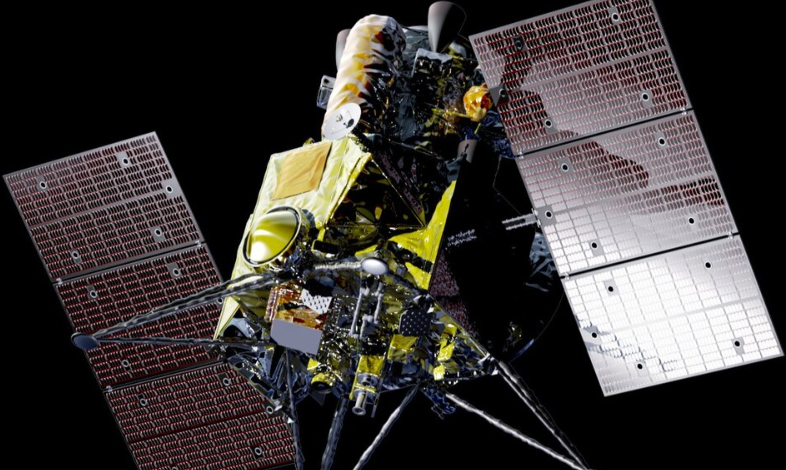
Japan successfully launched its Martian Moons eXploration (MMX) spacecraft on October 20, 2026, beginning an ambitious five-year mission to study Mars' two mysterious moons and return samples from Phobos to Earth. The spacecraft lifted off aboard an H3 rocket from the Tanegashima Space Center in southern Japan, marking a major step in the country's planetary exploration program.
The Japan Aerospace Exploration Agency (JAXA) confirmed that the rocket launched at 4:41 a.m. Japan Standard Time, corresponding to 3:41 p.m. Eastern Daylight Time on October 19. The rocket completed its planned flight and released the spacecraft approximately 71 minutes after liftoff.
If successful, MMX will become the first mission to return material from a moon of Mars. Scientists hope those samples will help explain how Phobos and Deimos formed and reveal important details about the early solar system.
Scientists Hope to Solve a Longstanding Martian Mystery
Mars has two small, irregularly shaped moons whose origins have puzzled researchers for decades. Phobos, the larger moon, measures approximately 27 kilometers across at its widest point, while Deimos is considerably smaller.
Their names come from Greek mythology, where Phobos represents fear and Deimos represents dread or terror.
Unlike Earth's large, nearly spherical moon, both Martian moons resemble dark, battered asteroids. Their unusual shapes and surface characteristics have led scientists to propose competing explanations for their formation.
One theory suggests they were originally asteroids that became trapped by Mars' gravity. Another proposes that they formed from debris produced when a large object collided with Mars billions of years ago.
Both explanations present scientific challenges. The moons' nearly circular orbits are difficult to reconcile with some simple asteroid-capture scenarios, while their dark surfaces resemble material commonly found on certain asteroids.
Determining which explanation is more likely requires better information about their chemical composition and internal structure.
MMX will investigate these questions by making detailed observations of both moons and collecting material directly from Phobos. Laboratory analysis of those samples could provide evidence unavailable through telescopes or remote observations.
Spacecraft Will Reach Mars in August 2027
The spacecraft is expected to arrive at Mars in August 2027 after traveling through interplanetary space for approximately ten months.
Rather than immediately landing, MMX will spend an extended period observing Phobos and studying its surface. It will enter a carefully controlled orbit that allows repeated close observations of the moon.
Cameras and scientific instruments will map surface features, examine mineral composition and evaluate possible landing locations.
The observations will also help scientists understand how loose surface material behaves under Phobos' extremely weak gravity.
Unlike Earth, where gravity holds objects firmly against the ground, Phobos has so little gravitational attraction that landing presents unusual engineering challenges. The spacecraft must approach the surface carefully to avoid bouncing or disturbing excessive amounts of material.
JAXA plans to conduct two sampling landings after selecting suitable locations. The spacecraft will then return to its observing orbit before eventually departing the Martian system.
The mission will also study Deimos, although it does not plan to land there or collect samples from its surface.
European Rover Will Explore Phobos Before Sampling
A small robotic rover named IDEFIX will play an important role in preparing for the landing operations.
The rover was developed through cooperation between the French space agency CNES and the German Aerospace Center, known as DLR.
MMX will release IDEFIX above Phobos, allowing it to descend onto the moon's surface. The rover will then investigate the terrain and provide close-up information about the environment.
Its instruments will examine surface material and help determine how the ground responds to movement in weak gravity.
These observations will provide information that could improve the main spacecraft's sampling operations.
European engineers designed the rover to cope with conditions unlike those encountered by vehicles operating on Earth or Mars. Its mobility system must function in a place where even small movements can affect stability.
The European Space Agency is also contributing technology and support to the wider mission.
International cooperation has become an important feature of MMX, allowing the project to combine Japanese spacecraft engineering with scientific instruments and expertise from several countries.
NASA Instruments Will Examine Phobos' Composition
NASA is contributing scientific equipment and research expertise to the mission, including an instrument called MEGANE.
The name means eyeglasses in Japanese and represents Mars-moon Exploration with Gamma Rays and Neutrons.
Developed by the Johns Hopkins Applied Physics Laboratory with contributions from Lawrence Livermore National Laboratory, MEGANE will measure gamma rays and neutrons associated with material near Phobos' surface.
These measurements will help scientists estimate the abundance of elements such as hydrogen, oxygen, silicon and iron.
The information could help distinguish between material associated with asteroids and debris originating from Mars.
NASA is also contributing a pneumatic sampling system designed to collect loose material from the surface using compressed gas.
MMX will carry two different sampling systems, increasing the mission's ability to gather material from different surface conditions.
The goal is to collect at least 10 grams of material, an amount small enough to hold in a person's hand but potentially valuable for scientific research.
Researchers can examine such samples with laboratory equipment far more sensitive than instruments that can be carried aboard a spacecraft.
Scientists will study mineral grains, chemical composition and isotopic signatures to reconstruct the material's history.
Samples Could Reveal Pieces of Mars' Ancient History
Researchers are particularly interested in the possibility that Phobos contains material ejected from Mars during ancient asteroid impacts.
Powerful collisions can blast rocks from a planet's surface into space. Some fragments may eventually reach nearby moons or become embedded in their surface material.
If Martian debris is present in the returned samples, researchers could potentially investigate parts of Mars' geological history without collecting those particular rocks directly from the planet.
However, scientists have not established that the samples will contain identifiable Martian material.
The mission could also provide clues about how water and other important substances moved through the early solar system.
Understanding the origin of Phobos and Deimos may help researchers reconstruct conditions that shaped Mars and other rocky planets.
The results could also improve scientific models of collisions, moon formation and the evolution of planetary systems.
Japan Builds on Successful Asteroid Sample Missions
JAXA has considerable experience collecting samples from distant objects and bringing them safely to Earth.
Its Hayabusa spacecraft returned material from asteroid Itokawa in 2010 after overcoming major technical problems during its mission.
Hayabusa2 later collected samples from asteroid Ryugu and delivered them to Earth in December 2020.
Those missions demonstrated techniques for approaching small celestial bodies, collecting surface material and returning sealed sample capsules through Earth's atmosphere.
MMX builds on that experience but introduces new challenges because Phobos is much farther away and operates within Mars' gravitational environment.
The spacecraft must complete a complicated sequence involving interplanetary navigation, orbital observations, rover deployment, surface sampling and the journey home.
The mission also represents an important milestone for Japan's H3 rocket, which is carrying out its first interplanetary launch.
Developed by JAXA and Mitsubishi Heavy Industries, the H3 is intended to become a central part of Japan's future launch capability.
Return to Earth Planned for 2031
MMX is scheduled to collect samples from Phobos in 2030 before beginning its return journey.
The samples will be stored inside a capsule designed to survive atmospheric reentry. JAXA plans to recover the capsule in Australia in 2031.
Scientists around the world will then examine portions of the material and compare their findings with measurements obtained by the spacecraft.
NASA is expected to receive an allocation of the samples for scientific analysis, while Japanese and international research teams will conduct additional investigations.
The mission has an estimated budget of approximately $578 million, according to the Associated Press.
Its scientific findings may help guide future spacecraft missions to Mars and its moons, including technologies useful for eventual human exploration.
For now, the successful launch completes only the first stage of a demanding journey. MMX must still navigate to Mars, study both moons, land on Phobos, collect material and deliver the samples safely back to Earth.
The next major milestone is the spacecraft's planned arrival at Mars in August 2027, when the close examination of Phobos and Deimos will begin.