

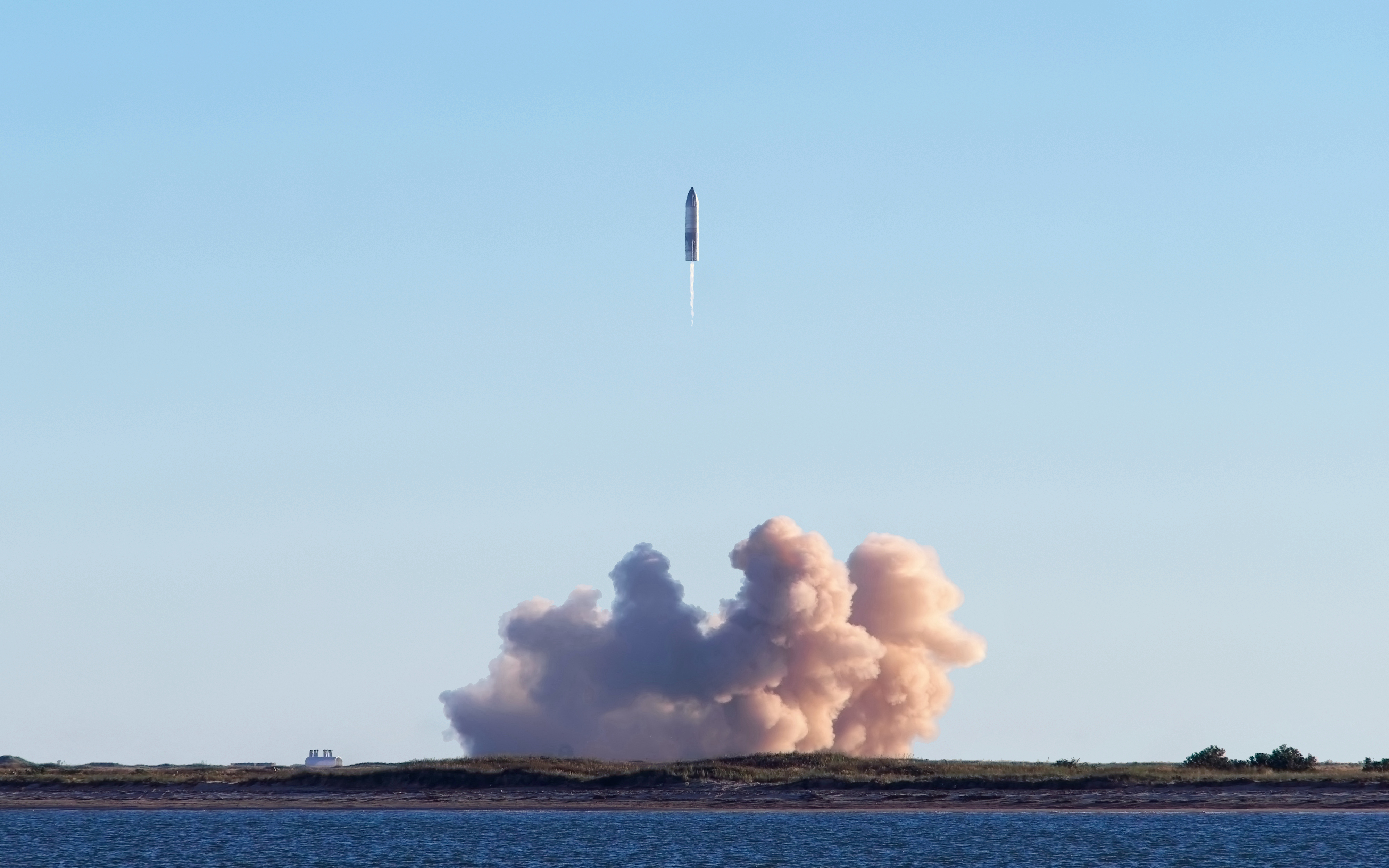
SpaceX launched its 15th Starship test flight Friday, November 13, 2026, from Starbase in South Texas, successfully sending its upper-stage spacecraft into orbit and deploying 26 Starlink satellites. However, the company's attempt to achieve the first recovery of both stages of an orbital rocket ended when its Super Heavy booster was diverted into the Gulf of Mexico and exploded.
The rocket lifted off at 4:47 p.m. Central Time, beginning an ambitious mission designed to demonstrate that both sections of Starship could return to the launch site for reuse. SpaceX had planned to capture the booster within minutes of launch and recover the upper stage the following afternoon.
Although the booster recovery was abandoned, the spacecraft continued its mission. Engineers are preparing for a potential first-ever catch of the Starship upper stage on Saturday, November 14, provided its systems remain healthy.
Starship Flight 15 Launches Successfully From Texas
The massive rocket rose from SpaceX's Starbase facility near Boca Chica, Texas, carrying an upgraded Super Heavy booster and the Starship upper-stage spacecraft.
The vehicle measures approximately 407 feet tall, making it the world's largest operational rocket system. Its booster uses 33 Raptor engines to produce more than 18 million pounds of thrust during liftoff.
Friday's launch marked another important test of SpaceX's Version 3 Starship design, which incorporates changes intended to improve performance and support repeated flights.
The initial ascent proceeded successfully. Approximately two and a half minutes after liftoff, the booster and upper stage separated through a process called hot staging.
During this maneuver, Starship ignites its engines while the booster is still completing separation. The technique helps maintain momentum as the upper stage continues accelerating toward space.
Starship subsequently completed its main engine burn and performed another maneuver to establish a stable orbit approximately 170 miles above Earth.
The achievement marked the second time a Starship upper stage had successfully entered orbit, following Flight 14 in September.
Super Heavy Booster Misses Planned Tower Catch
The first major setback occurred during the planned return of Super Heavy Booster 22.
SpaceX intended to guide the booster back toward its launch tower approximately six and a half minutes after liftoff. The tower uses two enormous mechanical arms, nicknamed chopsticks, to capture returning rockets.
Instead, mission controllers canceled the landing attempt and directed the booster toward a designated offshore location in the Gulf of Mexico.
The booster descended into the water and exploded, ending the possibility of recovering both rocket stages during Flight 15.
SpaceX did not immediately explain why the tower catch was abandoned. The company uses strict safety requirements to determine whether a returning rocket can safely approach its launch infrastructure.
The decision may have prevented a damaged or improperly functioning booster from approaching the tower, but the precise reason for the diversion remains unconfirmed.
The failure was particularly significant because Booster 22 represented the first planned catch attempt involving the newer Version 3 Super Heavy design.
SpaceX previously captured three first-generation Super Heavy boosters using its mechanical launch tower arms. Two of those boosters were subsequently reused during later flights.
Despite Friday's setback, the company gained additional information about the upgraded booster during launch, separation and its return toward Earth.
Starship Deploys 26 Next-Generation Starlink Satellites
While the booster recovery failed, the upper stage continued operating as planned.
Starship carried 26 Starlink Version 3 satellites, designed to expand SpaceX's satellite internet network and increase its capacity.
The spacecraft began releasing its payload shortly after reaching orbit. The satellites were deployed through a specially designed dispenser built into Starship's stainless-steel body.
This was the second Starship mission to carry operational Starlink V3 satellites. Flight 14 delivered the first batch of 26 spacecraft in September.
The new generation is significantly larger than earlier Starlink satellites and is designed to provide substantially greater communications capacity.
SpaceX expects each satellite to support approximately one terabit per second of network capacity under planned operating conditions. That improvement could help the company provide faster internet service to more customers.
The satellite deployment also demonstrated an increasingly important commercial function for Starship.
Rather than serving only as an experimental rocket, the vehicle is beginning to carry payloads that contribute directly to SpaceX's existing satellite network.
Successful satellite deployment does not guarantee that the spacecraft will complete its remaining objectives. The most difficult test may still occur when Starship attempts to return through Earth's atmosphere.
SpaceX Plans Historic Upper-Stage Catch on Saturday
The upper stage is scheduled to remain in orbit for approximately 22 hours before attempting to return to Starbase on Saturday afternoon.
If the spacecraft remains healthy, SpaceX plans to guide it through atmospheric reentry and back toward the launch tower.
The mission could mark the first time a Starship upper stage returns from orbit and is captured using mechanical arms rather than landing in the ocean.
Recovering an orbital spacecraft presents major technical challenges because it travels much faster than a booster returning shortly after launch.
Starship must survive extreme heating during reentry, maintain control while descending through the atmosphere and perform a precise landing maneuver near the tower.
The vehicle's heat shield is therefore one of the most important systems being evaluated during Flight 15.
Three modified Starlink satellites are equipped with cameras intended to inspect the spacecraft's thermal protection system while it remains in orbit.
Engineers can use those observations to help determine whether attempting a return to Starbase would be safe.
SpaceX has also established alternative landing locations in the Pacific Ocean. If the spacecraft develops problems, controllers can direct it toward a controlled splashdown instead of attempting a tower catch.
A successful upper-stage recovery would still represent a major technical achievement, even though Friday's booster failure made the planned double catch impossible.
Starship Reusability Remains Central to SpaceX Plans
Starship is being developed as a fully reusable launch system, a capability SpaceX believes could significantly reduce the expense of reaching orbit.
The company's Falcon 9 rockets already demonstrate how booster recovery can lower costs. However, Falcon 9's upper stage is generally discarded after completing its mission.
Starship is intended to go further by recovering both the booster and the spacecraft.
That design could eventually allow rockets to be refurbished, refueled and launched again without requiring an entirely new vehicle for each mission.
SpaceX executives envision much higher launch frequencies if the system becomes reliable enough for rapid reuse.
The program also supports the company's plans to expand the Starlink network, deliver large payloads and eventually transport people and equipment beyond Earth orbit.
Those ambitions depend on demonstrating that the spacecraft can survive repeated launches and atmospheric reentries.
Flight 15 represents an important test because it combines commercial satellite deployment with an attempt to recover the orbital upper stage intact.
NASA Watches Starship Development for Moon Missions
NASA is closely following the Starship program because the spacecraft is part of the agency's Artemis effort to return astronauts to the Moon.
SpaceX is developing a modified version of Starship that could transport astronauts from lunar orbit to the Moon's surface.
The company must demonstrate several capabilities before that vehicle can carry people, including reliable propulsion, spacecraft docking and transferring large quantities of propellant between vehicles in orbit.
NASA is also working with Blue Origin, which is developing its competing Blue Moon lunar lander.
The agency plans to test spacecraft docking procedures during its Artemis III mission before attempting future crewed lunar landings.
Starship's ability to launch large payloads and operate repeatedly is important because lunar missions may require multiple launches to support a single landing.
However, a successful orbital test does not automatically demonstrate readiness for human spaceflight. SpaceX must complete additional technical evaluations and satisfy NASA's safety requirements.
Flight 15 Continues Despite Booster Recovery Failure
Friday's mission produced mixed results for SpaceX. The rocket reached orbit, delivered its satellite payload and demonstrated several important flight operations, but the planned Super Heavy recovery was unsuccessful.
The loss prevents Flight 15 from becoming the first mission to recover an entire orbital rocket system.
SpaceX must now investigate why the booster was diverted while continuing to monitor the upper stage during its extended orbital mission.
The spacecraft's scheduled return on Saturday presents another opportunity to advance the company's reusable rocket technology.
If controllers determine that the spacecraft meets the necessary safety conditions, SpaceX will attempt to capture it at Starbase. Otherwise, the mission will end with an ocean splashdown.
The outcome of that decision will determine whether Flight 15 achieves its remaining major recovery objective.