

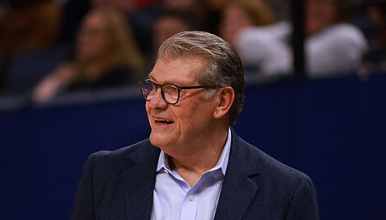
UConn women's basketball coach Geno Auriemma and South Carolina coach Dawn Staley will meet again Tuesday, November 24, 2026, in a highly anticipated rematch of last season's Final Four. The game at Mohegan Sun Arena in Uncasville, Connecticut, comes seven months after a confrontation between the coaches overshadowed South Carolina's victory. Their reunion also follows an NCAA decision to eliminate mandatory pregame handshakes between head coaches during the women's basketball tournament.
South Carolina enters the matchup ranked No. 1 nationally, while UConn holds the No. 7 ranking. Both programs are among the most successful in women's college basketball, but their latest meeting carries additional attention because of what happened in April.
Final Four Confrontation Remains a Talking Point
The tension began during the NCAA women's Final Four on April 3, 2026, when South Carolina defeated previously unbeaten UConn 62-48 in Phoenix. The Gamecocks ended the Huskies' 54-game winning streak and advanced to the national championship game.
The result was particularly disappointing for Auriemma, whose team had entered the tournament with championship expectations. However, attention quickly shifted from South Carolina's defensive performance to an argument between the coaches.
In the closing moments of the game, Auriemma approached Staley near the sideline. What appeared to begin as a postgame handshake became a heated exchange, with both coaches visibly upset.
UConn staff members intervened and separated them before the situation escalated further. Auriemma subsequently left the court without completing the traditional postgame handshake line.
The confrontation became one of the most widely discussed moments of the tournament, prompting questions about sportsmanship and the expectations placed on coaches during major college basketball events.
Auriemma Explains His Frustration
Following the semifinal defeat, Auriemma said he was upset because he believed Staley had not participated in the customary pregame handshake at the expected time.
He explained that he had waited several minutes for the greeting and considered the situation disrespectful. Staley disputed the implication that she had intentionally ignored him.
Auriemma later issued public apologies for his actions, acknowledging that his behavior did not reflect the standards he expected of himself.
Staley subsequently expressed respect for Auriemma and encouraged people to move beyond the disagreement. She emphasized that one heated moment should not define a coach's entire career.
Despite those statements, the incident has remained a subject of discussion leading into the November rematch.
During a Sunday media appearance, Auriemma said he had not spoken with Staley in recent months. He also made clear that he wanted attention directed toward the players rather than their coaches.
He explained that his responsibility was to prepare UConn for the game, not to turn the meeting into a personal confrontation.
NCAA Eliminates Mandatory Pregame Handshakes
The NCAA has now revised its handshake policy for the women's basketball tournament, removing a requirement that previously directed opposing head coaches to meet at midcourt.
According to a memorandum distributed November 20 by the NCAA Division I Women's Basketball Committee, coaches will no longer be required to shake hands after the starting lineups are introduced.
The committee continues to encourage informal greetings before team introductions, but participation will be voluntary.
The change follows the confrontation between Auriemma and Staley, although the NCAA has not identified that incident as the sole reason for revising the policy.
When asked about the decision, Auriemma appeared unconcerned. He indicated that coaches should simply follow whichever rules tournament officials establish.
The change applies specifically to the NCAA women's basketball tournament. It does not prohibit coaches from shaking hands or eliminate the expectation of professional conduct.
Media Access and Scheduling Requirements Also Change
The handshake policy is part of a broader set of adjustments intended to simplify tournament operations.
The NCAA will no longer require teams to provide open locker-room access to reporters between the Sweet 16 and Elite Eight at regional sites. Mandatory news conferences during that interval are also being eliminated, leaving participation to individual schools.
Pregame interviews with coaches at regional games and the Final Four will no longer be compulsory.
These adjustments follow complaints about demanding tournament schedules and the additional obligations placed on players and coaches.
The women's tournament uses two regional sites, each accommodating eight teams during the Sweet 16 and Elite Eight. That arrangement can create challenges when teams must share practice facilities, complete media responsibilities and prepare for games.
During the 2026 tournament, Auriemma questioned why UConn had been assigned an early morning shootaround before a late afternoon game against North Carolina.
He argued that scheduling decisions should better reflect the needs of participating teams rather than placing unnecessary demands on players and staff.
Staley also acknowledged scheduling difficulties while expressing support for the two-region format. She noted that reasonable practice times were sometimes difficult to obtain.
The NCAA's new media policies provide schools with greater flexibility as they prepare for important tournament games.
Player Availability Reports and Clock Changes
The NCAA is also introducing more detailed player availability reporting for the women's tournament.
Before games, teams will use five classifications: available, probable, questionable, doubtful and out.
On game day, those categories will be reduced to available, game-time decision and out.
The reporting system is designed to provide clearer information about player participation ahead of tournament contests.
Another adjustment involves timing equipment. For the 2027 tournament, shot clocks must display tenths of a second when host facilities have the necessary equipment.
That capability is already used during regional games and the Final Four. The NCAA plans to make it mandatory for all tournament host sites beginning in 2028.
The changes arrive as the women's NCAA tournament expands to 76 teams, adding another operational consideration for participating schools.
Rematch Returns Attention to the Court
Tuesday's game will be played as part of the Basketball Hall of Fame Women's Showcase, providing another prominent early-season test for both programs.
UConn has already faced four nationally ranked opponents this season, winning two and losing two. The Huskies are coming off a 40-point victory over Seton Hall but face a significantly different challenge against South Carolina.
Auriemma's team will also meet No. 5 Duke next Saturday, continuing an unusually demanding early-season schedule.
South Carolina has faced three ranked opponents and begins another difficult stretch with its trip to Connecticut. Five of the Gamecocks' next eight games are against ranked teams.
The matchup provides both programs with an opportunity to measure their progress against elite competition before conference play and the postseason.
Auriemma has praised Staley's success at South Carolina and acknowledged the difficulty of maintaining a championship-level program in modern college basketball.
The coaches have built their reputations through sustained success, recruiting and postseason achievements, making their meetings important events on the women's basketball calendar.
Tuesday's contest is scheduled for 8 p.m. Eastern on FS1. While the Final Four confrontation remains part of the buildup, the outcome will be determined by the players when UConn and South Carolina meet again at Mohegan Sun Arena.