

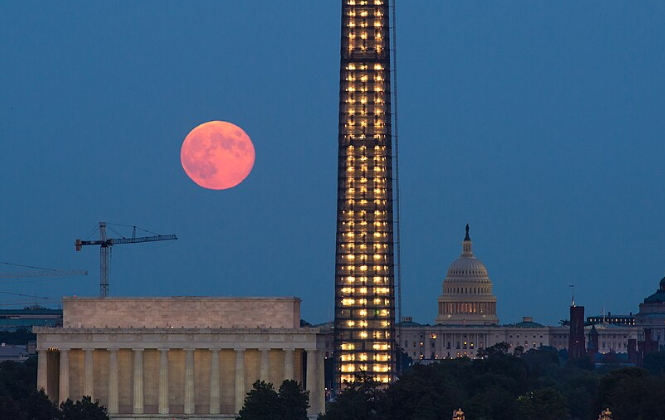
The Harvest Moon arrives on September 26, 2026, giving skywatchers a bright full moon close to the start of fall in the Northern Hemisphere. The moon reaches its exact full phase at 16:49 UTC, which is 12:49 EDT and 9:49 PDT. Because that moment happens during daylight across much of the United States, the best views come after sunset, when the moon rises in the east.
This year’s Harvest Moon also has a bright companion. NASA says Saturn will appear near the moon on the evening of September 26. The planet can be seen without a telescope as a bright point of light near the full moon, while much fainter Neptune will also be in the same general part of the sky.
The Harvest Moon is not a special type of moon in the physical sense. It is the name given to the full moon that occurs closest to the September equinox. That equinox marks the beginning of astronomical fall in the Northern Hemisphere and astronomical spring in the Southern Hemisphere.
Most years, the Harvest Moon occurs in September. In some years, however, an early October full moon is closer to the equinox and receives the Harvest Moon name instead. That happens because the roughly 29.5-day lunar cycle does not line up exactly with the solar calendar.
The name has a practical connection to farming.
During much of the year, the moon rises about 50 minutes later from one day to the next. Around the time of the Harvest Moon in the Northern Hemisphere, that delay can be much shorter. The result is several evenings when a bright moon rises relatively soon after sunset.
According to timeanddate.com, the difference between successive moonrises around the Harvest Moon can be about 25 minutes in New York and even shorter at higher northern latitudes. That creates a period of unusually consistent evening moonlight. Before tractors had powerful headlights and farms had widespread electric lighting, those extra minutes of light could be useful during one of the busiest times of the agricultural year.
Farmers could continue gathering crops after the Sun went down. The nearly full moon also provided useful evening light on nights just before and after the exact full moon. That pattern helped connect the moon with the autumn harvest.
Royal Museums Greenwich notes that the light of the Harvest Moon was historically said to help farmers work later into the night while bringing crops in from the fields. The name therefore describes more than a date on a lunar calendar. It reflects the way people once used the night sky as part of everyday work.
The term itself has been used for centuries. Historical references to “Harvest Moon” in English go back to the early 1700s, and a 1706 reference is often cited as one of the earliest known printed uses. The idea was already tied closely to the agricultural season by that time.
Full-moon names, however, have complicated histories. Modern lists often combine European names, Indigenous names and names recorded or translated by colonial writers. There was never one universal set of names used by every Native American nation or every European community.
History.com reports that many familiar full-moon names became widely standardized in modern popular culture through almanacs and later publications. Different Indigenous peoples had their own seasonal names tied to local plants, animals, weather and food gathering. For example, some communities used September names associated with corn, wild rice or changing leaves.
That is one reason September’s full moon is also sometimes called the Corn Moon. When the Harvest Moon occurs in October, the September full moon is often given the Corn Moon name instead. The naming system is based more on seasonal tradition than on a formal astronomical rulebook.
The Harvest Moon often appears orange or yellow when it first rises, but the color is not unique to this particular full moon. Any moon near the horizon can appear warmer in color because its light travels through more of Earth’s atmosphere. Shorter blue wavelengths are scattered more strongly, leaving more red, orange and yellow light to reach an observer.
The moon can also appear unusually large near the horizon. This is mostly the result of the “moon illusion,” a visual effect that makes the moon seem larger when buildings, trees or other objects are nearby for comparison. The moon itself does not suddenly grow as it rises.
A full moon occurs when the moon is positioned roughly opposite the Sun as seen from Earth. The side facing Earth is then almost completely illuminated by sunlight. The exact instant of full moon lasts only a moment, although the moon looks full to the eye for a night or two on either side.
The 2026 Harvest Moon should be especially easy to find. Look toward the eastern horizon around sunset on September 26. A clear, low horizon will provide the best view as the moon rises, and no telescope or binoculars are needed.
Saturn adds another reason to look up this year.
The Harvest Moon remains one of the best-known full moons because its name connects astronomy with everyday human history. For generations, people watched the changing seasons, the length of daylight and the movement of the moon because those cycles affected planting, harvesting and travel.
Modern farm equipment no longer depends on moonlight to finish a harvest. Even so, the name survives as a reminder of a time when the night sky played a much larger role in organizing work and measuring the year.
The 2026 Harvest Moon therefore offers both a skywatching event and a link to the past. Its peak occurs during the day in the United States, but the evening moonrise on September 26 will provide the view most people associate with the event: a bright full moon climbing above the eastern horizon as autumn begins.